


Role of intra-abdominal pressure in the unloading and stabilization of the human spine during static lifting tasks
- PMID: 16333683
- PMCID: PMC3233951
- DOI: 10.1007/s00586-005-0012-9
Role of intra-abdominal pressure in the unloading and stabilization of the human spine during static lifting tasks
Abstract
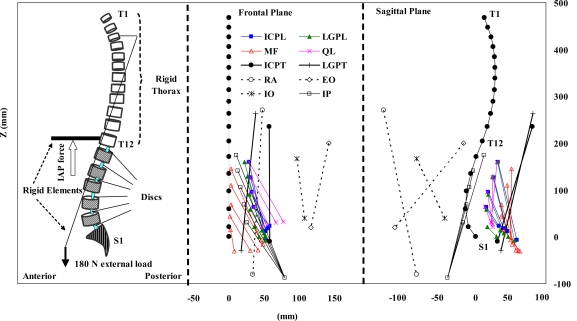
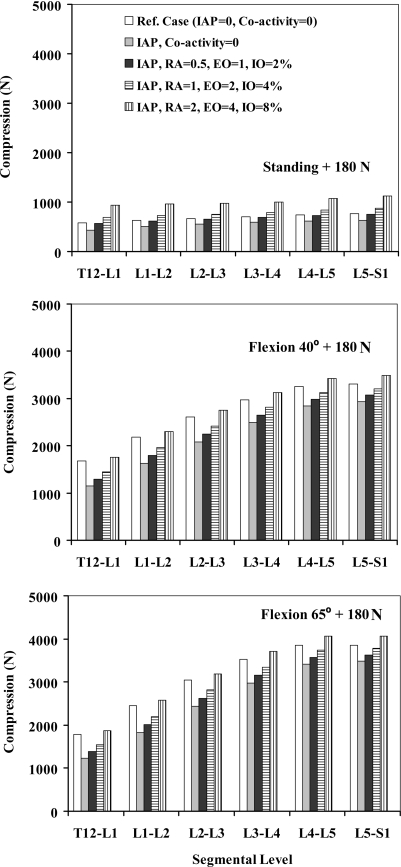
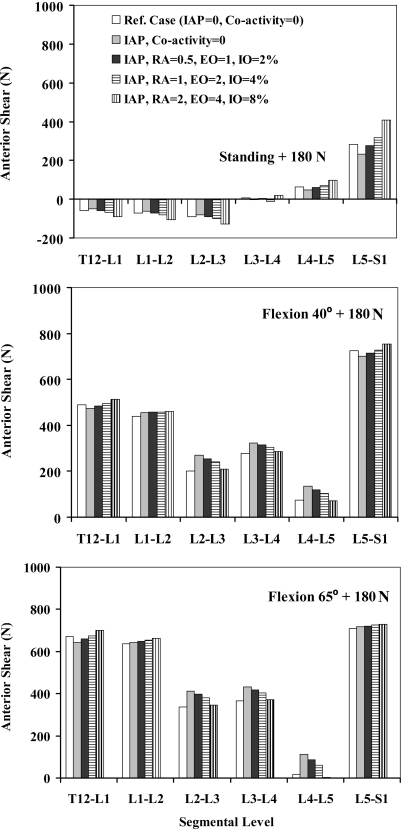
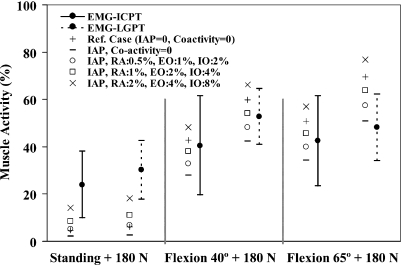
The role of intra-abdominal pressure (IAP) in unloading the spine has remained controversial. In the current study, a novel kinematics-based approach along with a nonlinear finite-element model were iteratively used to calculate muscle forces, spinal loads, and stability margin under prescribed postures and loads measured in in vivo studies. Four coactivity levels (none, low, moderate, and high) of abdominal muscles (rectus abdominis, external oblique, and internal oblique) were considered concurrently with a raise in IAP from 0 to 4 kPa when lifting a load of 180 N in upright standing posture and to 9 kPa when lifting the same load in forward trunk flexions of 40 degrees and 65 degrees. For comparison, reference cases with neither abdominal coactivity nor IAP were investigated as well. A raise in IAP unloaded and stabilized the spine when no coactivity was considered in the foregoing abdominal muscles for all lifting tasks regardless of the posture considered. In the upright standing posture, the unloading action of IAP faded away even in the presence of low level of abdominal coactivity while its stabilizing action continued to improve as abdominal coactivity increased to moderate and high levels. For lifting in forward-flexed postures, the unloading action of IAP disappeared only with high level of abdominal coactivities while its stabilizing action deteriorated as abdominal coactivities increased. The unloading and stabilizing actions of IAP, hence, appear to be posture and task specific.
Figures
References
-
- Andersson GB, Ortengren R, Nachemson A. Quantitative studies of back loads in lifting. Spine. 1976;1:178–185. doi: 10.1097/00007632-197609000-00009. - DOI
-
- Andersson GB, Ortengren R, Nachemson A. Intradiskal pressure, intra-abdominal pressure and myoelectric back muscle activity related to posture and loading. Clin Orthop Relat Res. 1977;129:156–164. - PubMed
-
- Arjmand N, Shirazi-Adl A (2005) Model and in vivo studies on human trunk load partitioning and stability in isometric forward flexions. J Biomech (in press) - PubMed
-
- Arjmand N, Shirazi-Adl A, Parnianpour M. A finite element model study on the role of trunk muscles in generating intra-abdominal pressure. Biomed Eng Appl Basis Commun. 2001;13(4):23–31.
-
- Bartelink DL. The role of abdominal pressure in relieving the pressure on the lumbar intervertebral discs. J Bone Joint Surg Br. 1957;39:718–725. - PubMed
Publication types
MeSH terms
LinkOut - more resources
Full Text Sources
Research Materials
