


Associations of maternal prenatal smoking with child adiposity and blood pressure
- PMID: 16339135
- PMCID: PMC1483219
- DOI: 10.1038/oby.2005.248
Associations of maternal prenatal smoking with child adiposity and blood pressure
Abstract
Objective: To examine the extent to which maternal prenatal smoking is associated with adiposity, central adiposity, and blood pressure in 3-year-old children.
Research methods and procedures: We studied 746 mother-child pairs in Project Viva, a prospective cohort study, and categorized mothers as never, early pregnancy, or former smokers. Main outcome measures were overweight (BMI for age and sex > 85th percentile), BMI z-score, sum of subscapular (SS) and triceps (TR) skinfolds, SS:TR skinfold ratio, and systolic blood pressure (SBP).
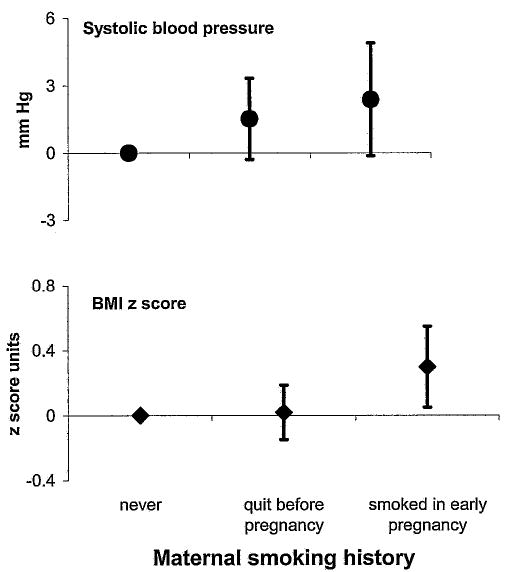
Results: One hundred sixty-one (22%) mothers quit smoking before pregnancy, 71 (10%) smoked in early pregnancy, and 514 (69%) never smoked. At age 3 years, 204 (27%) children were overweight. On multivariable analysis, compared with children of never smokers, children of early pregnancy smokers had an elevated risk for overweight [odds ratio (OR), 2.2; 95% confidence interval (CI), 1.2, 3.9] and higher BMI z-score (0.30 units; 95% CI, 0.05, 0.55), SS + TR (2.0 mm; 95% CI, 0.9, 3.0), and SBP (2.4 mm Hg; 95% CI, -0.1, 4.9). Children of former smokers were not more overweight (BMI z-score, 0.02 units; 95% CI, -0.15, 0.19) but had higher SBP (1.5 mm Hg; 95% CI, -0.1, 3.2). We saw no relationship of smoking with central adiposity (SS:TR).
Discussion: Former and early pregnancy smokers had children with somewhat higher SBP, but only early pregnancy smokers had children who were more overweight. Mechanisms linking smoking with child adiposity and blood pressure may differ. A long-term impact of maternal smoking on offspring cardiovascular risk provides further reason to reduce smoking in women.
Figures
References
-
- Olshanksy SJ, Passaro DJ, Hershow RC, et al. A potential decline in life expectancy in the United States in the 21st century. N Engl J Med. 2005;352:1138–45. - PubMed
-
- Power C, Jefferis BJ. Fetal environment and subsequent obesity: a study of maternal smoking. Int J Epidemiol. 2002;31:413–9. - PubMed
-
- Toschke AM, Koletzko B, Slikker W, Jr, Hermann M, von Kries R. Childhood obesity is associated with maternal smoking in pregnancy. Eur J Pediatr. 2002;161:445–8. - PubMed
-
- von Kries R, Toschke AM, Koletzko B, Slikker W., Jr Maternal smoking during pregnancy and childhood obesity. Am J Epidemiol. 2002;156:954–61. - PubMed
Publication types
MeSH terms
Grants and funding
LinkOut - more resources
Full Text Sources
Medical
