Comparative Study
. 2005 Nov;29(11):1949-58.
doi: 10.1097/01.alc.0000187605.91468.17.

Hybrid C57BL/6J x FVB/NJ mice drink more alcohol than do C57BL/6J mice

Affiliations
Comparative Study

Hybrid C57BL/6J x FVB/NJ mice drink more alcohol than do C57BL/6J mice

Yuri A Blednov et al. Alcohol Clin Exp Res. 2005 Nov.

Abstract

Background: From several recent strain surveys (28 strains: Bachmanov et al., personal communication; 22 strains: Finn et al., unpublished), and from data in >100 other published studies of 24-hr two-bottle ethanol preference, it is known that male C57BL/6 (B6) mice self-administer about 10-14 g/kg/day and that female B6 mice self-administer about 12-18 g/kg/day. No strain has been found to consume more ethanol than B6. In one of our laboratories (Texas), we noted a markedly greater intake of ethanol in an F1 hybrid of B6 and FVB/NJ (FVB) mice.

Methods: To confirm and extend this finding, we repeated the study at another site (Portland) using concentrations up to 30% ethanol and also tested B6xFVB F1 mice in restricted access drinking procedures that produce high levels of alcohol intake.

Results: At both sites, we found that B6xFVB F1 mice self-administered high levels of ethanol during two-bottle preference tests (females averaging from 20 to 35 g/kg/day, males 7-25 g/kg/day, depending on concentration). F1 hybrids of both sexes drank significantly more 20% ethanol than both the B6 and FVB strains. Female F1 hybrids also drank more 30% ethanol. In the restricted access tests, ethanol consumption in the F1 hybrids was equivalent to that in B6 mice.

Conclusions: These data show that this new genetic model has some significant advantages when compared to existing inbred strains, and could be used to explore the genetic basis of high ethanol drinking in mice.


Figures

Fig. 1
Fig. 1
Consumption of increasing concentrations of ethanol by B6 mice and B6×FVB F1 hybrid mice in a two-bottle preference test (Texas). Ten mice per sex were given 24 hr access to ethanol and tap water (in Texas). A) Mean ± SEM ethanol consumed (EtOH, g/kg) at each concentration, averaged across the four days of access at each concentration. B) Mean ± SEM preference ratio, calculated as the amount of ethanol consumed/total fluid consumed.
Fig. 2
Fig. 2
Consumption of increasing concentrations of ethanol by B6, FVB, and B6×FVB F1 hybrid mice in a two-bottle preference test (Oregon). Mice (n = 6-10/sex/genotype; total n = 65) were given 24 hr access to ethanol and tap water in Portland. A) Mean ± SEM ethanol consumed (EtOH, g/kg) over days by female mice. B) Mean ± SEM ethanol consumed (g/kg) over days by male mice. Panel C: Relationship between ethanol consumed on day 20 (g/kg) and blood ethanol concentration (BEC, mg/ml). Only data for animals with blood ethanol concentrations ≥ 0.05 mg/ml are shown (n = 15). One additional FVB mouse had a blood ethanol concentration of 0.13 mg/ml, but is not shown because its ethanol tube leaked on day 20 (day 19 consumption was 19.03 g/kg). Blood samples were obtained between 8:15 and 11:15 AM. Solid circle: B6 mouse; Open triangle: F1; Solid square: FVB mouse.
Fig. 3
Fig. 3
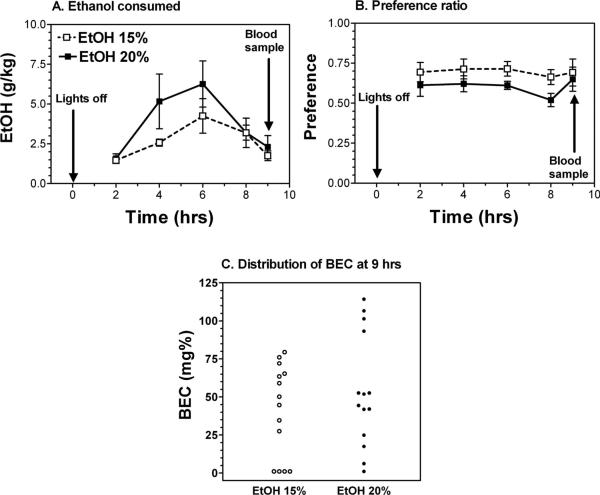
Blood sampling during the circadian dark phase following two-bottle ethanol preference in B6×FVB F1 mice. Mice in Texas had 24 hr access to either 15 or 20% ethanol (EtOH) and water for seven days before the period shown. A and B) X-axis: Time, in hours, after onset (0; left arrow) of dark cycle. Blood sampling occurred at hour 9 of the circadian dark phase (right arrow). C) blood ethanol concentrations (BEC, mg/ml) from mice drinking 15 or 20%, respectively (scatterplot).
Fig. 4
Fig. 4
The effect of drinking in the dark on amount of ethanol consumed during two (days 1–4) or four hours access (day 4 only) in B6, FVB, and B6×FVB F1 hybrid female mice. A) Amount of ethanol (EtOH) consumed during two (days 1–4) or four hours access. A single bottle of 20% ethanol was offered beginning 3 hr after lights off (in Portland). B) The relationship between ethanol consumed (g/kg) and blood ethanol concentration (BEC, mg/ml) measured at the end of the four-hour period on day 4. Solid circle: B6 mice; Open triangle: F1 hybrids; Solid square: FVB mice. n = 8–22/genotype.
Fig. 5
Fig. 5
The effect of scheduling fluid availability on ethanol dose consumed, blood ethanol concentration, and the correlation between blood ethanol concentration and ethanol dose consumed in male and female B6×FVB F1 mice. A) Ethanol (EtOH) dose consumed. B) Blood ethanol concentration (BEC). C) Correlation between blood ethanol concentration and ethanol dose consumed. Mice in Portland had 30 min access to a 5% ethanol solution every 3rd day. Values represent the mean ± SEM for 15 male and 8 female mice, except for the blood ethanol concentration data where n = 7 for female mice. Note the difference in y-axes. Data in panel C are collapsed across sexes, and the best-fit regression line is shown.
Fig. 6
Fig. 6
The change in blood ethanol concentration (mg/ml) after oral self-administration administration of ethanol (20% in tap water) during 4-hrs drinking in the dark phase in B6 and B6×FVB F1 female mice. A) amount of consumed ethanol (EtOH, g/kg) (mean ± SEM) during 4 hrs drinking. n = 10–11/genotype. B) blood ethanol concentrations (BEC, mg/ml) over time after drinking in the dark. n = 5-6/genotype. C) blood ethanol concentrations (mg/ml) over time after drinking in the dark and injection of ethanol (3 g/kg, IP). n = 5/genotype.

References

    1. Bachmanov AA, Beauchamp GK, Tordoff MG. Voluntary consumption of NaCl, KCl, CaCl2, and NH4Cl solutions by 28 mouse strains. Behav Genet. 2002;32:445–457. - PMC - PubMed
    1. Bachmanov AA, Tordoff MG, Beauchamp GK. Ethanol consumption and taste preferences in C57BL/6ByJ and 129/J mice. Alcohol Clin Exp Res. 1996;20:201–206. - PMC - PubMed
    1. Beck JA, Lloyd S, Hafezparast M, Lennon-Pierce M, Eppig JT, Festing MF, Fisher EM. Genealogies of mouse inbred strains. Nat Genet. 2000;24:23–25. - PubMed
    1. Belknap JK, Crabbe JC, Young ER. Voluntary consumption of ethanol in 15 inbred mouse strains. Psychopharmacology. 1993;112:503–510. - PubMed
    1. Blake JA, Richardson JE, Bult CJ, Kadin JA, Eppig JT. MGD: the Mouse Genome Database. Nucleic Acids Res. 2003;31:193–195. - PMC - PubMed

Publication types