


Anti-Abeta42- and anti-Abeta40-specific mAbs attenuate amyloid deposition in an Alzheimer disease mouse model
- PMID: 16341263
- PMCID: PMC1307561
- DOI: 10.1172/JCI25410
Anti-Abeta42- and anti-Abeta40-specific mAbs attenuate amyloid deposition in an Alzheimer disease mouse model
Abstract
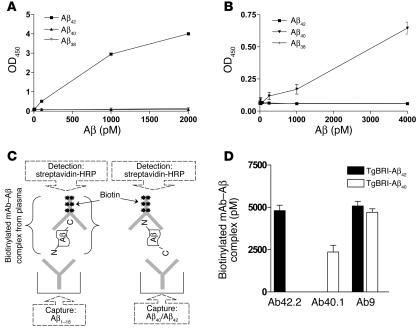
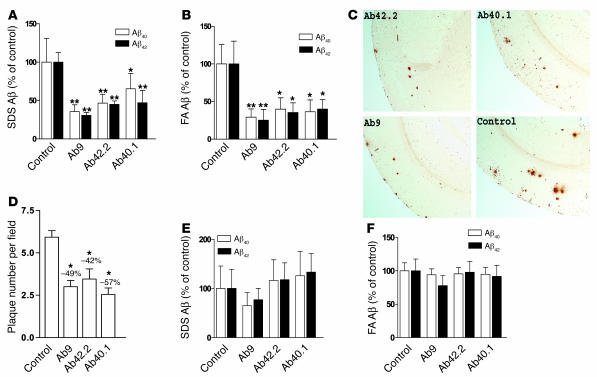
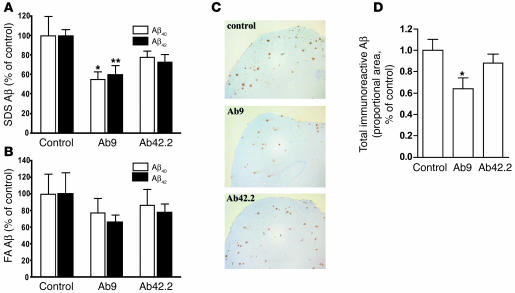
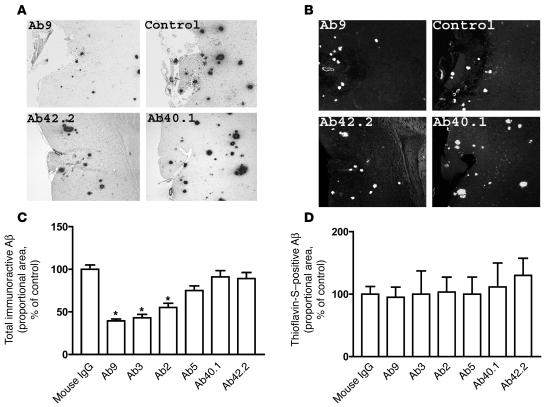
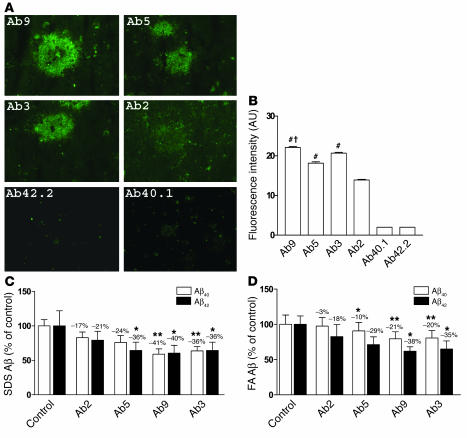
Accumulation and aggregation of amyloid beta peptide 1-42 (Abeta42) in the brain has been hypothesized as triggering a pathological cascade that causes Alzheimer disease (AD). To determine whether selective targeting of Abeta42 versus Abeta40 or total Abeta is an effective way to prevent or treat AD, we compared the effects of passive immunization with an anti-Abeta42 mAb, an anti-Abeta40 mAb, and multiple Abeta(1-16) mAbs. We established in vivo binding selectivity of the anti-Abeta42 and anti-Abeta40 mAbs using novel TgBRI-Abeta mice. We then conducted a prevention study in which the anti-Abeta mAbs were administered to young Tg2576 mice, which have no significant Abeta deposition, and therapeutic studies in which mAbs were administered to Tg2576 or CRND8 mice with modest levels of preexisting Abeta deposits. Anti-Abeta42, anti-Abeta40, and anti-Abeta(1-16) mAbs attenuated plaque deposition in the prevention study. In contrast, anti-Abeta42 and anti-Abeta40 mAbs were less effective in attenuating Abeta deposition in the therapeutic studies and were not effective in clearing diffuse plaques following direct injection into the cortex. These data suggest that selective targeting of Abeta42 or Abeta40 may be an effective strategy to prevent amyloid deposition, but may have limited benefit in a therapeutic setting.
Figures
References
-
- Hardy J, Selkoe DJ. The amyloid hypothesis of Alzheimer’s disease: progress and problems on the road to therapeutics. Science. 2002;297:353–356. - PubMed
-
- Iwatsubo T, et al. Visualization of A beta 42(43) and A beta 40 in senile plaques with and-specific A beta monoclonals: evidence that an initially deposited species is A beta 42(43) Neuron. 1994;13:45–53. - PubMed
-
- Gravina SA, et al. Amyloid beta protein (A beta) in Alzheimer’s disease brain. Biochemical and immunocytochemical analysis with antibodies specific for forms ending at A beta 40 or A beta 42(43) J. Biol. Chem. 1995;270:7013–7016. - PubMed
-
- Golde TE, Eckman CB, Younkin SG. Biochemical detection of Abeta isoforms: implications for pathogenesis, diagnosis, and treatment of Alzheimer’s disease. . Biochim. Biophys. Acta. 2000; 1502:172–187. - PubMed
Publication types
MeSH terms
Substances
Grants and funding
LinkOut - more resources
Full Text Sources
Other Literature Sources
Medical
Molecular Biology Databases
