. 2006 Jan;116(1):146-55.
doi: 10.1172/JCI21759. Epub 2005 Dec 8.

Reversing the defective induction of IL-10-secreting regulatory T cells in glucocorticoid-resistant asthma patients

Affiliations

Reversing the defective induction of IL-10-secreting regulatory T cells in glucocorticoid-resistant asthma patients

Emmanuel Xystrakis et al. J Clin Invest. 2006 Jan.

Abstract

We previously reported that human CD4+ Tregs secrete high levels of IL-10 when stimulated in the presence of dexamethasone and calcitriol (vitamin D3). We now show that following stimulation by allergen, IL-10-secreting Tregs inhibit cytokine secretion by allergen-specific Th2 cells in an IL-10-dependent manner. A proportion of patients with severe asthma fail to demonstrate clinical improvement upon glucocorticoid therapy, and their asthma is characterized as glucocorticoid resistant (SR, abbreviation derived from "steroid resistant"). Dexamethasone does not enhance secretion of IL-10 by their CD4+ T cells. Addition of vitamin D3 with dexamethasone to cultures of SR CD4+ T cells enhanced IL-10 synthesis to levels observed in cells from glucocorticoid-sensitive patients cultured with dexamethasone alone. Furthermore, pretreatment with IL-10 fully restored IL-10 synthesis in these cells in response to dexamethasone. Vitamin D3 significantly overcame the inhibition of glucocorticoid-receptor expression by dexamethasone while IL-10 upregulated glucocorticoid-receptor expression by CD4+ T cells, suggesting potential mechanisms whereby these treatments may overcome poor glucocorticoid responsiveness. We show here that administration of vitamin D3 to healthy individuals and SR asthmatic patients enhanced subsequent responsiveness to dexamethasone for induction of IL-10. This strongly suggests that vitamin D3 could potentially increase the therapeutic response to glucocorticoids in SR patients.


Figures
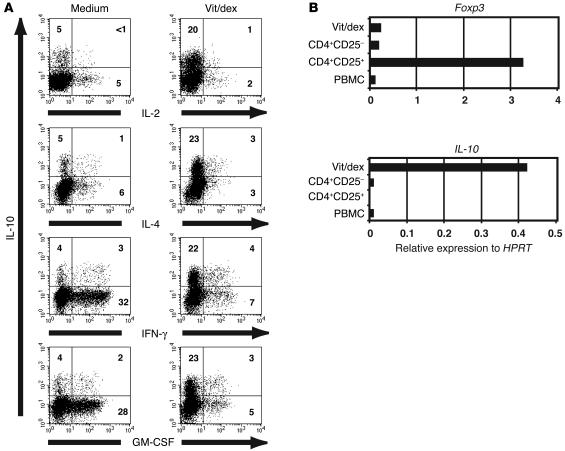
Figure 1
Figure 1
Polyclonal activation of human CD4+ T cells in the presence of dexamethasone plus vitamin D3 induces IL-10 expression, which does not correlate with expression of the transcription factor Foxp3. (A) CD4+ T cells from an SS asthma patient were cultured with APCs, anti-CD3, IL-2, and IL-4 alone (medium) or together with 10–7 M Vitamin D3 and 10–7 M dexamethasone (vit/dex). Cells were restimulated at 7 days with PMA and ionomycin for 4 hours, and coexpression of IL-10 with IL-2, IL-4, IFN-γ, or GM-CSF was analyzed by flow cytometry. Data are representative of 5 experiments. (B) Real-time RT-PCR was performed on PBMCs, freshly isolated CD4+CD25 and CD4+CD25+ T cells, and IL-10–secreting Tregs harvested after 14 days in culture to compare expression of Foxp3 and IL-10. Data are representative of 3 experiments. HPRT, hypoxanthine-guanine phosphoribosyl transferase.
Figure 2
Figure 2
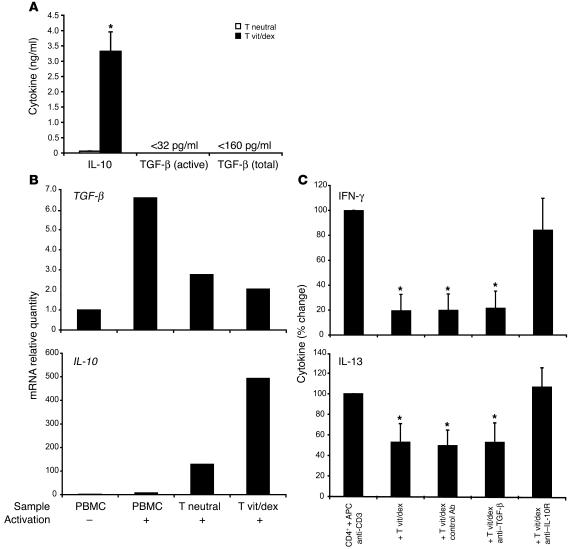
TGF-β is not upregulated by vitamin D3 and dexamethasone treatment and does not play a role in IL-10–secreting Treg–mediated suppression of Th1 and Th2 cytokine production. (A) CD4+ T cells were stimulated for 7 days with (T vit/dex) or without (T neutral) vitamin D3 and dexamethasone, as for Figure 1, and restimulated without drugs for 48 hours. TGF-β and IL-10 levels in culture supernatants were determined by ELISA. Mean data of 3 experiments are shown. (B) CD4+ T cells were cultured for two 7-day cycles with or without vitamin D3 and dexamethasone and then activated with PMA and ionomycin for 4 hours. PBMCs were cultured without or with PMA and ionomycin for 4 hours. TGF-β and IL-10 mRNA were determined by real-time RT-PCR and expressed relative to unactivated PBMCs. A representative experiment of 4 is shown. (C) CD4+ T cell lines were cultured for 7 days with vitamin D3 and dexamethasone and then used in cocultures with fresh autologous T cells (1:4 ratio) and irradiated APCs. Day 3 supernatants were assessed for IFN-γ and IL-13 content. Mean data from 4 experiments is shown. *P < 0.05 using 2-tailed Student’s t test.
Figure 3
Figure 3
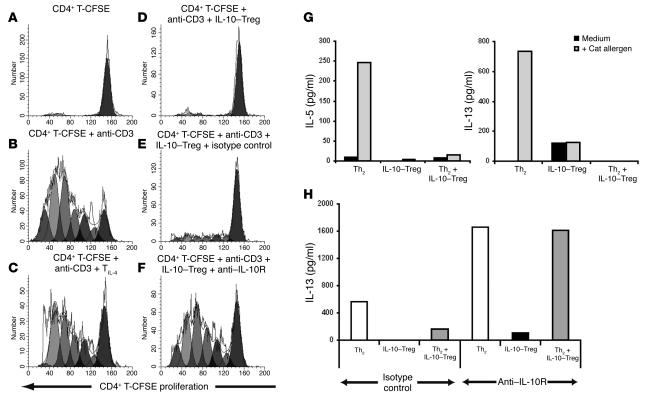
IL-10–secreting Tregs inhibit polyclonal T cell proliferative responses to anti-CD3 and cytokine production by allergen-stimulated Th2 cells. This inhibition is reversed by an IL-10 antagonist. (AF). Freshly isolated CFSE-labeled CD4+ T cells (CD4+ T-CFSE) were cultured with irradiated APCs and (A) medium or (B) anti-CD3. Alternatively, they were (C) cocultured at a ratio of 1 TIL-4 to 4 CD4+ T-CFSE or (DF) 1 IL-10–secreting Treg (IL-10–Treg) to 4 CD4+ T-CFSE. (E) Isotype control or (F) anti–IL-10 receptor monoclonal antibodies were added as indicated. Cell-cycle progression was analyzed at day 6. (G) Allergen-specific IL-10–secreting Tregs or Th2 cells were cultured alone or together (1 IL-10–secreting Treg to 4 Th2 cells) with APCs in medium or with cat allergen extract. Day 3 culture supernatants were analyzed by ELISA and cytometric bead array. Data are representative of 5 experiments. (H) Grass pollen allergen extract–stimulated cultures were established as above with the addition of a control isotype or anti–IL-10 receptor monoclonal antibody as indicated. Cytokine levels detected in the absence of allergen were 200 pg/ml or less and were subtracted in all groups. Data are representative of 3 experiments.
Figure 4
Figure 4
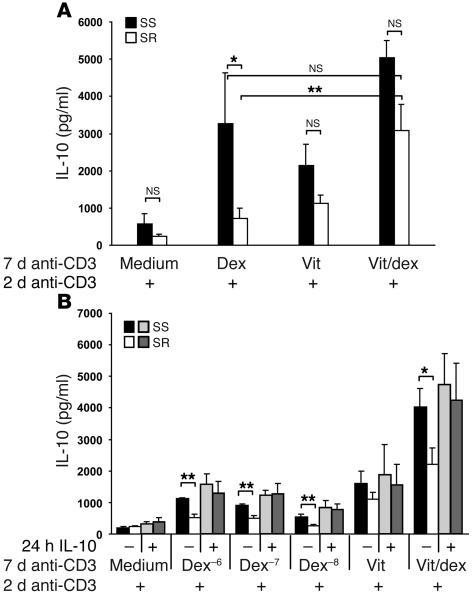
Enhancement of glucocorticoid-induced IL-10 synthesis by T cells from SR asthma patients with vitamin D3 and pretreatment with IL-10. (A) CD4+ T cells from SS (n = 4) and GR (n = 8) asthma patients were cultured with anti-CD3, APCs, IL-2, IL-4, and the indicated combinations of 10–7 M dexamethasone and 5 × 10⁻⁷ M vitamin D3 for 7 days. Cells were recultured at 1 × 10⁶ cells/ml with anti-CD3 and IL-2 alone, and 48-hour culture supernatants were assayed for IL-10 content by ELISA. One patient was tested 2 different times at an interval of 1 year. (B) CD4+ T cells from SS (n = 4) and SR (n = 6) asthma patients were cultured with APCs overnight in medium or with 2 ng/ml IL-10, washed and cultured with anti-CD3, IL-2, IL-4, and the indicated concentrations of dexamethasone, 5 × 10⁻⁷ M vitamin D3, or 10–7M dexamethasone plus vitamin D3 for 7 days. Cells were recultured with anti-CD3 and IL-2 alone and 48-hour culture supernatants assayed by ELISA. *P < 0.05; **P < 0.01 using 2-tailed Student’s t test.
Figure 5
Figure 5
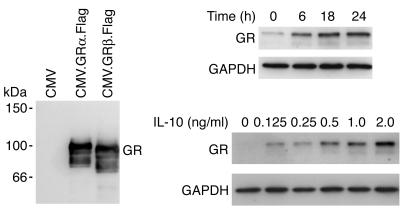
IL-10 enhances GR expression in CD4+ T cells. Purified CD4+ T cells were cultured in (a) medium (0 hours) or with 2 ng/ml IL-10 for the indicated time periods (in hours) or (b) medium or the indicated concentrations of IL-10 for 18 hours prior to analysis of GR and GAPDH levels by Western blotting. Data shown are from 2, and representative of 4, healthy nonasthmatic donors. Identification of the immunoreactive protein as GRα was permitted by comparison of migration of native extract with extracts of cells transiently transfected with cDNAs encoding FLAG-tagged GRα and GRβ. CMV, cytomegalovirus. CMV.GRα.Flag, CMV promotor driving the expression of full-length GRα engineered to include the 8-aa FLAG epitope.
Figure 6
Figure 6
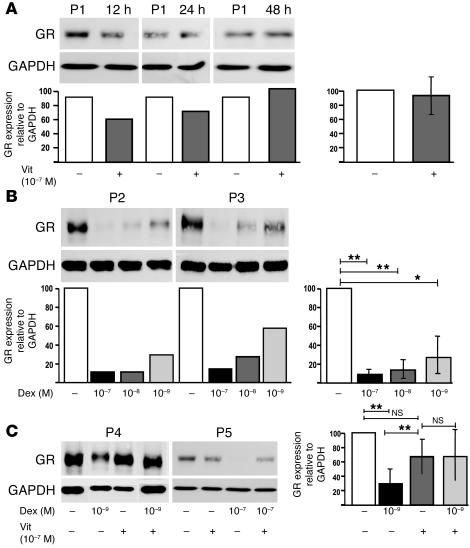
Vitamin D3 does not increase GR expression in CD4+ T cells but prevents downregulation by dexamethasone. (A) CD4+ T cells were cultured in medium (–) or with 10–7 M vitamin D3 (+) for 12, 24, or 48 hours and then analyzed for GR and GAPDH by Western blot. Data from a representative donor (P1) and densitometry analysis of the ratio of GR to GAPDH is shown in the left panel; mean data from 4 individuals at 48 hours is shown in the right panel. (B) CD4+ T cells were cultured without or with dexamethasone for 48 hours prior to Western blot analysis. Data from 2 representative individuals (P2 and P3, left panel) and mean data from 4 individuals (right panel) are shown. (C) Culture of CD4+ T cells with vitamin D3, dexamethasone, or both drugs for 48 hours. Western blot analysis from 2 representative individuals (P4 and P5; left panel) and mean data from 7 individuals (right panel) are shown. *P < 0.05; **P < 0.001.
Figure 7
Figure 7
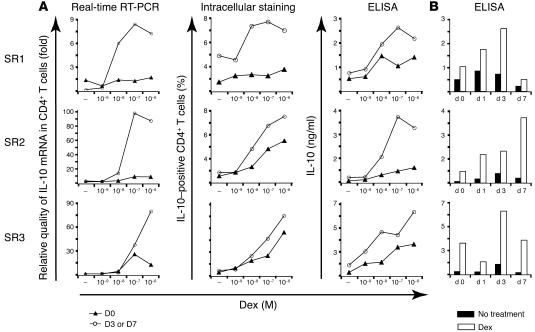
Ingestion of vitamin D3 enhances responsiveness to dexamethasone for induction of IL-10 synthesis. CD4+ T cells isolated prior to (day 0 [d 0]) or 1, 3, or 7 days after ingestion of vitamin D3 were cultured with anti-CD3 and IL-2 with or without the indicated concentrations of dexamethasone for 7 days. Cells were then assayed for mRNA at this time or recultured for 48 hours with anti-CD3 and IL-2 and analyzed for expression of IL-10 by intracellular cytokine staining and ELISA. (A) IL-10 responses to a range of dexamethasone concentrations were assessed, and data are shown at the time of maximal induction for each donor (SR1 and SR3, day 3; SR2, day 7). mRNA levels are expressed relative to day 0, medium (–). (B) IL-10 responses to a single dose of dexamethasone (10–6 or 10–7 M) over time.

References

    1. Wills-Karp M. Immunologic basis of antigen-induced airway hyperresponsiveness. Annu. Rev. Immunol. 1999;17:255–281. - PubMed
    1. Umland SP, Schleimer RP, Johnston SL. Review of the molecular and cellular mechanisms of action of glucocorticoids for use in asthma. Pulm. Pharmacol. Ther. 2002;15:35–50. - PubMed
    1. Richards DF, Fernandez M, Caulfield J, Hawrylowicz CM. Glucocorticoids drive human CD8(+) T cell differentiation towards a phenotype with high IL-10 and reduced IL-4, IL-5 and IL-13 production. Eur. J. Immunol. 2000;30:2344–2354. - PubMed
    1. John M, et al. Inhaled corticosteroids increase interleukin-10 but reduce macrophage inflammatory protein-1α, granulocyte-macrophage colony stimulating factor and interferon-γ release from alveolar macrophages in asthma. Am. J. Respir. Crit. Care Med. 1998;157:256–262. - PubMed
    1. Moore KW, de Waal Malefyt R, Coffman RL, O’Garra A. Interleukin-10 and the interleukin-10 receptor. Annu. Rev. Immunol. 2001;19:683–765. - PubMed

Publication types

MeSH terms