Comparative Study
. 2006 Jan;16(1):88-96.
doi: 10.1101/gr.3810906. Epub 2005 Dec 12.

The evolutionary dynamics of alpha-satellite

Affiliations
Comparative Study

The evolutionary dynamics of alpha-satellite

M Katharine Rudd et al. Genome Res. 2006 Jan.

Abstract

Alpha-satellite is a family of tandemly repeated sequences found at all normal human centromeres. In addition to its significance for understanding centromere function, alpha-satellite is also a model for concerted evolution, as alpha-satellite repeats are more similar within a species than between species. There are two types of alpha-satellite in the human genome; while both are made up of approximately 171-bp monomers, they can be distinguished by whether monomers are arranged in extremely homogeneous higher-order, multimeric repeat units or exist as more divergent monomeric alpha-satellite that lacks any multimeric periodicity. In this study, as a model to examine the genomic and evolutionary relationships between these two types, we have focused on the chromosome 17 centromeric region that has reached both higher-order and monomeric alpha-satellite in the human genome assembly. Monomeric and higher-order alpha-satellites on chromosome 17 are phylogenetically distinct, consistent with a model in which higher-order evolved independently of monomeric alpha-satellite. Comparative analysis between human chromosome 17 and the orthologous chimpanzee chromosome indicates that monomeric alpha-satellite is evolving at approximately the same rate as the adjacent non-alpha-satellite DNA. However, higher-order alpha-satellite is less conserved, suggesting different evolutionary rates for the two types of alpha-satellite.


Figures
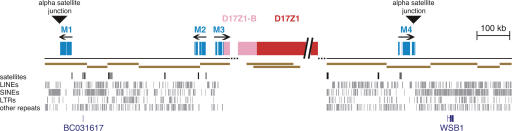
Figure 1.
Figure 1.
α-Satellite organization in the centromeric region of chromosome 17. The genomic landscape 500 kb distal of both sides of the centromere gap (dotted lines) is depicted. Blocks of monomeric α-satellite (light blue) are shown on both p and q arm contigs, and the p arm contig terminates with D17Z1-B higher-order α-satellite (pink). The proposed organization of D17Z1 (red) and D17Z1-B (pink) is shown inside the centromere gap. Arrows indicate the orientation of α-satellite monomers, and triangles show the junctions between α-satellite and non-satellite sequences (α-satellite junctions). BACs comprising the minimal tiling path are shown in brown, as are the two BACs containing D17Z1 at one end and D17Z1-B at the other. Other repeats are shown below the BAC contigs; from top to bottom, satellites (black), LINEs, SINEs, LTRs and other repeats (gray). The locations of RefSeq genes BC031617 and WSB1 are shown in dark blue at the bottom.
Figure 2.
Figure 2.
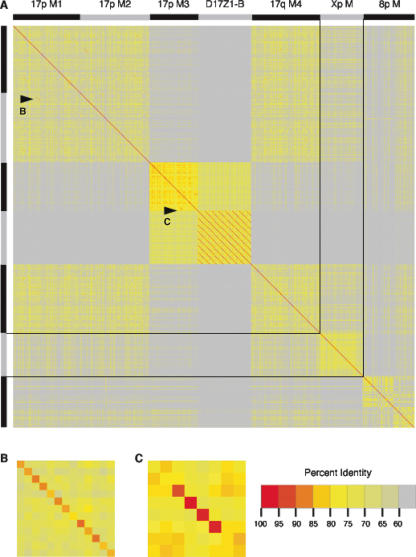
Percent identity scores for pairwise comparisons of α-satellite monomers. All pairwise comparisons were calculated for α-satellite monomers and percent identity scores were depicted according to the color scale. The chromosomal origin of α-satellite monomers is shown at the top of the figure in alternating black and gray bars. (A) Pairwise comparisons for monomers from the assemblies of chromosomes 8 and 17 and the X chromosome. Black lines indicate the boundaries of monomers from each chromosome. (B,C) Detailed versions of percent identity scores from regions indicated by arrowheads.
Figure 3.
Figure 3.
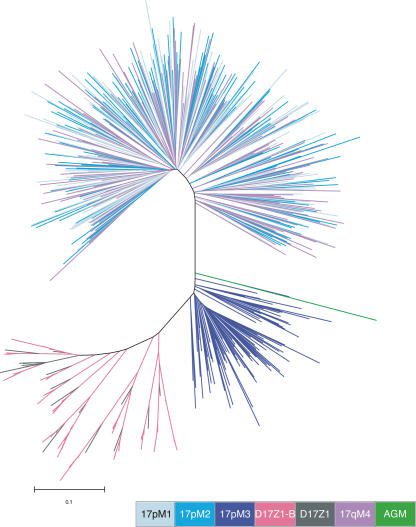
Phylogenetic tree of α-satellite on chromosome 17. Neighbor-joining methods were used to generate the phylogenetic tree containing both higher-order and monomeric α-satellite from chromosome 17. The tree contains 641 monomers, including the outgroup monomer from the African green monkey. The key at the bottom of the figure indicates the chromosomal origin of the monomers. Monomeric α-satellite 17pM1, 17pM2, 17pM3, 17qM4; higher-order α-satellite D17Z1 and D17Z1-B; and α-satellite from the African Green Monkey (AGM) are shown.
Figure 4.
Figure 4.
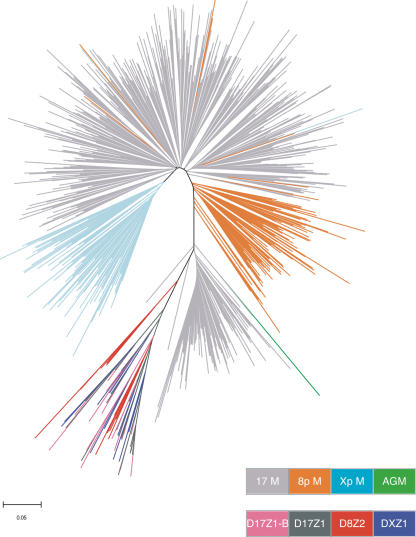
Neighbor-joining tree of monomers from different chromosomes. Neighbor-joining methods were used to generate the phylogenetic tree containing higher-order and monomeric α-satellite from chromosomes 8 and 17 and the X chromosome. The key at the bottom of the figure indicates the chromosomal origin of the monomers from monomeric α-satellite (8p M, 17 M, and Xp M) and higher-order α-satellite (D8Z2, D17Z1, D17Z1-B, and DXZ1).
Figure 5.
Figure 5.
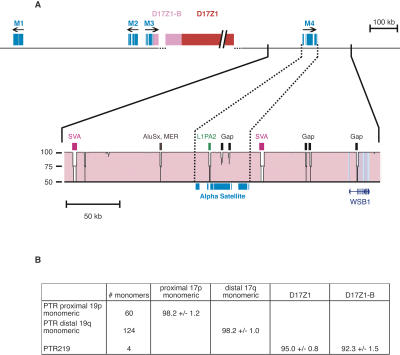
Genomic organization of 17q compared to the orthologous Pan troglodytes region. (A) The genomic organization of the chromosome 17 centromeric region is depicted; α-satellite is colored as described in Figure 1. A 300-kb region containing monomeric α-satellite on human chromosome arm 17q was compared to the orthologous region of chimpanzee chromosome arm 19q. A VISTA alignment of the two regions is shown in pink. Percent identity between aligning sequences is indicated by the y-axis (50%-100% identical). α-Satellite (blue) and the gene WSB1 (purple) are shown. Areas of low percent identity between the two genomes can be explained by gaps in the chimpanzee assembly (black boxes) or sequences inserted in the human genome or deleted from the chimpanzee genome (colored boxes). (B) Mean percent identity ± one standard deviation for aligned α-satellite monomers from chimpanzees and humans.

References

    1. Alexandrov, I.A., Mashkova, T.D., Akopian, T.A., Medvedev, L.I., Kisselev, L.L., Mitkevich, S.P., and Yurov, Y.B. 1991. Chromosome-specific α satellites: Two distinct families on human chromosome 18. Genomics 11 15-23. - PubMed
    1. Alexandrov, I.A., Medvedev, L.I., Mashkova, T.D., Kisselev, L.L., Romanova, L.Y., and Yurov, Y.B. 1993. Definition of a new α satellite suprachromosomal family characterized by monomeric organization. Nucleic Acids Res. 21 2209-2215. - PMC - PubMed
    1. Alexandrov, I., Kazakov, A., Tumeneva, I., Shepelev, V., and Yurov, Y. 2001. α-Satellite DNA of primates: Old and new families. Chromosoma 110 253-266. - PubMed
    1. Alkan, C., Eichler, E.E., Bailey, J.A., Sahinalp, S.C., and Tuzun, E. 2004. The role of unequal crossover in α-satellite DNA evolution: A computational analysis. J. Comp. Biol. 11 933-944. - PubMed
    1. Alves, G., Seuanez, H.N., and Fanning, T. 1994. α-Satellite DNA in neotropical primates (Platyrrhini). Chromosoma 103 262-267. - PubMed

Web site references

    1. http://darwin.uvigo.es/software/modeltest.html; Modeltest.
    1. http://genome.ucsc.edu; UCSC Genome Bioinformatics site.
    1. http://macclade.org/macclade.html; MacClade.
    1. http://paup.csit.fsu.edu/downl.html; PAUP.
    1. http://pipeline.lbl.gov/cgi-bin/gateway2; VISTA browser.

Publication types

LinkOut - more resources