Abundant novel transcriptional units and unconventional gene pairs on human chromosome 22
- PMID: 16344557
- PMCID: PMC1356128
- DOI: 10.1101/gr.3883606
Abundant novel transcriptional units and unconventional gene pairs on human chromosome 22
Abstract
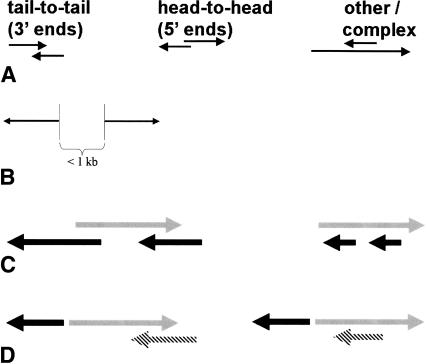
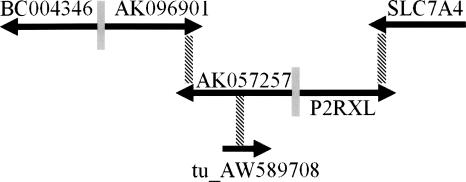
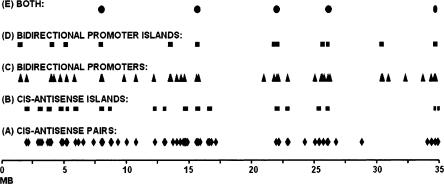
Novel transcriptional units (TUs) are EST-supported transcribed features not corresponding to known genes. Unconventional gene pairs (UGPs) are pairs of genes and/or TUs sharing exon-to-exon cis-antisense overlaps or putative bidirectional promoters. Computational TU and UGP discovery followed by manual curation was performed in the entire published 34.9-Mb human chromosome 22 euchromatic sequence. Novel TUs (n = 517) were as abundant as known genes (n = 492) and typically did not have nonprimate DNA and protein homologies. One hundred seventy-one (33%) of TUs, but only 13 (3%) of genes, both lacked nonprimate conservation and localized to gaps in the human-mouse BLASTZ alignment. Novel TUs were richer in exonic primate-specific interspersed repetitive elements (P = 0.001) and were more likely to rely on splice junctions provided by them, than were known genes: 19% of spliced TUs, versus 5% of spliced genes, had a splice site within a primate-specific repeat. Hence, novel TUs and known genes may represent different portions of the transcriptome. Two hundred nine (21%) of chromosome 22 transcripts participated in 77 cis-antisense and 42 promoter-sharing UGPs. Transcripts involved simultaneously in both UGP types were more common than was expected (P = 0.01). UGPs were nonrandomly distributed along the sequence: 89 (75%) clustered in distinct regions, the sum of which equaled 4.4 Mb (<13% of the chromosome). Eighty (67%) of the UGPs possessed significant locus structure differences between primates and rodents. Since some TUs may be functional noncoding transcripts and since the cis-regulatory potential of UGPs is well recognized, TUs and UGPs specific to the primate lineage may contribute to the genomic basis for primate-specific phenotypes.
Figures
Similar articles
-
Global discovery of primate-specific genes in the human genome.Proc Natl Acad Sci U S A. 2009 Jul 21;106(29):12019-24. doi: 10.1073/pnas.0904569106. Epub 2009 Jul 6. Proc Natl Acad Sci U S A. 2009. PMID: 19581580 Free PMC article.
-
Complex Loci in human and mouse genomes.PLoS Genet. 2006 Apr;2(4):e47. doi: 10.1371/journal.pgen.0020047. Epub 2006 Apr 28. PLoS Genet. 2006. PMID: 16683030 Free PMC article.
-
Novel transcriptional units and unconventional gene pairs in the human genome: toward a sequence-level basis for primate-specific phenotypes?Cold Spring Harb Symp Quant Biol. 2003;68:461-70. doi: 10.1101/sqb.2003.68.461. Cold Spring Harb Symp Quant Biol. 2003. PMID: 15338649 No abstract available.
-
[Analysis, identification and correction of some errors of model refseqs appeared in NCBI Human Gene Database by in silico cloning and experimental verification of novel human genes].Yi Chuan Xue Bao. 2004 May;31(5):431-43. Yi Chuan Xue Bao. 2004. PMID: 15478601 Chinese.
-
Primate-specific endogenous cis-antisense transcription in the human 5q31 protocadherin gene cluster.J Mol Evol. 2006 Jan;62(1):73-88. doi: 10.1007/s00239-005-0041-3. Epub 2005 Dec 6. J Mol Evol. 2006. PMID: 16341467
Cited by
-
Phylogenetic reconstruction of orthology, paralogy, and conserved synteny for dog and human.PLoS Comput Biol. 2006 Sep 29;2(9):e133. doi: 10.1371/journal.pcbi.0020133. PLoS Comput Biol. 2006. PMID: 17009864 Free PMC article.
-
Pioneering geneticist Mary-Claire King receives the 2014 Lasker~Koshland Special Achievement Award in Medical Science.J Clin Invest. 2014 Oct;124(10):4148-51. doi: 10.1172/JCI78507. Epub 2014 Sep 8. J Clin Invest. 2014. PMID: 25196046 Free PMC article. No abstract available.
-
Noncoding RNAs database (ncRNAdb).Nucleic Acids Res. 2007 Jan;35(Database issue):D162-4. doi: 10.1093/nar/gkl994. Epub 2006 Dec 14. Nucleic Acids Res. 2007. PMID: 17169980 Free PMC article.
-
Viral vectors based on bidirectional cell-specific mammalian promoters and transcriptional amplification strategy for use in vitro and in vivo.BMC Biotechnol. 2008 May 16;8:49. doi: 10.1186/1472-6750-8-49. BMC Biotechnol. 2008. PMID: 18485188 Free PMC article.
-
Sense-antisense gene pairs: sequence, transcription, and structure are not conserved between human and mouse.Front Genet. 2013 Sep 26;4:183. doi: 10.3389/fgene.2013.00183. eCollection 2013. Front Genet. 2013. PMID: 24133500 Free PMC article.
References
-
- Adachi, N. and Lieber, M.R. 2002. Bidirectional gene organization: A common architectural feature of the human genome. Cell 109 807-809. - PubMed
-
- Andres, A.M., Soldevila, M., Saitou, N., Volpini, V., Calafell, F., and Bertranpetit, J. 2003. Understanding the dynamics of Spinocerebellar ataxia 8 (SCA8) locus through a comparative genetic approach in humans and apes. Neurosci. Lett. 336 143-146. - PubMed
-
- Angiolillo, A., Russo, G., Porcellini, A., Smaldone, S., D'Alessandro, F., and Pietropaolo, C. 2002. The human homologue of the mouse Surf5 gene encodes multiple alternatively spliced transcripts. Gene 284 169-178. - PubMed
-
- Caffrey, J.J., Safrany, S.T., Yang, X., and Shears, S.B. 2000. Discovery of molecular and catalytic diversity among human diphosphoinositol-polyphosphate phosphohydrolases: An expanding Nudt family. J. Biol. Chem. 275 12730-12736. - PubMed
Web site references
-
- http://www.repeatmasker.org/cgi-bin/WEBRepeatMasker; RepeatMasker.
-
- http://cgap.nci.nih.gov/Tissues/LibraryFinder; cDNA Library Finder.
Publication types
MeSH terms
Substances
Grants and funding
LinkOut - more resources
Full Text Sources
Research Materials
Miscellaneous