Organization of the Caenorhabditis elegans small non-coding transcriptome: genomic features, biogenesis, and expression
- PMID: 16344563
- PMCID: PMC1356125
- DOI: 10.1101/gr.4139206
Organization of the Caenorhabditis elegans small non-coding transcriptome: genomic features, biogenesis, and expression
Abstract
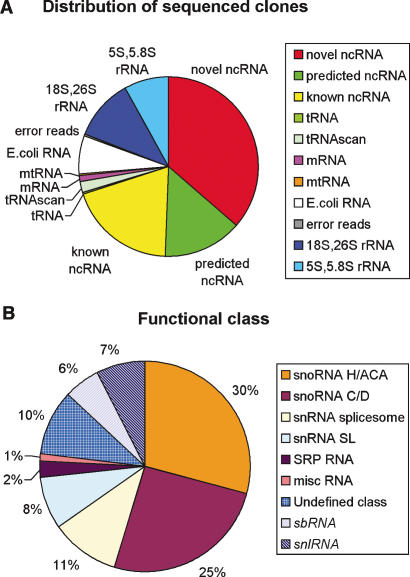
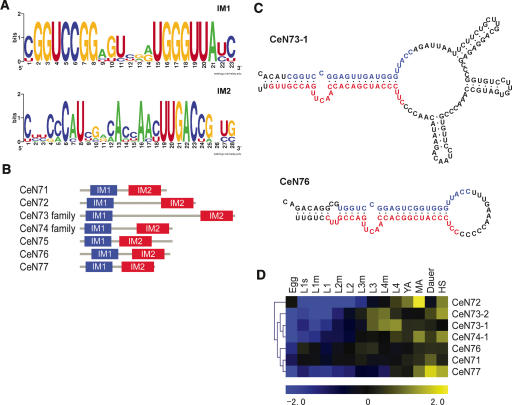
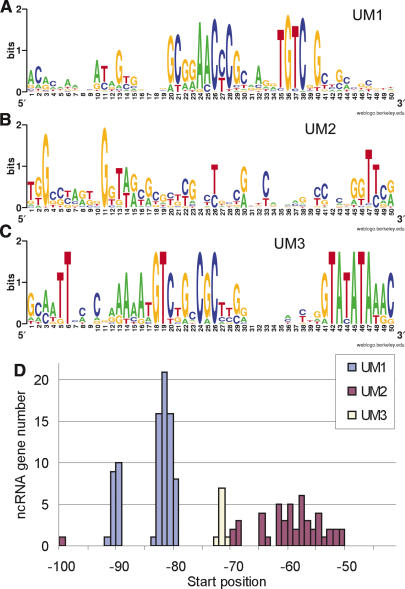
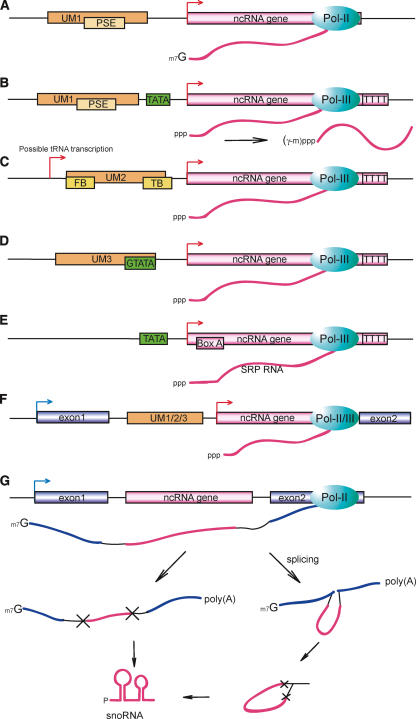
Recent evidence points to considerable transcription occurring in non-protein-coding regions of eukaryote genomes. However, their lack of conservation and demonstrated function have created controversy over whether these transcripts are functional. Applying a novel cloning strategy, we have cloned 100 novel and 61 known or predicted Caenorhabditis elegans full-length ncRNAs. Studying the genomic environment and transcriptional characteristics have shown that two-thirds of all ncRNAs, including many intronic snoRNAs, are independently transcribed under the control of ncRNA-specific upstream promoter elements. Furthermore, the transcription levels of at least 60% of the ncRNAs vary with developmental stages. We identified two new classes of ncRNAs, stem-bulge RNAs (sbRNAs) and snRNA-like RNAs (snlRNAs), both featuring distinct internal motifs, secondary structures, upstream elements, and high and developmentally variable expression. Most of the novel ncRNAs are conserved in Caenorhabditis briggsae, but only one homolog was found outside the nematodes. Preliminary estimates indicate that the C. elegans transcriptome contains approximately 2700 small non-coding RNAs, potentially acting as regulatory elements in nematode development.
Figures
References
-
- Bailey, T.L. and Elkan, C. 1995. The value of prior knowledge in discovering motifs with MEME. Proc. Int. Conf. Intell. Syst. Mol. Biol. 3 21-29. - PubMed
-
- Bejerano, G., Pheasant, M., Makunin, I., Stephen, S., Kent, W.J., Mattick, J.S., and Haussler, D. 2004. Ultraconserved elements in the human genome. Science 304 1321-1325. - PubMed
-
- Bertone, P., Stolc, V., Royce, T.E., Rozowsky, J.S., Urban, A.E., Zhu, X., Rinn, J.L., Tongprasit, W., Samanta, M., Weissman, S., et al. 2004. Global identification of human transcribed sequences with genome tiling arrays. Science 306 2242-2246. - PubMed
Publication types
MeSH terms
Substances
Associated data
- Actions
- Actions
- Actions
- Actions
- Actions
- Actions
- Actions
- Actions
- Actions
- Actions
- Actions
- Actions
- Actions
- Actions
- Actions
- Actions
- Actions
- Actions
- Actions
- Actions
- Actions
- Actions
- Actions
- Actions
- Actions
- Actions
- Actions
- Actions
- Actions
- Actions
- Actions
- Actions
- Actions
- Actions
- Actions
- Actions
- Actions
- Actions
- Actions
- Actions
- Actions
- Actions
- Actions
- Actions
- Actions
- Actions
- Actions
- Actions
- Actions
- Actions
- Actions
- Actions
- Actions
- Actions
- Actions
- Actions
- Actions
- Actions
- Actions
- Actions
- Actions
- Actions
- Actions
- Actions
- Actions
- Actions
- Actions
- Actions
- Actions
- Actions
- Actions
- Actions
- Actions
- Actions
- Actions
- Actions
- Actions
- Actions
- Actions
- Actions
- Actions
- Actions
- Actions
- Actions
- Actions
- Actions
- Actions
- Actions
- Actions
- Actions
- Actions
- Actions
- Actions
- Actions
- Actions
- Actions
- Actions
- Actions
- Actions
- Actions
- Actions
- Actions
- Actions
- Actions
- Actions
- Actions
- Actions
- Actions
- Actions
- Actions
- Actions
- Actions
- Actions
- Actions
- Actions
- Actions
- Actions
- Actions
- Actions
- Actions
- Actions
- Actions
- Actions
- Actions
- Actions
- Actions
- Actions
- Actions
- Actions
- Actions
- Actions
- Actions
- Actions
- Actions
- Actions
- Actions
- Actions
- Actions
- Actions
- Actions
- Actions
- Actions
- Actions
- Actions
- Actions
- Actions
- Actions
- Actions
- Actions
- Actions
- Actions
- Actions
- Actions
- Actions
- Actions
- Actions
- Actions
- Actions
- Actions
- Actions
- Actions
- Actions
- Actions
- Actions
- Actions
LinkOut - more resources
Full Text Sources
Other Literature Sources