


doi: 10.1128/AEM.64.4.1545-1547.1998.
Effects of Cellular Metabolism and Viability on Metal Ion Accumulation by Cultured Biomass from a Bloom of the Cyanobacterium Microcystis aeruginosa
Affiliations
- PMID: 16349552
- PMCID: PMC106185
- DOI: 10.1128/AEM.64.4.1545-1547.1998
Item in Clipboard
Effects of Cellular Metabolism and Viability on Metal Ion Accumulation by Cultured Biomass from a Bloom of the Cyanobacterium Microcystis aeruginosa
Appl Environ Microbiol.
1998 Apr.
Abstract
The sorption of nickel, cadmium, and copper by cultured biomass from a naturally occurring bloom of Microcystis aeruginosa was demonstrated in two systems: cells suspended in culture medium and cells immobilized in alginate. Incubation in the absence of light, in the presence of metabolic inhibitors, and at 4 degrees C did not substantially decrease the copper accumulation by cells in culture medium. Heat-killed, formaldehyde-treated, and air-dried biomass samples sorbed nearly as much (or in some cases slightly more) copper as did viable samples.
Figures
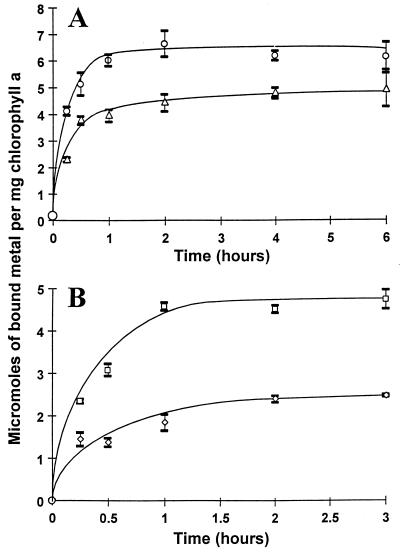
Time course of metal sorption by cultured cells from an M. aeruginosa bloom. (A) ○, 31.5 μM CuCl2 (2.0 μg of Cu2+/ml); ▵, 7.87 μM CuCl2 (0.5 μg of Cu2+/ml); cells at a density of 1.5 mg of CHL per liter. (B) ◊, 4.45 μM CdCl2 (0.5 μg of Cd2+/ml); □, 8.52 μM NiCl2 (0.5 μg of Ni2+/ml); cells at a density of 1.8 mg of CHL per liter. Error bars indicate the ranges of duplicate measurements.
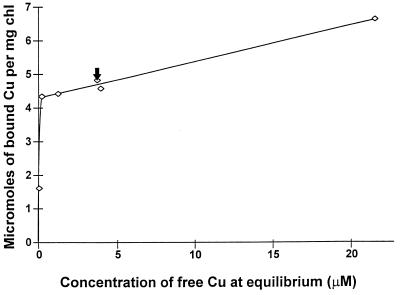
Relationship between bound and free copper at various concentrations of added copper (7.87 to 31.5 μM) and various biomass concentrations (0.68 to 1.8 mg of CHL/liter), for the steady-state conditions observed after 2 h of incubation at 29°C in culture medium. The arrow indicates the conditions of bound and free copper in subsequent studies of metabolic inhibition.
References
-
- Aguilar C, Nealson K. The role of cyanobacteria in the manganese cycle in Oneida Lake, N.Y. Elsevier Oceanogr Ser. 1990;71:1022.
-
- Amemiya Y, Nakayama O. The chemical composition and metal adsorption capacity of the sheath materials isolated from Microcystis, Cyanobacteria. Jpn J Limnol. 1984;45:187–193.
-
- Beveridge T J, Doyle R J, editors. Metal ions and bacteria. New York, N.Y: John Wiley & Sons; 1989.
-
- Campbell P M, Smith G D. Transport and accumulation of nickel ions in the cyanobacterium Anabaena cylindrica. Arch Biochem Biophys. 1986;244:470–477. - PubMed
-
- De Filippis L F, Pallaghy C K. Heavy metals: sources and biological effects. In: Rai L C, Gaur J P, Soeder C J, editors. Algae and water pollution. E. Stuttgart, Germany: Schweizerbart’sche Verlagsbuchhandlung; 1994. pp. 31–77.
LinkOut - more resources
Full Text Sources
