. 2005 Dec 1;6 Suppl 4(Suppl 4):S21.
doi: 10.1186/1471-2105-6-S4-S21.

HomoMINT: an inferred human network based on orthology mapping of protein interactions discovered in model organisms

Affiliations

HomoMINT: an inferred human network based on orthology mapping of protein interactions discovered in model organisms

Maria Persico et al. BMC Bioinformatics. .

Abstract

Background: The application of high throughput approaches to the identification of protein interactions has offered for the first time a glimpse of the global interactome of some model organisms. Until now, however, such genome-wide approaches have not been applied to the human proteome.

Results: In order to fill this gap we have assembled an inferred human protein interaction network where interactions discovered in model organisms are mapped onto the corresponding human orthologs. In addition to a stringent assignment to orthology classes based on the InParanoid algorithm, we have implemented a string matching algorithm to filter out orthology assignments of proteins whose global domain organization is not conserved. Finally, we have assessed the accuracy of our own, and related, inferred networks by benchmarking them against i) an assembled experimental interactome, ii) a network derived by mining of the scientific literature and iii) by measuring the enrichment of interacting protein pairs sharing common Gene Ontology annotation.

Conclusion: The resulting networks are named HomoMINT and HomoMINT_filtered, the latter being based on the orthology table filtered by the domain architecture matching algorithm. They contains 9749 and 5203 interactions respectively and can be analyzed and viewed in the context of the experimentally verified interactions between human proteins stored in the MINT database. HomoMINT is constantly updated to take into account the growing information in the MINT database.


Figures
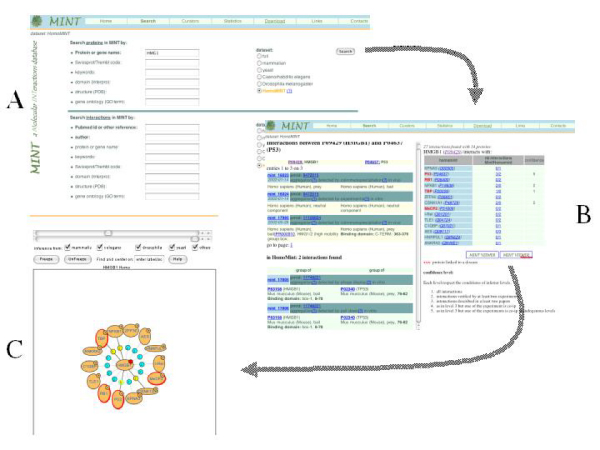
Figure 1
Figure 1
HomoMINT as a web tool. HomoMINT can be searched and analyzed by taking advantage of the tools developed for MINT. A) A search can be carried out in the protein table by entering in the form one of the following: a protein name, a Uniprot or a PDB identifier, a keyword, an InterPro domain or a gene ontology term (top part of the form). Alternatively the search can be carried out on the interaction table (centre). Finally (lower part) a BLAST search can be carried out by entering a protein sequence. B) Search output listing on the right the partners of the query protein and on the left the experimental evidence supporting the interactions. C) The Mint Viewer is an applet that permits the graphic display of interaction networks. Edges marked by small blue circles indicate that the corresponding interactions were inferred from experiments carried out in model organisms, while yellow circles mark interactions supported by direct experimental results. Interactions that are inferred from model organisms but are also supported by direct experiments are marked by yellow circles with a blue contour. A series of check boxes make it possible to visualize interactions inferred by any combination of model organism interactomes.
Figure 2
Figure 2
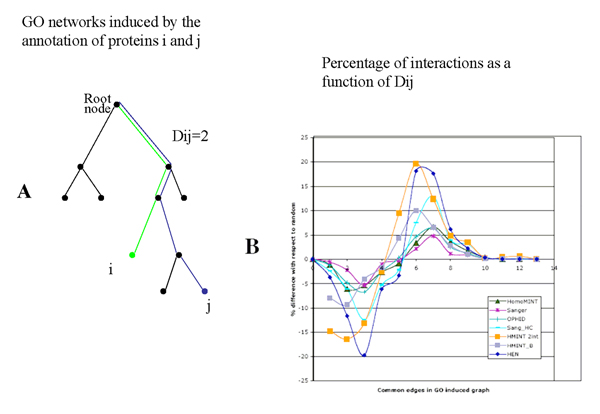
Degree of common annotation in interacting protein pairs in experimental and inferred networks. A) Schematic representation of the algorithm used to evaluate the relatedness of gene ontology annotation. The Gene Ontology graph induced by protein 'i ' is in green, while the one induced by protein 'j' is in blue. Dij is the number of edges that the two induced graphs have in common. B) For any given network we have derived a 'scrambled network' containing the same protein nodes linked by the same number of edges with their connections rearranged at random. For each interacting protein pair, in which both proteins have a GO annotation, we have then calculated Dij. Finally we have plotted, as a function of Dij, the difference between the percentage of nodes having a specific Dij in the inferred and in the scrambled network.
Figure 3
Figure 3
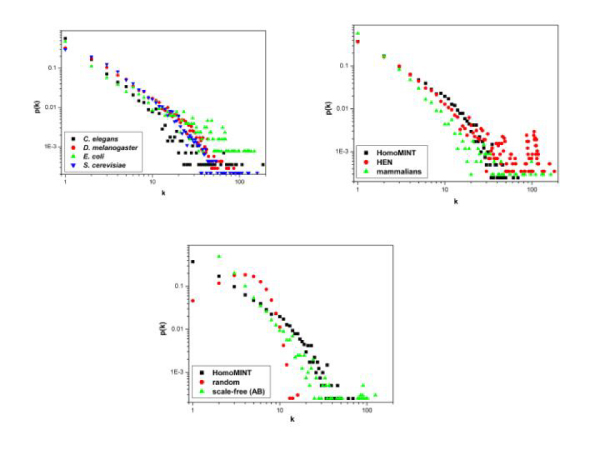
Degree distribition of the HomoMINT network compared with different biological networks. Frequency of nodes with k links for A) the model organism experimental networks in the MINT database B) the assembled Human experimental network (HEN), the Human inferred (HomoMINT) data set, the Mammalian data set in MINT and C), for a random network of similar size and for a scale-free network assembled according to Barabasi [31].

References

    1. Chien CT, Bartel PL, Sternglanz R, Fields S. The two-hybrid system: a method to identify and clone genes for proteins that interact with a protein of interest. Proc Natl Acad Sci U S A. 1991;88:9578–82. doi: 10.1073/pnas.88.21.9578. - DOI - PMC - PubMed
    1. Rigaut G, Shevchenko A, Rutz B, Wilm M, Mann M, Seraphin B. A generic protein purification method for protein complex characterization and proteome exploration. Nat Biotechnol. 1999;17:1030–2. doi: 10.1038/13732. - DOI - PubMed
    1. Rain JC, Selig L, De Reuse H, Battaglia V, Reverdy C, Simon S, Lenzen G, Petel F, Wojcik J, Schachter V, et al. The protein-protein interaction map of Helicobacter pylori. Nature. 2001;409:211–5. doi: 10.1038/35051615. - DOI - PubMed
    1. Butland G, Peregrin-Alvarez JM, Li J, Yang W, Yang X, Canadien V, Starostine A, Richards D, Beattie B, Krogan N, et al. Interaction network containing conserved and essential protein complexes in Escherichia coli. Nature. 2005;433:531–7. doi: 10.1038/nature03239. - DOI - PubMed
    1. Ho Y, Gruhler A, Heilbut A, Bader GD, Moore L, Adams SL, Millar A, Taylor P, Bennett K, Boutilier K, et al. Systematic identification of protein complexes in Saccharomyces cerevisiae by mass spectrometry. Nature. 2002;415:180–3. doi: 10.1038/415180a. - DOI - PubMed

Publication types

LinkOut - more resources