Matching and anatomical labeling of human airway tree
- PMID: 16353371
- PMCID: PMC2077841
- DOI: 10.1109/TMI.2005.857653
Matching and anatomical labeling of human airway tree
Abstract
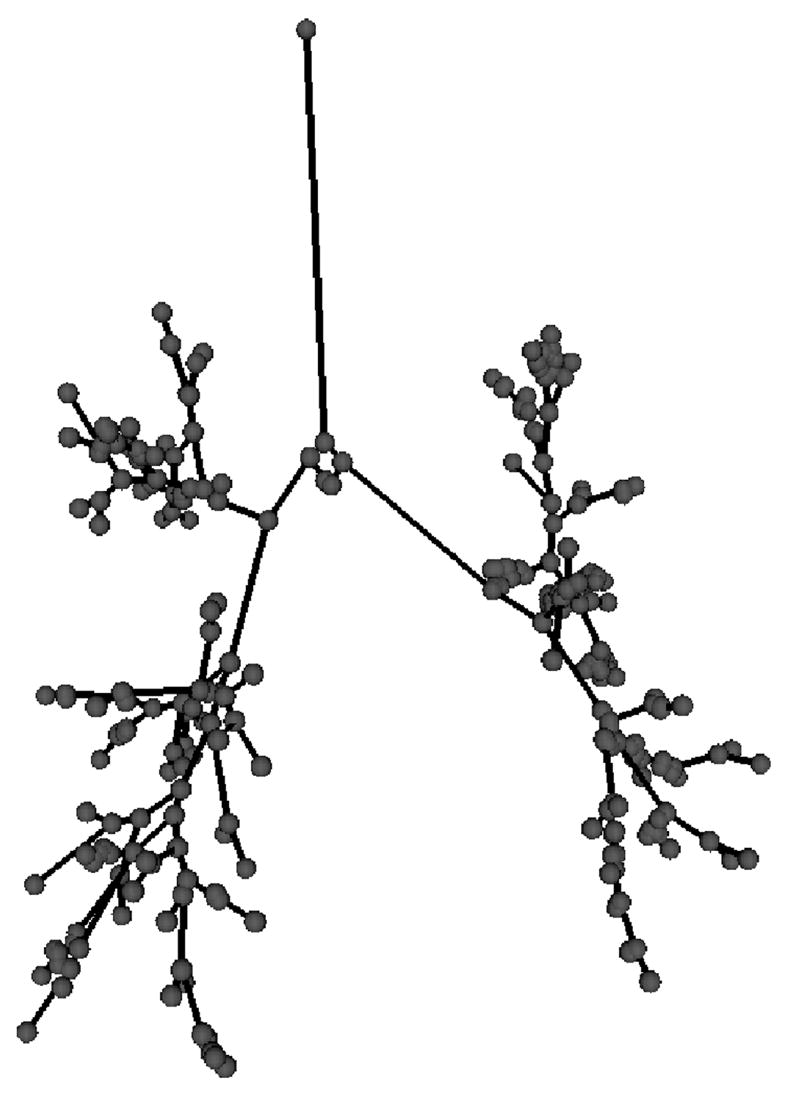
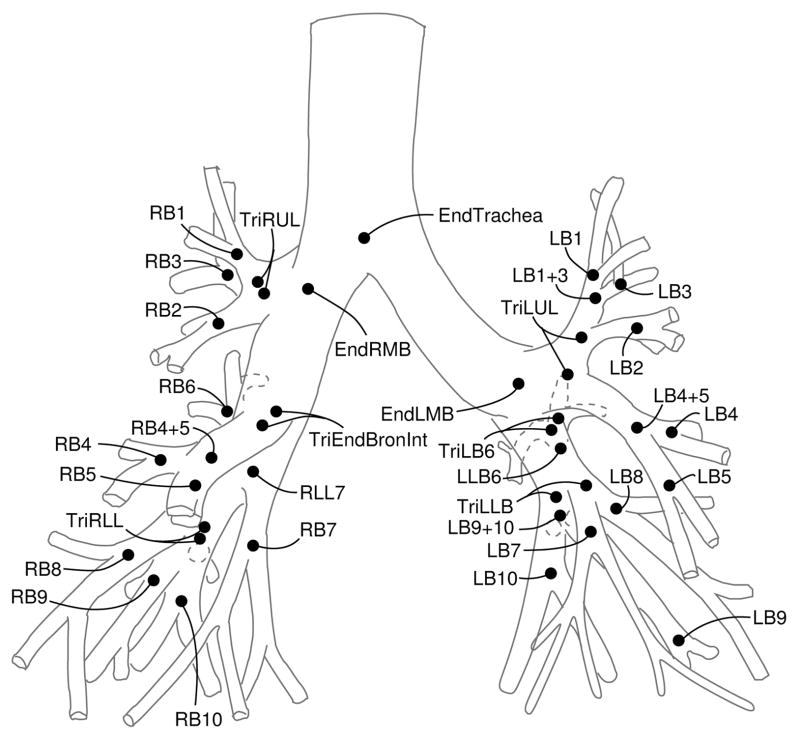
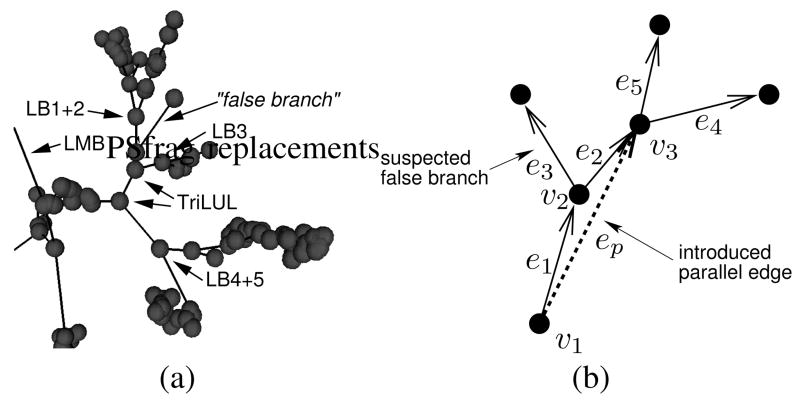
Matching of corresponding branchpoints between two human airway trees, as well as assigning anatomical names to the segments and branchpoints of the human airway tree, are of significant interest for clinical applications and physiological studies. In the past, these tasks were often performed manually due to the lack of automated algorithms that can tolerate false branches and anatomical variability typical for in vivo trees. In this paper, we present algorithms that perform both matching of branchpoints and anatomical labeling of in vivo trees without any human intervention and within a short computing time. No hand-pruning of false branches is required. The results from the automated methods show a high degree of accuracy when validated against reference data provided by human experts. 92.9% of the verifiable branchpoint matches found by the computer agree with experts' results. For anatomical labeling, 97.1% of the automatically assigned segment labels were found to be correct.
Figures



References
-
- Boyden EA. Segmental anatomy of the lungs. McGraw-Hill; 1955.
-
- Wood SA, Zerhouni EA, Hoford JD, Hoffman EA, Mitzner W. Measurement of three-dimensional lung tree structures by using computed tomography. Journal of Applied Physiology. 1995;79:1687–1697. - PubMed
-
- Pisupati C, Wolff L, Mitzner W, Zerhouni E. Tracking 3-D pulmonary tree structures. Mathematical Methods in Biomedical Image Analysis, 1996; Proceedings of the Workshop; Jun, 1996. pp. 160–169.
-
- Pisupati C, Wolff L, Mitzner W, Zerhouni E. Geometric Tree Matching with applications to 3D Lung Structures. ACM Symposium on Computational Geometry; Philadelphia, PA. Jun, 1996.
-
- Park Y. PhD dissertation. Osaka University, Japan: Department of Informatics and Mathematical Science; Jan, 2002. Registration of linear structures in 3-D medical images.
Publication types
MeSH terms
Grants and funding
LinkOut - more resources
Full Text Sources
Other Literature Sources
Medical
Miscellaneous