. 2005;6(12):R103.
doi: 10.1186/gb-2005-6-12-r103. Epub 2005 Dec 2.

The design of transcription-factor binding sites is affected by combinatorial regulation

Affiliations

The design of transcription-factor binding sites is affected by combinatorial regulation

Yonatan Bilu et al. Genome Biol. 2005.

Abstract

Background: Transcription factors regulate gene expression by binding to specific cis-regulatory elements in gene promoters. Although DNA sequences that serve as transcription-factor binding sites have been characterized and associated with the regulation of numerous genes, the principles that govern the design and evolution of such sites are poorly understood.

Results: Using the comprehensive mapping of binding-site locations available in Saccharomyces cerevisiae, we examined possible factors that may have an impact on binding-site design. We found that binding sites tend to be shorter and fuzzier when they appear in promoter regions that bind multiple transcription factors. We further found that essential genes bind relatively fewer transcription factors, as do divergent promoters. We provide evidence that novel binding sites tend to appear in specific promoters that are already associated with multiple sites.

Conclusion: Two principal models may account for the observed correlations. First, it may be that the interaction between multiple factors compensates for the decreased specificity of each specific binding sequence. In such a scenario, binding-site fuzziness is a consequence of the presence of multiple binding sites. Second, binding sites may tend to appear in promoter regions that are subject to low selective pressure, which also allows for fuzzier motifs. The latter possibility may account for the relatively low number of binding sites found in promoters of essential genes and in divergent promoters.


Figures
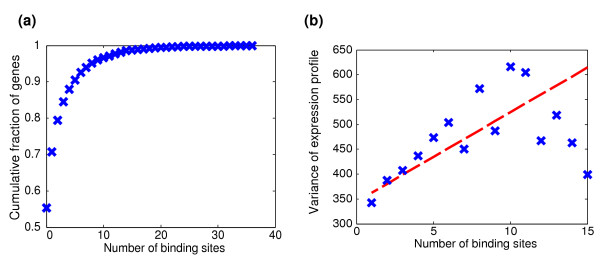
Figure 1
Figure 1
Distribution of binding sites numbers and correlation to gene expression. (a) Cumulative fraction of genes according the number of binding sites in their promoter region. (b) Expression variance averaged over all genes with like number of binding sites in their promoter. The dashed red line shows the best linear fit to the data points.
Figure 2
Figure 2
'Fuzziness' of Reb1 binding sites. Average fit of Reb1 binding sites to the consensus matrix, as a function of the number of binding sites within the promoter they appear in.
Figure 3
Figure 3
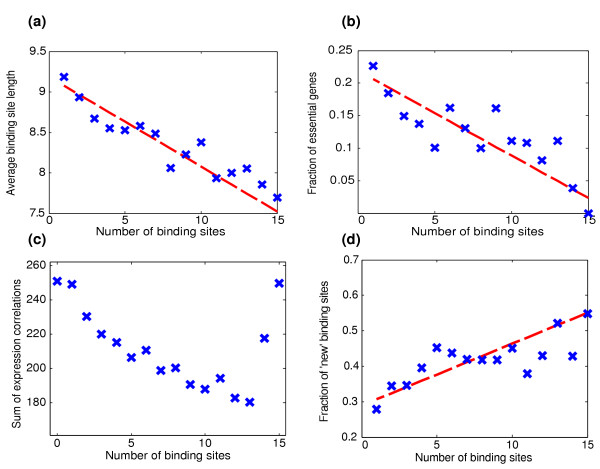
Average promoter and gene properties as a function of the number of binding sites. (a) Average binding site length. (b) Fraction of essential genes. (c) Sum of expression correlations. (d) Fraction of binding sites that are 'new' (not conserved in other species). P values for the displayed correlations are as follows: (a), 10-42; (b), 6 × 10⁻⁷; (c), 10-16; and (d), 10-22. Dashed red lines show the linear line that best matches the data points. Graphs show promoters of up to 15 binding sites. These constitute 97% of the promoters for which data are available.
Figure 4
Figure 4
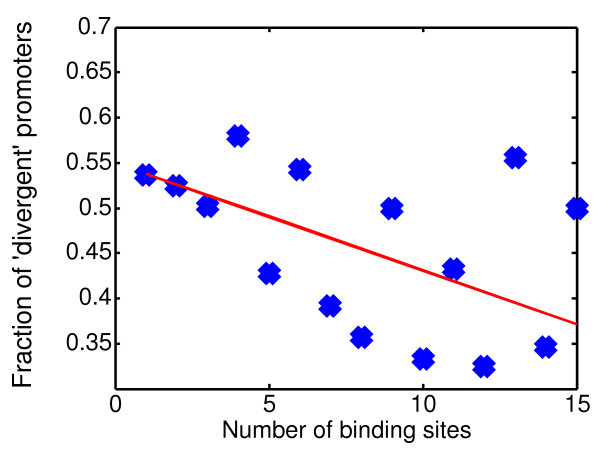
Distribution of 'divergent' promoters. The fraction of promoters that potentially regulate two genes in each subset of promoters with an equal number of binding sites.

References

    1. Robison K, McGuire AM, Church GM. A comprehensive library of DNA-binding site matrices for 55 proteins applied to the complete Escherichia coli K-12 genome. J Mol Biol. 1998;284:241–254. doi: 10.1006/jmbi.1998.2160. - DOI - PubMed
    1. Matys V, Fricke E, Geffers R, Gossling E, Haubrock M, Hehl R, Hornischer K, Karas D, Kel AE, Kel-Margoulis OV, et al. TRANSFAC: transcriptional regulation, from patterns to profiles. Nucleic Acids Res. 2003;31:374–378. doi: 10.1093/nar/gkg108. - DOI - PMC - PubMed
    1. Lisser S, Margalit H. Compilation of E. coli mRNA promoter sequences. Nucleic Acids Res. 1993;21:1507–1516. - PMC - PubMed
    1. Carey M, Smale ST. Transcriptional Regulation in Eukaryotes. Cold Spring Harbor, New York: CSHL Press; 1999.
    1. Struhl K. Fundamentally different logic of gene regulation in eukaryotes and prokaryotes. Cell. 1999;98:1–4. doi: 10.1016/S0092-8674(00)80599-1. - DOI - PubMed

Publication types

MeSH terms

Substances

LinkOut - more resources