. 2005 Dec 15;19(24):2947-52.
doi: 10.1101/gad.1372505.

The Drosophila microRNA iab-4 causes a dominant homeotic transformation of halteres to wings

Affiliations

The Drosophila microRNA iab-4 causes a dominant homeotic transformation of halteres to wings

Matthew Ronshaugen et al. Genes Dev. .

Abstract

The Drosophila Bithorax Complex encodes three well-characterized homeodomain proteins that direct segment identity, as well as several noncoding RNAs of unknown function. Here, we analyze the iab-4 locus, which produces the microRNAs iab-4-5p and iab-4-3p. iab-4 is analogous to miR-196 in vertebrate Hox clusters. Previous studies demonstrate that miR-196 interacts with the Hoxb8 3' untranslated region. Evidence is presented that miR-iab-4-5p directly inhibits Ubx activity in vivo. Ectopic expression of mir-iab-4-5p attenuates endogenous Ubx protein accumulation and induces a classical homeotic mutant phenotype: the transformation of halteres into wings. These findings provide the first evidence for a noncoding homeotic gene and raise the possibility that other such genes occur within the Bithorax complex. We also discuss the regulation of mir-iab-4 expression during development.


Figures
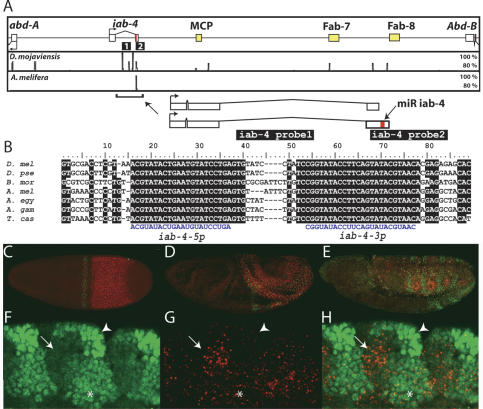
Figure 1.
Figure 1.
Structure, conservation, and expression of the iab-4 miRNA. (A) A 120-kb interval of the D. melanogaster Bithorax Complex that includes the homeobox genes abd-A and Abd-B, the noncoding RNA gene iab-4, and three transcribed boundary elements (MCP, Fab-7, and Fab-8). Shown are VISTA plots depicting highly conserved sequences in the distantly related Drosophilid Drosophila mojaviensis (regions of >80% identity in a window of 50 nt) and the honeybee A. mellifera (regions of >80% identity in a window of 150 nt). Note that all of these conserved regions are associated with transcribed noncoding elements. Depicted at higher magnification are two iab-4 splice forms, an ∼2.1-kb transcript containing the iab-4 miRNA hairpin and a shorter transcript that terminates just 5′ of the miRNAs. The two iab-4 probes used in this study (iab-4 probe1 and iab-4 probe2) are shown as black bars below the schematics in A. (B) Perfect conservation of the iab-4-5p and iab-4-3p miRNAs in diverse arthropods: D. melanogaster (D. mel) D. pseudoobscura (D. pse), Bombyx mori (B. mor), A. mellifera (A. mel), A. aegypti (A. egy), A. gambiae (A. gam), and T. castaneum (T. cas). (C-E) Time course of iab-4 (red) and Ubx (green) nascent transcription: stage 5 (C), stage 8 (D), stage 11 (E). Nascent iab-4 transcription was detected with an intronic probe marked as probe 1 in A. (F-H) Complementary expression of iab-4 RNA (red) and Ubx protein (green) in a stage 12 embryo. Shown is a maximum projection through a sagittal section revealing the ectoderm and underlying mesoderm (approximately five cell layers). Domains of highest Ubx protein levels do not express iab-4 (arrowheads), whereas cells with highest levels of iab-4 do not accumulate Ubx (arrows). Other regions show low levels of coexpression (asterisk).
Figure 2.
Figure 2.
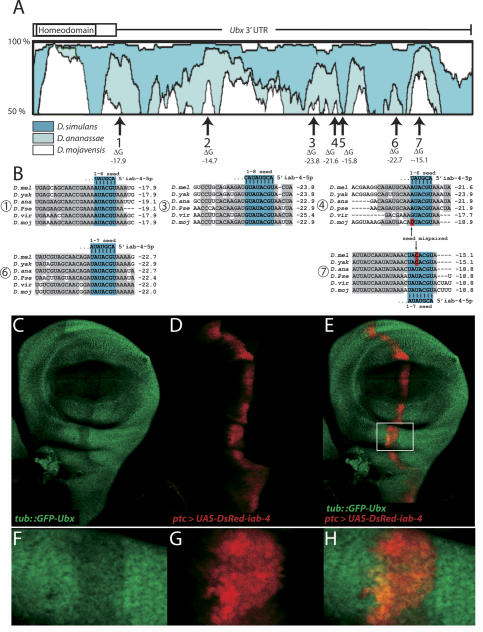
Identification and validation of iab-4-5p target sites in the Ubx 3′ UTR. (A) Conserved regions of the Ubx 3′ UTR revealed by VISTA plots between D. melanogaster and other Drosophilids (dark blue, Drosophila simulans; light blue, D. ananassae; white, D. mojaviensis). All but one of seven putative iab-4-5p target sites (Stark et al. 2003) correspond to islands of conserved sequence (numbered arrows); free energies of predicted iab-4-5p:target duplexes are noted below. (B) Alignments and free energies of likely iab-4-5p target sites from six divergent Drosophilids: D. melanogaster (D. mel), D. yakuba (D. yak), D. ananassae (D. ana), D. pseudoobscura (D. pse), D. virilis (D. vir), and D. mojaviensis (D. moj). Conserved Ubx 3′ UTR sequences are shaded gray; nucleotides that pair with the iab-4-5p seed are shaded blue. Note apparent compensatory mutations between strong/weak sites in different species (in red, arrows). For example, site #4 is likely active in D. melanogaster but inactive in D. mojaviensis, while site #7 probably inactive in D. melanogaster but active in D. mojaviensis. (C-H) Evidence for direct recognition of the Ubx 3′ UTR by iab-4-5p. Shown is expression of a tub-GFP-Ubx 3UTR sensor transgene (green) in a background where a UAS-DsRed-iab-4 transgene has been activated using ptc-Gal4 (red). The Ubx sensor is specifically down-regulated in mir-iab-4-misexpressing cells marked by expression of DsRed. (F-H) Close-ups of the boxed region in E.
Figure 3.
Figure 3.
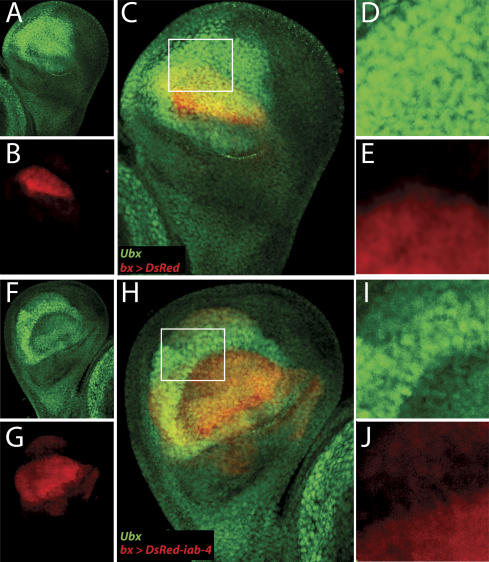
Expression of mir-iab-4 in the haltere disc reduces endogenous Ubx protein accumulation. (A-E) Normal expression of Ubx protein (green) in bx-Gal4/Y; UAS-DsRed/+ haltere discs. (A) Ubx is detected throughout the pouch region of the haltere disc. (B) DsRed (red) marks bx-Gal4 activity in the dorsal compartment of the presumptive haltere pouch. (C) Merge. (D,E) Close-ups of the region boxed in C. (F-H) bx-Gal4/Y; UAS-DsRed-mir-iab-4 haltere disc exhibits reduced accumulation of Ubx protein (green) in the presence of ectopic mir-iab-4 (red). (I,J) Close-ups of the region boxed in H.
Figure 4.
Figure 4.
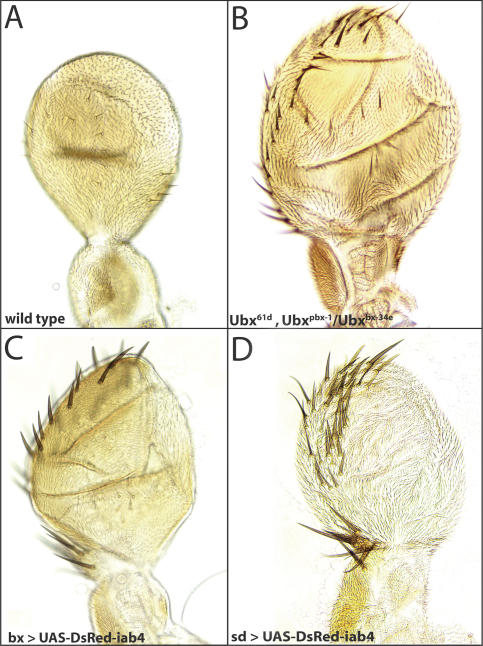
Directed expression of mir-iab-4 induces a homeotic transformation. (A) Wild-type haltere, which contains small lightly pigmented sensilla but lacks the triple row of sensory bristles seen in wings. (B) Haltere-to-wing transformation in a mild Ubx loss-of-function mutant background. Misexpression of iab-4 miRNA hairpin in bx-Gal4/Y; UAS-DsRed-mir-iab-4 (C) and sd-Gal4, UAS-DsRed-mir-iab-4 (D) animals induces a similar haltere-to-wing transformation.
Figure 5.
Figure 5.
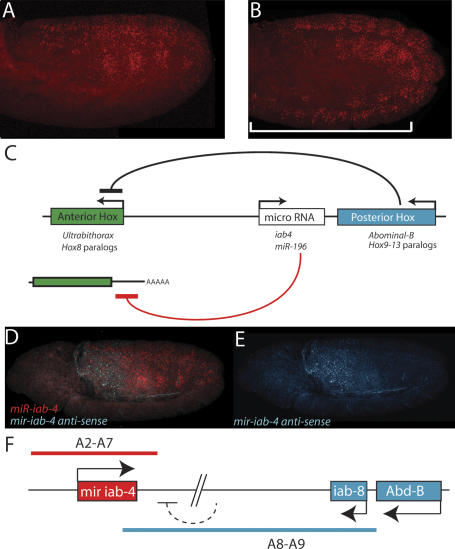
Regulation and function of iab-4. (A,B) Expression of iab-4 in wild-type (A) and Pc1 (B) stage 12 embryos. The domain of iab-4 transcription is expanded anteriorly in the Pc mutant, which correlates with suppression of Ubx activity in this mutant background. (C) Similar regulatory and functional arrangement of the BX-C and the vertebrate HOX clusters. Posteriorly expressed Hox proteins repress the transcription of anterior Hox genes; posteriorly expressed microRNAs (iab-4-5p and iab-4-3p in insects, and miR-196 in vertebrates) repress anterior Hox genes at a post-transcriptional level (either by transcript cleavage or inhibition of productive translation). (D,E) Double RNA FISH staining to localize iab-4 transcripts (red) and a noncoding RNA produced from the opposite strand (blue). The opposite transcript is not detected with iab-4 probes until the onset of germband elongation, presumably due to the time it takes for Pol II to progress from the iab-8 promoter located ∼75 kb away. In germband-elongated embryos the two transcripts are expressed in complementary patterns. The probes used for hybridization reside within 2 kb of one another within the iab-4 transcription unit and are described in Figure 1. (F) Summary of the strand-exclusion model. A large transcript derived from the Abd-B/iab-8 domain might preclude transcription from the iab-4 promoter on the opposite strand.

References

    1. Aravin A.A., Lagos-Quintana, M., Yalcin, A., Zavolan, M., Marks, D., Snyder, B., Gaasterland, T., Meyer, J., and Tuschl, T. 2003. The small RNA profile during Drosophila melanogaster development. Dev. Cell 5: 337-350. - PubMed
    1. Bae E., Calhoun, V.C., Levine, M., Lewis, E.B., and Drewell, R.A. 2002. Characterization of the intergenic RNA profile at Abdominal-A and Abdominal-B in the Drosophila bithorax complex. Proc. Natl. Acad. Sci. 99: 16847-16852. - PMC - PubMed
    1. Barges S., Mihaly, J., Galloni, M., Hagstrom, K., Muller, M., Shanower, G., Schedl, P., Gyurkovics, H., and Karch, F. 2000. The Fab-8 boundary defines the distal limit of the bithorax complex iab-7 domain and insulates iab-7 from initiation elements and a PRE in the adjacent iab-8 domain. Development 127: 779-790. - PubMed
    1. Bartel D.P. 2004. MicroRNAs: Genomics, biogenesis, mechanism, and function. Cell 116: 281-297. - PubMed
    1. Bentwich I., Avniel, A., Karov, Y., Aharonov, R., Gilad, S., Barad, O., Barzilai, A., Einat, P., Einav, U., Meiri, E., et al. 2005. Identification of hundreds of conserved and nonconserved human microRNAs. Nat. Genet. 37: 766-770. - PubMed

Publication types

MeSH terms

LinkOut - more resources