Controlled Clinical Trial
. 2006 Oct;16(10):1462-73.
doi: 10.1093/cercor/bhj087. Epub 2005 Dec 15.

Effects of human cerebellar thalamus disruption on adaptive control of reaching

Affiliations
Controlled Clinical Trial

Effects of human cerebellar thalamus disruption on adaptive control of reaching

Haiyin Chen et al. Cereb Cortex. 2006 Oct.

Abstract

Lesion or degeneration of the cerebellum can profoundly impair adaptive control of reaching in humans. Computational models have proposed that internal models that help control movements form in the cerebellum and influence planned motor output through the cerebello-thalamo-cortical pathway. However, lesion studies of the cerebellar thalamus have not consistently found impairment in reaching or adaptation of reaching. To elucidate the role of the cerebellar thalamus in humans, we studied a group of essential tremor (ET) patients with deep brain stimulation (DBS) electrodes placed in the cerebellar thalamus. The stimulation can be turned on or off remotely and is thought to reduce tremor by blocking the spread of the pathological output from the cerebellum. We studied the effect of thalamic DBS on the ability to adapt arm movements to novel force fields. Although thalamic DBS resulted in a dramatic and significant reduction of tremor in ET, it also impaired motor adaptation: the larger the stimulation voltage, the greater the reduction in rates of adaptation. We next examined ET patients that had undergone unilateral thalamotomy in the cerebellar thalamus and found that adaptation with the contralateral arm was impaired compared with the ipsilateral arm. Therefore, although both lesion and electrical stimulation of the cerebellar thalamus are highly effective in reducing tremor, they significantly impair the ability of the brain to form internal models of action. Adaptive control of reaching appears to depend on the integrity of the cerebello-thalamo-cortical pathway.


Figures
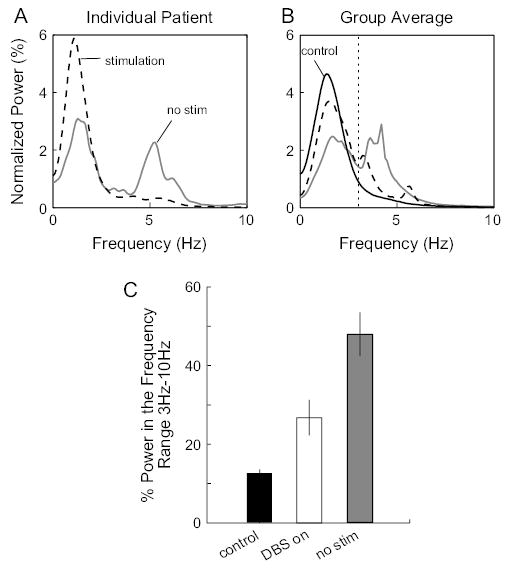
Figure 1
Figure 1
Tremor reduction in DBS patients. (A) Normalized average PSD for trials in the first null set of each experimental session for a DBS patient. With no stimulation, the PSD exhibited a peak centered at 5 Hz. With stimulation, this tremor-associated peak was absent. (B) Group averages of the normalized PSD measured under each stimulation condition were plotted along with the group average PSD for the control subjects (averaged over the 2 sessions). Dotted vertical line marks 3 Hz. The fraction of power in the range of 3–10 Hz (tremor frequency range) was used to quantify tremor amplitude. (C) Average fraction of power in the tremor frequency range for the control group, DBS patients with stimulation, and DBS patients with no stimulation. Error bars are standard errors. Stimulation resulted in significant reduction of tremor power (P = 0.0051).
Figure 2
Figure 2
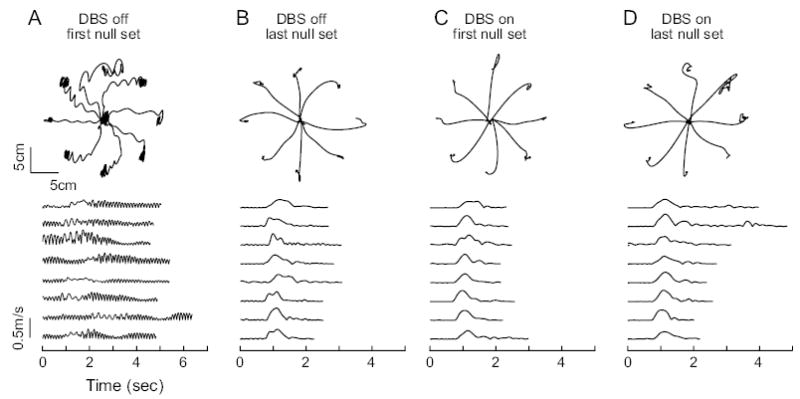
Example of reach trajectories from a DBS patient. Top row: paths of the first movements made in each direction during selected sets. Bottom row: speed profiles of the movements in the top row, corresponding to directions 0°, 45°, . . . , 315° (from top to bottom). (A) Trajectories from the first null set of the no-stimulation session. (B) Trajectories from the last null set of the no-stimulation session. (C) Trajectories from the first null set of the DBS-on session. (D) Trajectories from the last null set of the DBS-on session. With DBS on, the first null set began with dramatically less tremor than the no-stimulation condition. However, in the no-stimulation condition, with the support of the sling at the elbow and increasing familiarity with the task, tremor subsided to levels comparable with DBS on.
Figure 3
Figure 3
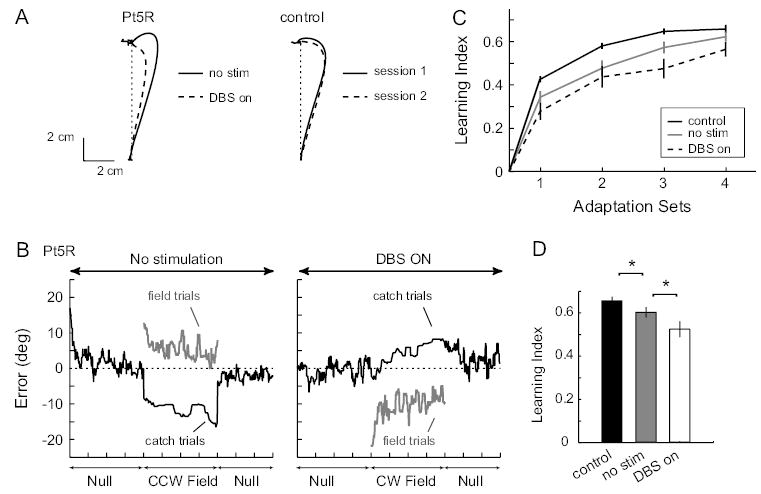
Effect of DBS on motor adaptation. (A) Average catch trial trajectories of a DBS patient and a control subject. Trials were taken from the last adaptation set of each session and were rotated to a canonical direction before averaging. Trials from the session where a clockwise force field was given are inverted for ease of visual comparison. (B) Performance of a DBS patient with stimulation (left) and with out stimulation (right). Shown here are moving averages (window size = 15) of angular error for all trials in each session. The patient achieved significantly higher catch trial errors and lower field trial errors with DBS off than DBS on. (C) Average learning index for each adaptation set is shown for the control group and each stimulation condition for the patient group. Error bars are standard errors. (D) Summary of performance: the average learning index over the last 2 adaptation sets for each subject group. With no stimulation, patients showed reduced learning index compared with control subjects (P = 0.025). With DBS turned on, an additional reduction in learning was observed (P = 0.024).
Figure 4
Figure 4
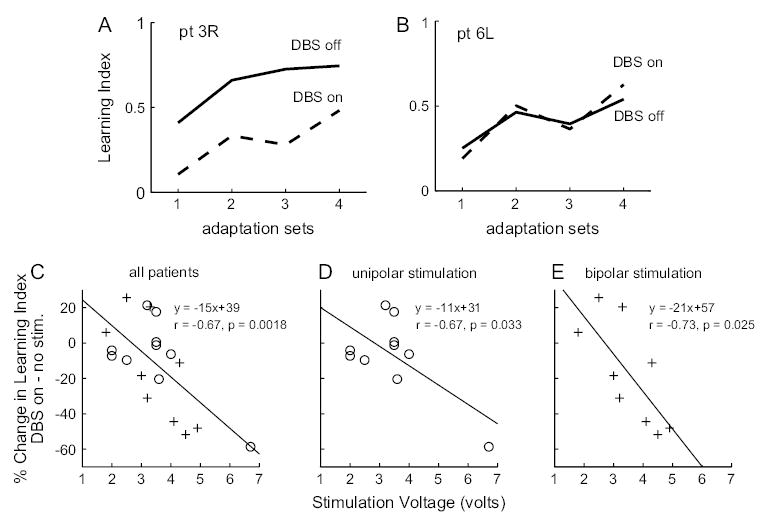
Relationship between stimulation voltage and adaptation impairment. (A) Performance by a patient whose stimulation voltage for the DBS was set at 4.9 V. (B) Performance by a patient whose stimulation voltage was set at 1.8 V. (C) Percent change in learning index (DBS on − no stim.) as a function of stimulation voltage for all 19 DBS cases. Circles indicate patients with unipolar stimulation, and pluses indicate patients with bipolar stimulation. (D, E) Relationship between stimulation voltage and percent change in learning index fit separately for patients with unipolar and bipolar stimulations.
Figure 5
Figure 5
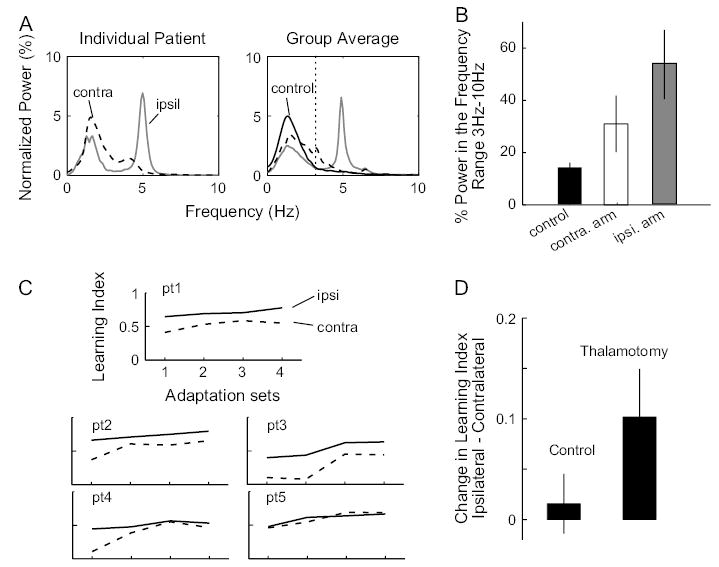
Effect of thalamotomy on tremor and motor adaptation. (A) Left: normalized average PSD for all trials in the first null set of each session for a thalamotomy patient. PSD for the untreated arm, ipsilateral to the thalamotomy, has a tremor-associated peak at 5 Hz. In the treated arm, contralateral to thalamotomy, this peak is greatly reduced. Right: group averages of normalized PSD for the patients’ ipsilateral arms and contralateral arms, as well as the control subjects’ (average of the 2 arms). Dotted vertical line marks 3 Hz, as in Figure 1A. (B) Group average of fractional power in the tremor frequency range (3–10 Hz) for the control subjects and the ipsilateral and the contralateral arms of the patients. Error bars are standard errors. (C) Performance of each thalamotomy patient quantified by learning index. Solid line indicates performance of the ipsilateral arm and dotted line that of the contralateral arm. (D) Average between-arm change in learning index for the patient group (ipsilateral – contralateral) and the control group (session 1 – session 2). Only learning indices from the last 2 adaptation sets are used. Thalamotomy patients show a significant decrease in adaptation in the contralateral arm (P = 0.038).

References

    1. Anderson ME, Postupna N, Ruffo M. Effects of high-frequency stimulation in the internal globus pallidus on the activity of thalamic neurons in the awake monkey. J Neurophysiol. 2003;89:1150–1160. - PubMed
    1. Bastian AJ, Martin TA, Keating JG, Thach WT. Cerebellar ataxia: abnormal control of interaction torques across multiple joints. J Neurophysiol. 1996;76:492–509. - PubMed
    1. Ceballos-Baumann AO, Boecker H, Fogel W, Alesch F, Bartenstein P, Conrad B, Diederich N, von Falkenhayn I, Moringlane JR, Schwaiger M, Tronnier VM. Thalamic stimulation for essential tremor activates motor and deactivates vestibular cortex. Neurology. 2001;56:1347–1354. - PubMed
    1. Conrad B, Matsunami K, Meyer-Lohmann J, Wiesendanger M, Brooks VB. Cortical load compensation during voluntary elbow movements. Brain Res. 1974;71:507–514. - PubMed
    1. Deuschl G, Bergman H. Pathophysiology of nonparkinsonian tremors. Mov Disord. 2002;17(Suppl 3):S41–S48. - PubMed

Publication types