


Pediatric brain natriuretic peptide and N-terminal pro-brain natriuretic peptide reference intervals
- PMID: 16360137
- PMCID: PMC3636975
- DOI: 10.1016/j.cca.2005.11.005
Pediatric brain natriuretic peptide and N-terminal pro-brain natriuretic peptide reference intervals
Abstract
Background: Brain natriuretic peptide (BNP) and N-terminal pro-brain natriuretic peptide (NT-proBNP) have been shown to be useful biomarkers for the diagnosis of heart failure. Pediatric reference intervals for these analytes have been reported in part. Previous studies lack large numbers in each group, have not covered all age ranges and have not compared results for BNP with NT-proBNP in simultaneously drawn samples.
Methods: We measured BNP in whole blood using the Biosite Triage point-of-care method and plasma NT-proBNP using the Dade RxL Dimension. We assessed between and within-day precision of both methods and after removing outliers employed the Hoffmann approach to calculate pediatric reference intervals over the age range of 0-21 y. We also compared the 2 methods on simultaneously drawn samples.
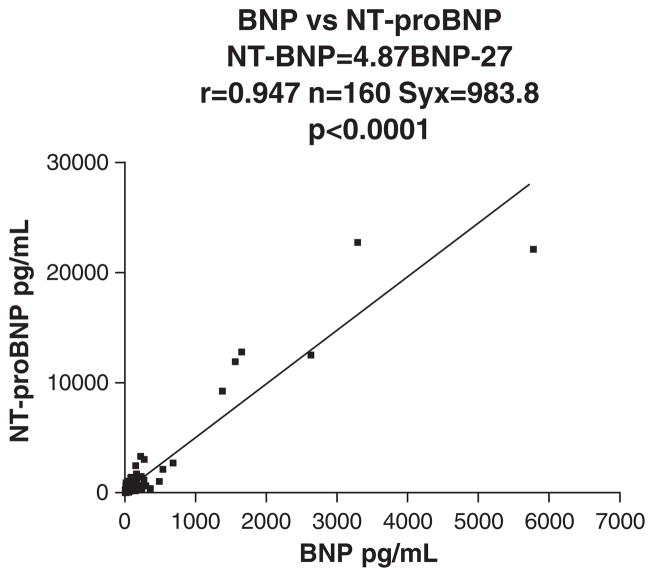
Results: Reference intervals revealed approximately 20-fold higher 97.5th percentiles for neonates than for children >3 y of age. 97.5th percentiles decreased significantly over the first 3 years of life. As shown by others, the CVs for the automated Dade RxL platform were somewhat lower than those for the POCT method. BNP and NT-proBNP correlated well in simultaneously drawn samples (r=0.947).
Discussion: Reference intervals for BNP and NT-proBNP are far higher in neonates and infants than in children older than three years of age. The reasons for this are unknown but resemble the elevated CK-MBs and troponins also found in neonates, although the 97.5th percentiles for these latter 2 cardiac markers decrease more rapidly to values found in older children by 6 months of age.
Figures
References
-
- Maisel AS, Zoorob R. American Academy of Family Physicians. 2004. B-type natriuretic peptide in congestive heart failure diagnosis and management.
-
- Zoorob RJ, Campbell JS. Acute dyspnea in the office. Am Fam Physician. 2003;68:1803– 10. - PubMed
-
- National Guideline Clearinghouse. Complete summary: inpatient management of heart failure. Institute for Clinical Systems Improvement; National Institutes of Health; Updated 2004 Feb. http://www.guideline.gov/summary. Heart failure. Updated 2004 Jun 19.
-
- Elin RJ, Winter WE. Laboratory and clinical aspects of B-type natriuretic peptides. Arch Pathol Lab Med. 2004;128:697– 9. - PubMed
-
- Chenevier-Gobeaux C, Claessens YE, Voyer S, Desmoulins D, Ekindjian OG. Influence of renal function on N-terminal pro-brain natriuretic peptide (NT-proBNP) in patients admitted for dyspnoea in the Emergency Department: comparison with brain natriureticpeptide (BNP) Clin Chim Acta. 2005;361:167– 75. - PubMed
Publication types
MeSH terms
Substances
Grants and funding
LinkOut - more resources
Full Text Sources
Other Literature Sources
Research Materials
