. 2005 Dec;1(7):e68.
doi: 10.1371/journal.pcbi.0010068. Epub 2005 Dec 16.

The activity reaction core and plasticity of metabolic networks

Affiliations

The activity reaction core and plasticity of metabolic networks

Eivind Almaas et al. PLoS Comput Biol. 2005 Dec.

Abstract

Understanding the system-level adaptive changes taking place in an organism in response to variations in the environment is a key issue of contemporary biology. Current modeling approaches, such as constraint-based flux-balance analysis, have proved highly successful in analyzing the capabilities of cellular metabolism, including its capacity to predict deletion phenotypes, the ability to calculate the relative flux values of metabolic reactions, and the capability to identify properties of optimal growth states. Here, we use flux-balance analysis to thoroughly assess the activity of Escherichia coli, Helicobacter pylori, and Saccharomyces cerevisiae metabolism in 30,000 diverse simulated environments. We identify a set of metabolic reactions forming a connected metabolic core that carry non-zero fluxes under all growth conditions, and whose flux variations are highly correlated. Furthermore, we find that the enzymes catalyzing the core reactions display a considerably higher fraction of phenotypic essentiality and evolutionary conservation than those catalyzing noncore reactions. Cellular metabolism is characterized by a large number of species-specific conditionally active reactions organized around an evolutionary conserved, but always active, metabolic core. Finally, we find that most current antibiotics interfering with bacterial metabolism target the core enzymes, indicating that our findings may have important implications for antimicrobial drug-target discovery.


Conflict of interest statement

Competing interests. The authors have declared that no competing interests exist.

Figures

Figure 1
Figure 1. The Emergence of the Metabolic Core
(A–C) The average relative size of the number of reactions that are always active as a function of the number of sampled conditions (black line) for (A) H. pylori, (B) E. coli, and (C) S. cerevisiae. As the number of conditions increases, the curve converges to a constant denoted by the dashed line, identifying the metabolic core of an organism. The red line denotes the number of reactions that are always active if activity is randomly distributed in the metabolic network. The fact that it converges to zero indicates that the real core represents a collective network effect, forcing a group of reactions to be active in all conditions. (D and E) The number of metabolic reactions (D) and the number of metabolic core reactions (E) in the three studied organisms.
Figure 2
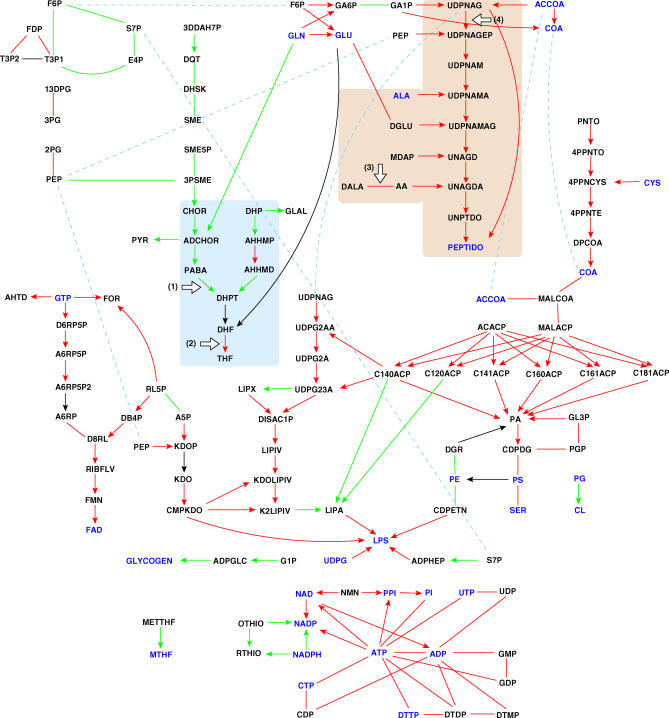
Figure 2. The Metabolic Core of E. coli
All reactions that are found to be active in each of the 30,000 investigated external conditions are shown. Metabolites that contribute directly to biomass formation [8] are colored blue, while core reactions (links) catalyzed by essential (or nonessential) enzymes [13] are colored red (or green). (Black-colored links denote enzymes with unknown deletion phenotype.) The blue dashed lines indicate multiple appearances of a metabolite, while links with arrows denote unidirectional reactions. Note that 20 out of the 51 metabolites necessary for biomass synthesis are not present in the core, indicating that they are produced (or consumed) in a growth-condition-specific manner. See Protocol S1 and Table S1 for the abbreviations of metabolites and a list of core reactions for E. coli, H. pylori, and S. cerevisiae. The folate and peptidoglycan biosynthesis pathways are indicated by blue and brown shading, respectively, and the white numbered arrows denote current antibiotic targets inhibited by: (1) sulfonamides, (2) trimethoprim, (3) cycloserine, and (4) fosfomycin. Note that a few reactions appear disconnected since we have omitted the drawing of cofactors.
Figure 3
Figure 3. Characterizing the Metabolic Cores
(A) The number of overlapping metabolic reactions in the metabolic core of H. pylori, E. coli, and S. cerevisiae. (B) The fraction of metabolic reactions catalyzed by essential enzymes in the cores (black) and outside the core in E. coli and S. cerevisiae. (C) The distribution of average metabolic fluxes for the core and the noncore reactions in E. coli.
Figure 4
Figure 4. Correlations among E. coli Metabolic Reactions
(A) We calculated the Pearson correlation using flux values from 30,000 conditions for each reaction pair before grouping the reactions according to a hierarchical average-linkage clustering algorithm. The values of the flux-correlation matrix range from −1 (red) through 0 (white) to unity (blue). The horizontal color bar denotes if a reaction is a member of the core (green), and the vertical color bar denotes whether the enzymes catalyzing the reaction are essential (red). (B) Distribution of Pearson correlation in mRNA copy numbers from 41 experiments [14]. The correlations of the core reactions are clearly shifted towards higher values, with an average correlation coefficient of = 0.23 compared with the average noncore coefficient of = 0.07

References

    1. Edwards JS, Palsson BO. The Escherichia coli MG1655 in silico metabolic genotype: Its definition, characteristics, and capabilities. Proc Natl Acad Sci U S A. 2000;97:5528–5533. - PMC - PubMed
    1. Schilling CH, Letscher D, Palsson BO. Theory for the systemic definition of metabolic pathways and their use in interpreting metabolic function from a pathway-oriented perspective. J Theor Biol. 2000;203:229–248. - PubMed
    1. Almaas E, Kovács B, Vicsek T, Oltvai ZN, Barabási AL. Global organization of metabolic fluxes in the bacterium Escherichia coli . Nature. 2004;427:839–843. - PubMed
    1. Burgard AP, Nikolaev EV, Schilling CH, Maranas CD. Flux coupling analysis of genome-scale metabolic reconstructions. Genome Res. 2004;14:301–312. - PMC - PubMed
    1. Reed JL, Palsson BO. Genome-scale in silico models of E. coli have multiple equivalent phenotypic states: Assessment of correlated reaction subsets that comprise network states. Genome Res. 2004;14:1797–1805. - PMC - PubMed

Publication types

MeSH terms

LinkOut - more resources