Expression of mutant huntingtin in glial cells contributes to neuronal excitotoxicity
- PMID: 16365166
- PMCID: PMC2171327
- DOI: 10.1083/jcb.200508072
Expression of mutant huntingtin in glial cells contributes to neuronal excitotoxicity
Erratum in
- J Cell Biol. 2006 Mar 13;172(6):953
Abstract
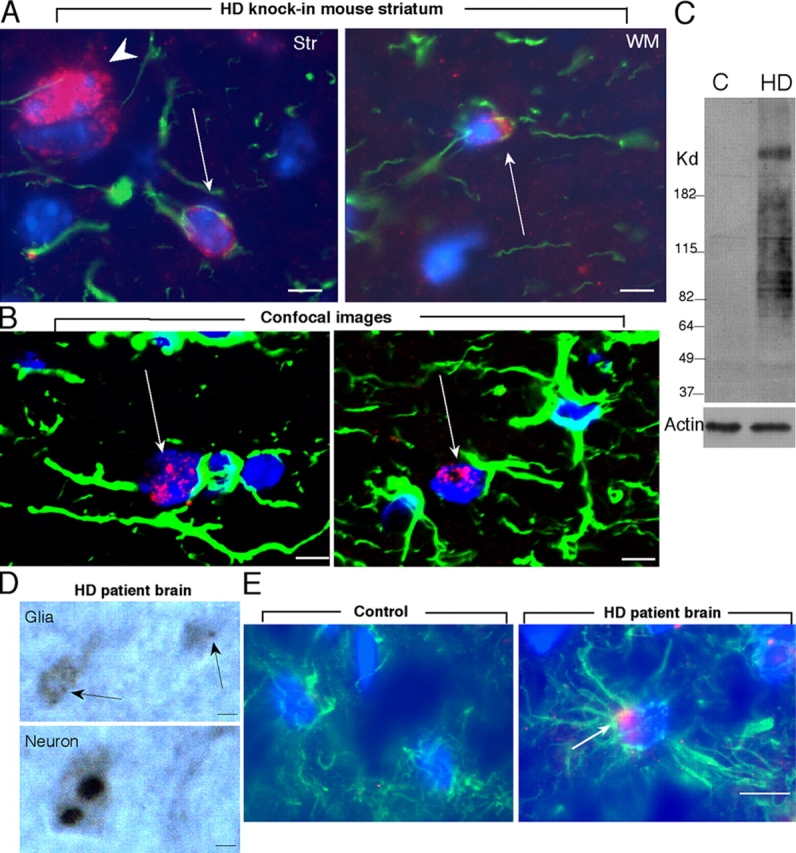
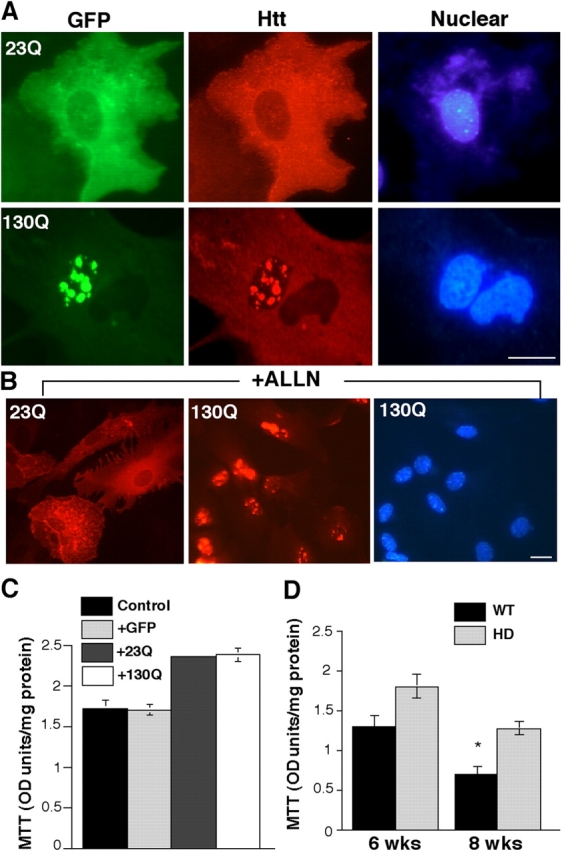
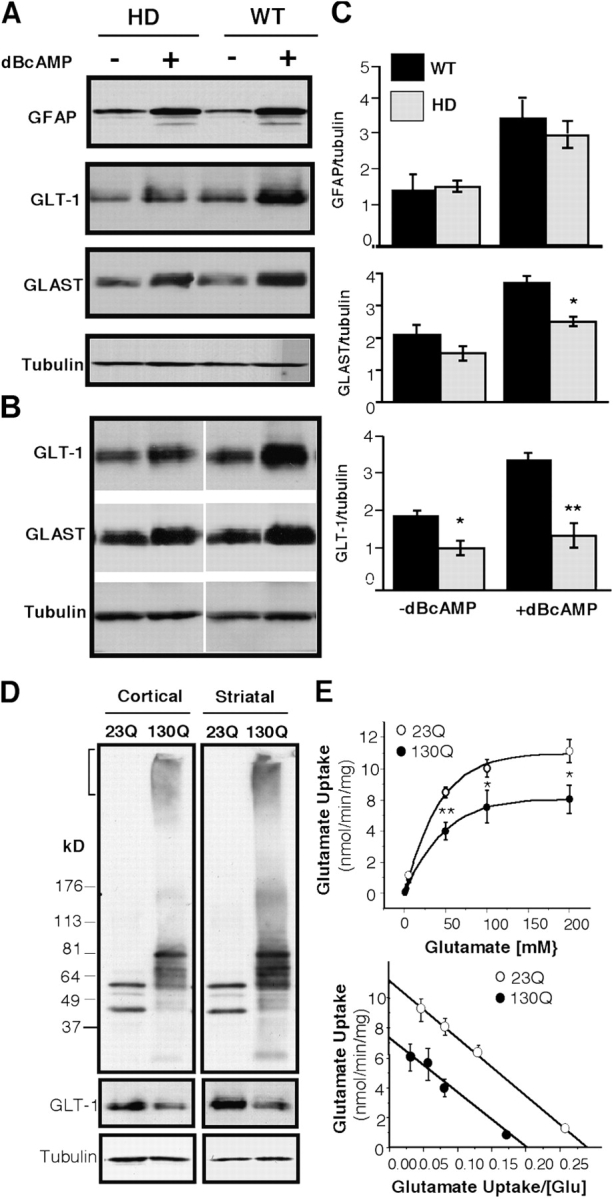
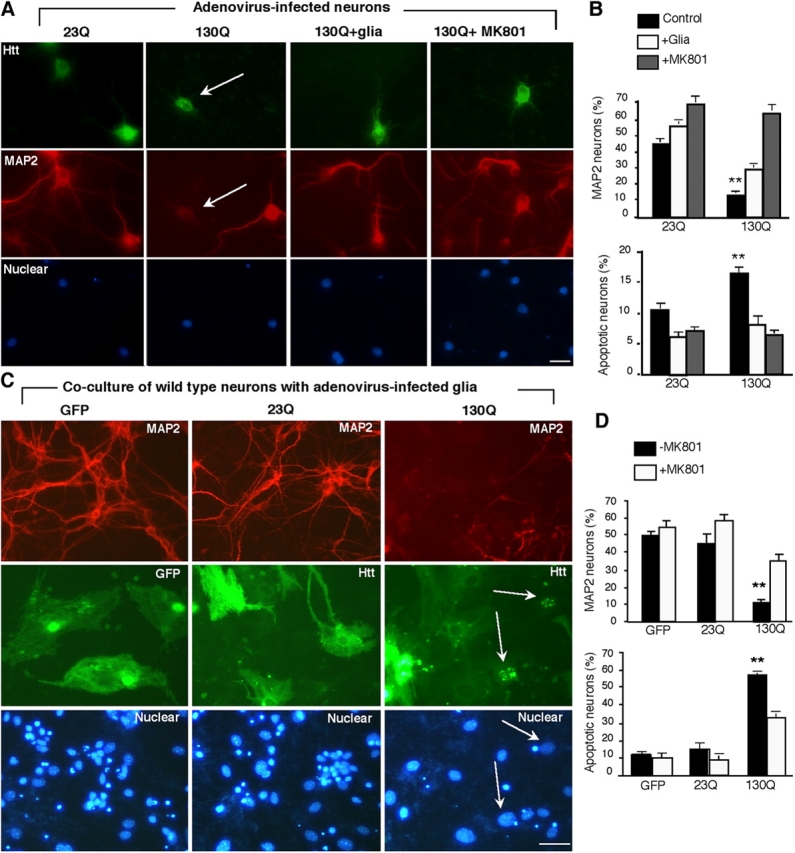
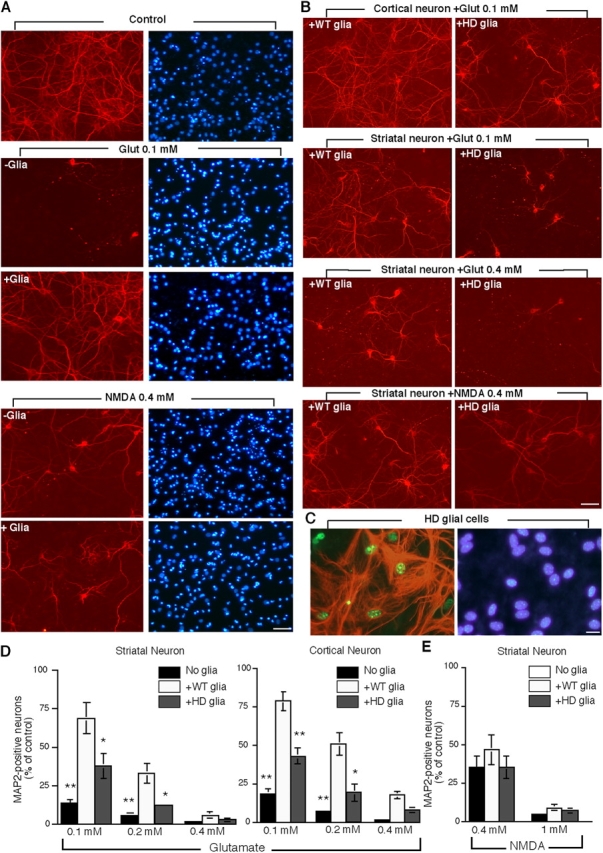
Huntington disease (HD) is characterized by the preferential loss of striatal medium-sized spiny neurons (MSNs) in the brain. Because MSNs receive abundant glutamatergic input, their vulnerability to excitotoxicity may be largely influenced by the capacity of glial cells to remove extracellular glutamate. However, little is known about the role of glia in HD neuropathology. Here, we report that mutant huntingtin accumulates in glial nuclei in HD brains and decreases the expression of glutamate transporters. As a result, mutant huntingtin (htt) reduces glutamate uptake in cultured astrocytes and HD mouse brains. In a neuron-glia coculture system, wild-type glial cells protected neurons against mutant htt-mediated neurotoxicity, whereas glial cells expressing mutant htt increased neuronal vulnerability. Mutant htt in cultured astrocytes decreased their protection of neurons against glutamate excitotoxicity. These findings suggest that decreased glutamate uptake caused by glial mutant htt may critically contribute to neuronal excitotoxicity in HD.
Figures
References
-
- Beal, M.F. 1994. Huntington's disease, energy, and excitotoxicity. Neurobiol. Aging. 15:275–276. - PubMed
-
- Behrens, P.F., P. Franz, B. Woodman, K.S. Lindenberg, and G.B. Landwehrmeyer. 2002. Impaired glutamate transport and glutamate-glutamine cycling: downstream effects of the Huntington mutation. Brain. 125:1908–1922. - PubMed
-
- Calabresi, P., D. Centonze, A. Pisani, G. Sancesario, P. Gubellini, G.A. Marfia, and G. Bernardi. 1998. Striatal spiny neurons and cholinergic interneurons express differential ionotropic glutamatergic responses and vulnerability: implications for ischemia and Huntington's disease. Ann. Neurol. 43:586–597. - PubMed
-
- Cepeda, C., M.A. Ariano, C.R. Calvert, J. Flores-Hernandez, S.H. Chandler, B.R. Leavitt, M.R. Hayden, and M.S. Levine. 2001. NMDA receptor function in mouse models of Huntington disease. J. Neurosci. Res. 66:525–539. - PubMed
-
- Clement, A.M., M.D. Nguyen, E.A. Roberts, M.L. Garcia, S. Boillee, M. Rule, A.P. McMahon, W. Doucette, D. Siwek, R.J. Ferrante, et al. 2003. Wild-type nonneuronal cells extend survival of SOD1 mutant motor neurons in ALS mice. Science. 302:113–117. - PubMed
Publication types
MeSH terms
Substances
Grants and funding
LinkOut - more resources
Full Text Sources
Other Literature Sources
Molecular Biology Databases
Research Materials