Comparative Study
. 2006 Feb;16(2):197-207.
doi: 10.1101/gr.4108706. Epub 2005 Dec 19.

Defining the mammalian CArGome

Affiliations
Comparative Study

Defining the mammalian CArGome

Qiang Sun et al. Genome Res. 2006 Feb.

Abstract

Serum response factor (SRF) binds a 1216-fold degenerate cis element known as the CArG box. CArG boxes are found primarily in muscle- and growth-factor-associated genes although the full spectrum of functional CArG elements in the genome (the CArGome) has yet to be defined. Here we describe a genome-wide screen to further define the functional mammalian CArGome. A computational approach involving comparative genomic analyses of human and mouse orthologous genes uncovered >100 hypothetical SRF-dependent genes, including 10 previously identified SRF targets, harboring a conserved CArG element within 4000 bp of the annotated transcription start site (TSS). We PCR-cloned 89 hypothetical SRF targets and subjected each of them to at least two of several validations including luciferase reporter, gel shift, chromatin immunoprecipitation, and mRNA expression following RNAi knockdown of SRF; 60/89 (67%) of the targets were validated. Interestingly, 26 of the validated SRF target genes encode for cytoskeletal/contractile or adhesion proteins. RNAi knockdown of SRF diminishes expression of several SRF-dependent cytoskeletal genes and elicits an attending perturbation in the cytoarchitecture of both human and rodent cells. These data illustrate the power of integrating existing algorithms to interrogate the genome in a relatively unbiased fashion for cis-regulatory element discovery. In this manner, we have further expanded the mammalian CArGome with the discovery of an array of cyto-contractile genes that coordinate normal cytoskeletal homeostasis. We suggest one function of SRF is that of an ancient master regulator of the actin cytoskeleton.


Figures
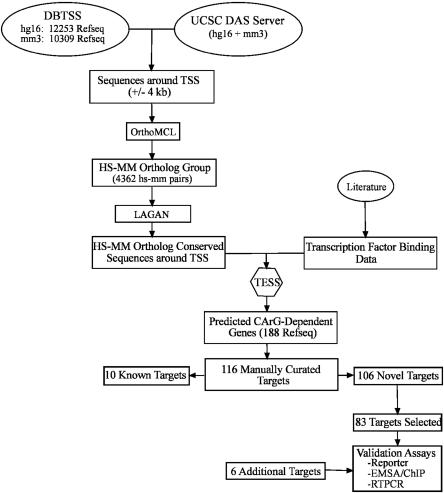
Figure 1.
Figure 1.
General strategy for defining the mammalian CArGome. Bioinformatics pipeline for evaluating mouse and human orthologous pairs of genes having accurately annotated TSS for the presence of conserved CArG boxes predicted either computationally (83) or manually (six) as described in Methods.
Figure 2.
Figure 2.
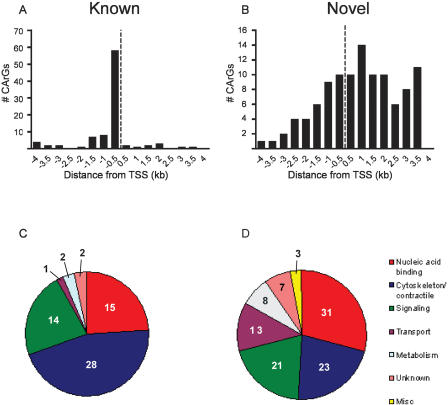
Features of novel CArG-containing genes. Comparison of (A,C) known and (B,D) computationally predicted CArG elements and corresponding genes with respect to distance from TSS (A vs. B) and GO annotation (C vs. D), respectively. Note broad distribution of predicted CArG elements around the TSS (B) as compared to known CArG boxes (A). Dotted vertical lines in A and B indicate the TSS.
Figure 3.
Figure 3.
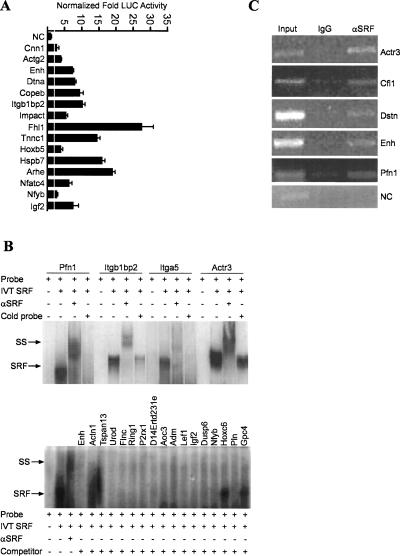
Functional validation studies of CArG-containing sequences. (A) Representative luciferase assay results for a sample of computer-predicted CArG sequences (13 novel and two known) in C2C12 myoblasts. The white vertical line across bars indicates the experimentally defined threshold for scoring a target CArG sequence as positive over the value obtained from a collection of negative controls (see Methods); (NC) negative control is the tk promoter-linked luciferase plasmid only. (B) Representative in vitro SRF-binding assays for predicted CArG sequences. (Top panel) The results of radiolabeled target sequences binding to in vitro translated (IVT) SRF. Note supershift of each nucleoprotein complex with antibody to SRF. Addition of unlabeled target DNA attenuates the nucleoprotein signal. (Bottom panel) A cold competition EMSA in which a radiolabeled probe containing the CArG sequence CCTTATTTGG was incubated with IVT SRF in the absence or presence of a molar excess of each target CArG-containing sequence. The results indicate that all target sequences except Hoxc6 and Gpc4 compete with labeled CArG probe for binding to IVT SRF, thus reducing the signal intensity of the nucleoprotein complex. The smearing below Actn1 and Tspan13 is an artifact of the gel. (C) ChIP assay results for a select group of novel SRF targets showing an enriched PCR product from cross-linked DNA immunoprecipitated with SRF antibody. No detectable PCR product is seen for a region of a negative control sequence (NC) corresponding to the Myocd gene, which does not contain any CArG sequences. Moreover, little or no amplified product is observed for any of the CArG targets when an IgG control antibody is used to immunoprecipitate cross-linked DNA.
Figure 4.
Figure 4.
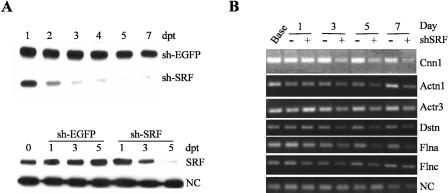
shRNA knockdown of SRF and novel CArG-containing target genes. (A) shRNA knockdown of endogenous SRF in A7r5 rat vascular smooth muscle cells (upper panel) and human coronary artery smooth muscle cells (HCASMC, lower panel). Cells were transduced with adenovirus carrying either a short hairpin (sh) to EGFP or SRF and total cell lysates harvested at the indicated days post-transduction (dpt) for Western blotting of SRF protein levels. Note the virtual absence of detectable SRF 5 dpt in both cell types; (NC) negative control protein Tuba whose gene does not contain functional CArG boxes. (B) Linear RT-PCR results showing shSRF-mediated suppression of Cnn1, Actn1, Actr3, Dstn, Flna, and Flnc mRNA expression in A7r5 smooth muscle cells. shSRF has little effect on the negative control (NC) gene Tuba, a gene that is not SRF-dependent.
Figure 5.
Figure 5.
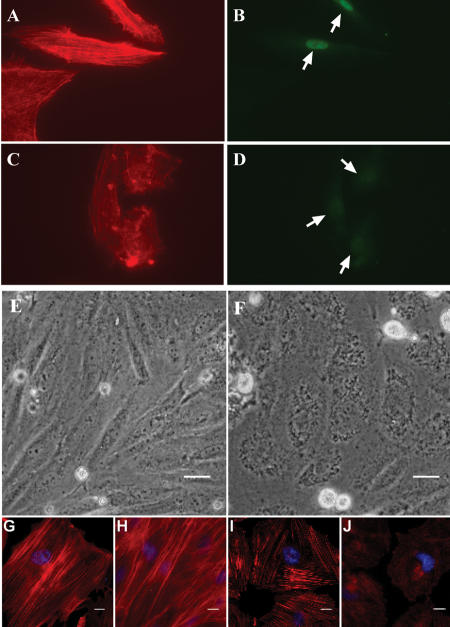
The actin cytoskeleton is dependent on SRF. (A,B,C,D) Human umbilical vein endothelial cells virally transduced for 5 d with either (A,B) shEGFP or (C,D) shSRF and then stained with phalloidin for (A,C) actin cytoskeleton or (B,D) a fluorescently tagged antibody to SRF. Arrows indicate nuclear staining for SRF. (E,F) Phase contrast micrographs of rat A7r5 smooth muscle cells transduced with (E) shEGFP or (F) shSRF for 3 d. Note the loss of cell definition in shSRF-transduced cells. This change is readily apparent by this time and remained apparent as long as 7 d post-transduction (not shown); size bars, 20 μm. (G,H) Normal cytoskeleton in A7r5 cells transduced with shEGFP for 3 and 5 d, respectively. As with human endothelial cells above, shSRF results in an alteration in normal cytoarchitecture (I) 3 d and (J) 5 d post-transduction. Note the shorter filament length, altered filament orientation, and overall lower phalloidin staining intensity in Ad-shSRF cells as compared to controls. The microtubule network in both shSRF and shEGFP transduced cells was similar, indicating the effect of shSRF is specific to the actin cytoskeleton (data not shown). Size bars, 10 μm.
Figure 6.
Figure 6.
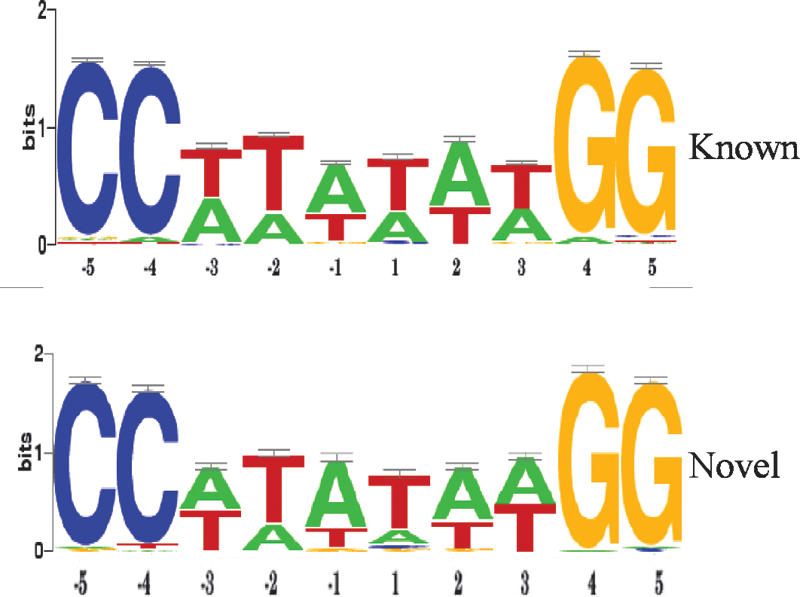
Sequence similarity of novel SRF targets with known CArGome. Sequence Logos of known and novel SRF-binding sequences show a high level of similarity in preferred base composition across the CArG element. Sequence Logos were generated from 92 known CArG sequences and compared to the 60 novel CArG sequences reported here (see Table 2).
Figure 7.
Figure 7.
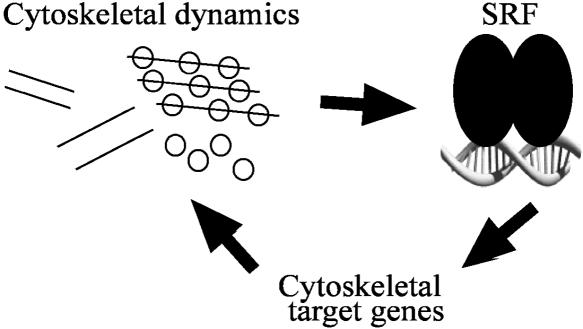
Autoregulatory loop for SRF-dependent cytoskeletal target gene activation. The schematic models a positive feedback mechanism for SRF-mediated cytoskeletal gene expression wherein actin dynamics stimulate SRF activity, which, in turn, activates genes encoding the cytoskeletal apparatus. We propose this feedback loop is an ancient mechanism for SRF-dependent regulation of normal cytoskeletal homeostasis, which, in turn, is requisite for SRF activity.

References

    1. Alberti, S., Krause, S.M., Kretz, O., Philippar, U., Lemberger, T., Casanova, E., Wiebel, F.F., Schwarz, H., Frotscher, M., Schutz, G., et al. 2005. Neuronal migration in the murine rostral migratory stream requires serum response factor. Proc. Natl. Acad. Sci. 102 6148-6153. - PMC - PubMed
    1. Arsenian, S., Weinhold, B., Oelgeschlager, M., Ruther, U., and Nordheim, A. 1998. Serum response factor is essential for mesoderm formation during mouse embryogenesis. EMBO J. 17 6289-6299. - PMC - PubMed
    1. Ashburner, M., Ball, C.A., Blake, J.A., Botstein, D., Butler, H., Cherry, J.M., Davis, A.P., Dolinski, K., Dwight, S.S., Eppig, J.T., et al. 2000. Gene ontology: Tool for the unification of biology. Nat. Genet. 25 25-29. - PMC - PubMed
    1. Blais, A., Tsikitis, M., Acosta-Alvear, D., Sharan, R., Kluger, Y., and Dynlacht, B.D. 2005. An initial blueprint for myogenic differentiation. Genes & Dev. 19 553-569. - PMC - PubMed
    1. Boffelli, D., McAuliffe, J., Ovcharenko, D., Lewis, K.D., Ovcharenko, I., Pachter, L., and Rubin, E.M. 2003. Phylogenetic shadowing of primate sequences to find functional regions of the human genome. Science 299 1391-1394. - PubMed

Publication types

Substances

LinkOut - more resources