


Role of Cys-603 in dimer/oligomer formation of the breast cancer resistance protein BCRP/ABCG2
- PMID: 16367905
- PMCID: PMC11159771
- DOI: 10.1111/j.1349-7006.2005.00126.x
Role of Cys-603 in dimer/oligomer formation of the breast cancer resistance protein BCRP/ABCG2
Abstract
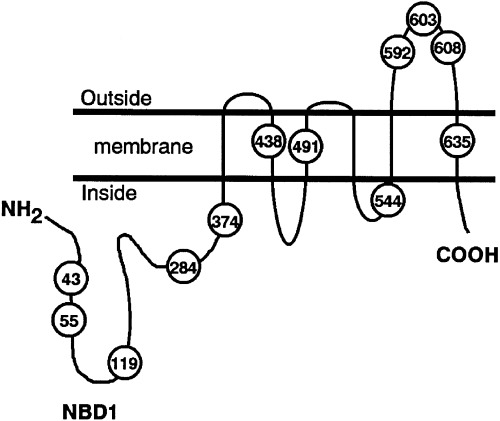
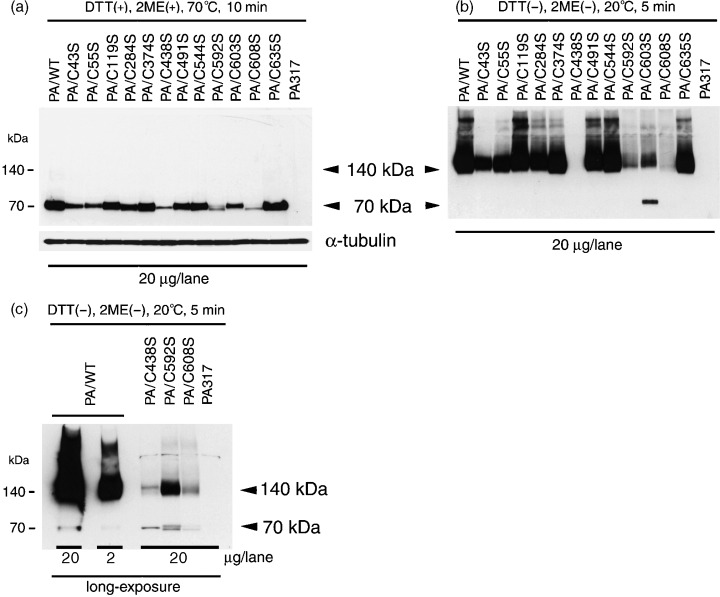
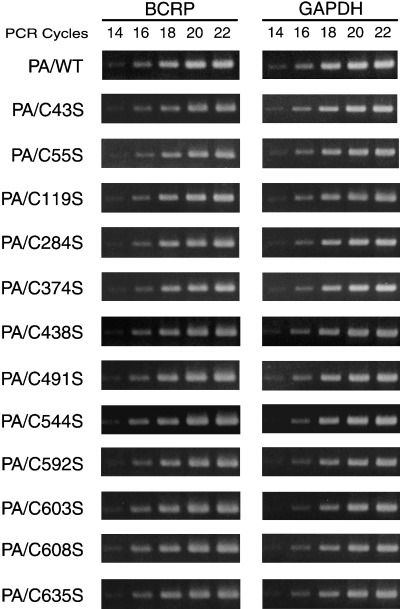
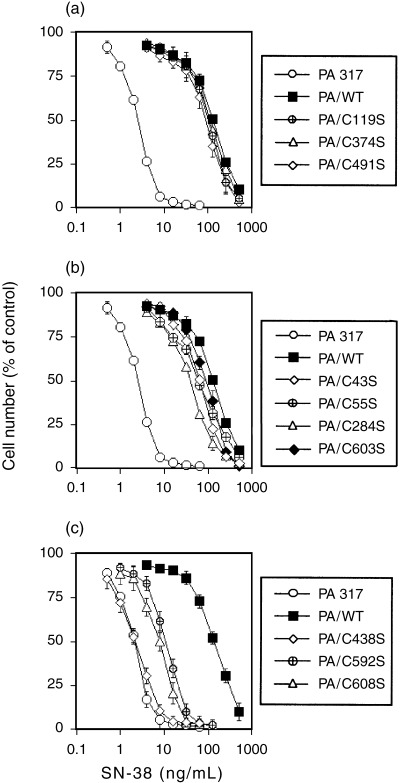
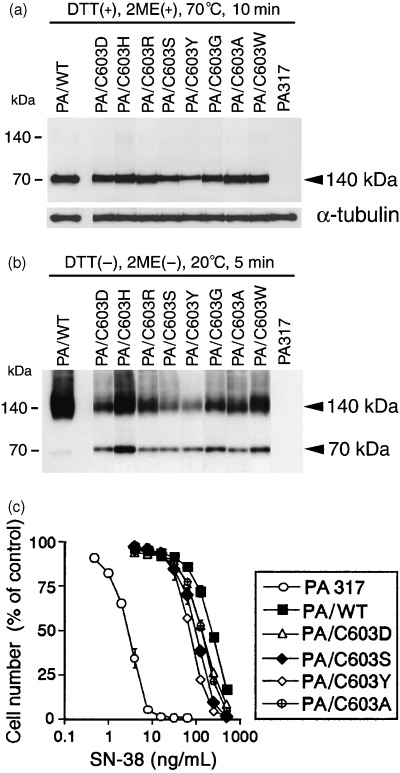
Breast cancer resistance protein (BCRP/ABCG2) is a half-molecule ATP-binding cassette transporter that we have previously suggested might function as a homodimer, bridged by disulfide bonds. In the present study, we carried out cysteine-scanning mutagenesis, substituting Ser for Cys, and established 12 PA317 transfectants expressing BCRP mutants with possible disruptions to their S-S bonds. Western blot analysis of BCRP from the wild-type transfectants (PA/WT) confirmed that the wild-type protein migrates as a 140-kDa dimer under non-reducing conditions, but as a 70-kDa monomer under reducing conditions. However, under non-reducing conditions the BCRP-C603S mutant migrated both as a 70-kDa monomer and a 140-kDa dimer, whereas all other mutant BCRP migrated only as dimers. PA317 cells transfected with C603S-BCRP (PA/C603S) showed either similar or only marginally lower SN-38 resistance than PA/WT cells, despite the reduced levels of BCRP dimer in these cells. Moreover, the degree of SN-38 resistance in the mutant BCRP transfectants was found to be associated with the monomer expression levels under reducing conditions. Reverse transcription-polymerase chain reaction analysis showed that the BCRP mRNA levels were similar in the transfectants. We subsequently generated six C603X mutants of BCRP (X=D, H, R, Y, A and W) and carried out western blot analysis and drug sensitivity assays. The results were equivalent to those from the PA/C603S cells, with some variations that again corresponded to the monomer levels. Our findings suggest that Cys-603 is an important residue in the covalent bridge between BCRP monomers but that a functioning unit of BCRP may not necessarily require covalent linkages.
(Cancer Sci 2005; 96: 866-872).
Figures

References
-
- Chen C‐J, Chin JE, Ueda K et al. Internal duplication and homology with bacterial transport proteins in the mdr1 (P‐glycoprotein) gene from multidrug‐resistant human cells. Cell 1986; 47: 381–9. - PubMed
-
- Ueda K, Clark DP, Chen C‐J, Roninson IB, Gottesman MM, Pastan I. The human multidrug resistance (mdr1) gene. cDNA cloning and transcription initiation. J Biol Chem 1987; 262: 505–8. - PubMed
-
- Gottesman MM, Hrycyna CA, Schoenlein PV, Germann UA, Pastan I. Genetic analysis of the multidrug transporter. Annu Rev Genet 1995; 29: 607–49. - PubMed
-
- Cole SPC, Bhardwaj G, Gerlach JH et al. Overexpression of a transporter gene in a multidrug‐resistant human lung cancer cell line. Science 1992; 258: 1650–4. - PubMed
Publication types
MeSH terms
Substances
LinkOut - more resources
Full Text Sources
Other Literature Sources
