


Expression of OX40 (CD134) on CD4+ T-cells from patients with myasthenia gravis
- PMID: 16367941
- PMCID: PMC1809569
- DOI: 10.1111/j.1365-2249.2005.02955.x
Expression of OX40 (CD134) on CD4+ T-cells from patients with myasthenia gravis
Abstract
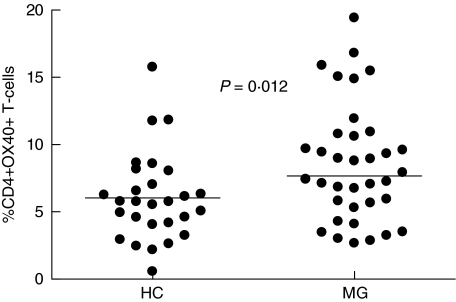
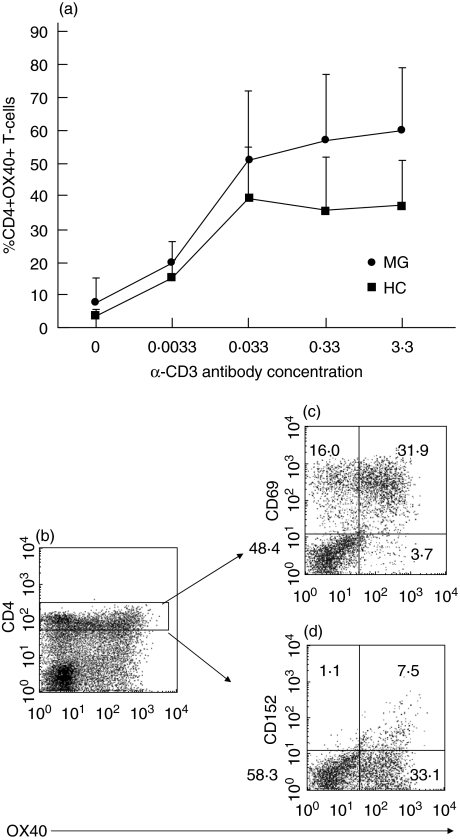
Myasthenia gravis (MG) is commonly regarded as the prototype of an antibody-mediated, organ-specific autoimmune disease. Antibodies against the acetylcholine receptor (AChR) on the muscle endplate trigger its typical clinical manifestations of weakness and fatiguability. T-B cell interactions are thought to play a crucial role in the pathogenesis of MG. OX40 (CD134), a costimulatory molecule that is expressed on activated CD4+ T-cells, might contribute to the development or pathogenesis of immune-mediated diseases such as rheumatoid arthritis and graft-versus-host disease. In the present study, we investigated the expression of OX40 on CD4+ T-cells from patients with MG and healthy individuals. Results from 36 MG patients and 28 healthy controls revealed that more freshly isolated CD4+ T-cells from MG patients expressed OX40 than cells from healthy individuals. High levels of antibodies against the AChR, thymic hyperplasia and onset at an early age were associated with elevated expression of OX40. Upon activation by various concentrations of anti-CD3 antibodies, CD4+ T-cells from MG patients showed a tendency toward higher levels of OX40 expression than cells from healthy individuals. Given the role of OX40 in the immune system, we conclude that OX40 might contribute to the development of MG.
Figures
References
-
- Lennon VA, Lindstrom JM, Seybold ME. Experimental autoimmune myasthenia gravis: cellular and humoral immune responses. Ann NY Acad Sci. 1976;274:283–99. - PubMed
-
- Hohlfeld R, Kalies I, Kohleisen B, Heininger K, Conti-Tronconi B, Toyka KV. Myasthenia gravis: stimulation of antireceptor autoantibodies by autoreactive T cell lines. Neurology. 1986;36:618–21. - PubMed
-
- Wang XB, Kakoulidou M, Giscombe R, Qiu Q, Huang D, Pirskanen R, Lefvert AK. Abnormal expression of CTLA-4 by T cells from patients with myasthenia gravis: effect of an AT-rich gene sequence. J Neuroimmunol. 2002;130:224–32. - PubMed
-
- McIntosh KR, Linsley PS, Bacha PA, Bacha PA, Drachman DB. Immunotherapy of experimental autoimmune myasthenia gravis. selective effects of CTLA4Ig and synergistic combination with an IL2-diphtheria toxin fusion protein. J Neuroimmunol. 1998;87:136–46. - PubMed
-
- Croft M. Costimulation of T cells by OX40, 4–1BB, and CD27. Cytokine Growth Factor Rev. 2003;14:265–73. - PubMed
Publication types
MeSH terms
Substances
LinkOut - more resources
Full Text Sources
Other Literature Sources
Medical
Research Materials
