Comparative Study
. 2005 Dec 20:5:72.
doi: 10.1186/1471-2148-5-72.

Genome-wide comparative analysis of the IQD gene families in Arabidopsis thaliana and Oryza sativa

Affiliations
Comparative Study

Genome-wide comparative analysis of the IQD gene families in Arabidopsis thaliana and Oryza sativa

Steffen Abel et al. BMC Evol Biol. .

Abstract

Background: Calcium signaling plays a prominent role in plants for coordinating a wide range of developmental processes and responses to environmental cues. Stimulus-specific generation of intracellular calcium transients, decoding of calcium signatures, and transformation of the signal into cellular responses are integral modules of the transduction process. Several hundred proteins with functions in calcium signaling circuits have been identified, and the number of downstream targets of calcium sensors is expected to increase. We previously identified a novel, calmodulin-binding nuclear protein, IQD1, which stimulates glucosinolate accumulation and plant defense in Arabidopsis thaliana. Here, we present a comparative genome-wide analysis of a new class of putative calmodulin target proteins in Arabidopsis and rice.

Results: We identified and analyzed 33 and 29 IQD1-like genes in Arabidopsis thaliana and Oryza sativa, respectively. The encoded IQD proteins contain a plant-specific domain of 67 conserved amino acid residues, referred to as the IQ67 domain, which is characterized by a unique and repetitive arrangement of three different calmodulin recruitment motifs, known as the IQ, 1-5-10, and 1-8-14 motifs. We demonstrated calmodulin binding for IQD20, the smallest IQD protein in Arabidopsis, which consists of a C-terminal IQ67 domain and a short N-terminal extension. A striking feature of IQD proteins is the high isoelectric point (approximately 10.3) and frequency of serine residues (approximately 11%). We compared the Arabidopsis and rice IQD gene families in terms of gene structure, chromosome location, predicted protein properties and motifs, phylogenetic relationships, and evolutionary history. The existence of an IQD-like gene in bryophytes suggests that IQD proteins are an ancient family of calmodulin-binding proteins and arose during the early evolution of land plants.

Conclusion: Comparative phylogenetic analyses indicate that the major IQD gene lineages originated before the monocot-eudicot divergence. The extant IQD loci in Arabidopsis primarily resulted from segmental duplication and reflect preferential retention of paralogous genes, which is characteristic for proteins with regulatory functions. Interaction of IQD1 and IQD20 with calmodulin and the presence of predicted calmodulin binding sites in all IQD family members suggest that IQD proteins are a new class of calmodulin targets. The basic isoelectric point of IQD proteins and their frequently predicted nuclear localization suggest that IQD proteins link calcium signaling pathways to the regulation of gene expression. Our comparative genomics analysis of IQD genes and encoded proteins in two model plant species provides the first step towards the functional dissection of this emerging family of putative calmodulin targets.


Figures
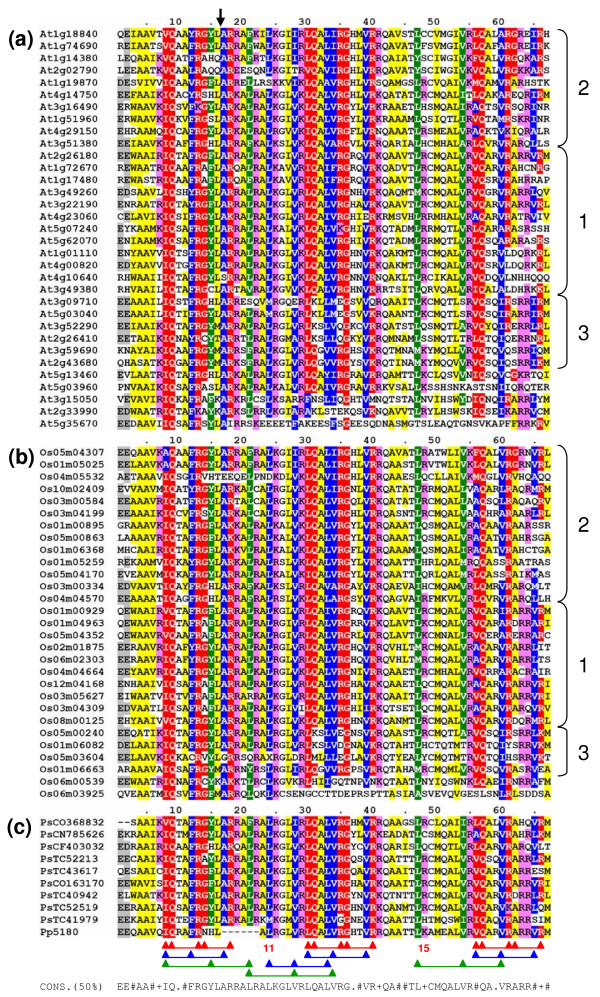
Figure 2
Figure 2
Amino acid sequence conservation of the IQ67 domain. Aligned are sequences of the IQ67 domain of 72 putative IQD proteins form Arabidopsis thaliana (a), Oryza sativa (b), Pinus spp. and Physcomitrella patens (c). Each protein is identified by its gene identification (Arabidopsis and rice) or accession number (pine and moss). The numbers above the scheme (1–67) indicate the position within the domain as defined in this study. The position of the conserved phase-0 intron that separates the coding region of the IQ67 domain between codon 16 and 17 is marked by an arrow. The shading of the alignment presents residues (white text) of the IQ motifs (red), the 1-5-10 motifs (blue) and the 1-8-14 motifs (green). If a residue is part of more than one motif, the residue is shaded in the first assigned color as determined by the order of motifs listed above. In addition, acidic, basic and hydrophobic amino acid residues that are conserved in at least 50% of the 72 sequences are shaded in grey, pink and yellow, respectively. The scheme of connected triangles below panel C depicts the position and boundaries of the IQ (red), 1-5-10 (blue) and 1-8-14 (green) motifs. The consensus sequence at the bottom is based on the residues with greater than 50% conservation among the 72 proteins shown (#, hydrophobic; +, basic). Black braces at right indicate the major subfamilies as defined by the phylogenetic analysis of the 72 IQ67 domain sequences in Figure 7. Accession numbers of the putative pine and moss IQD proteins are given the prefixes 'Ps' and 'Pp', respectively.
Figure 1
Figure 1
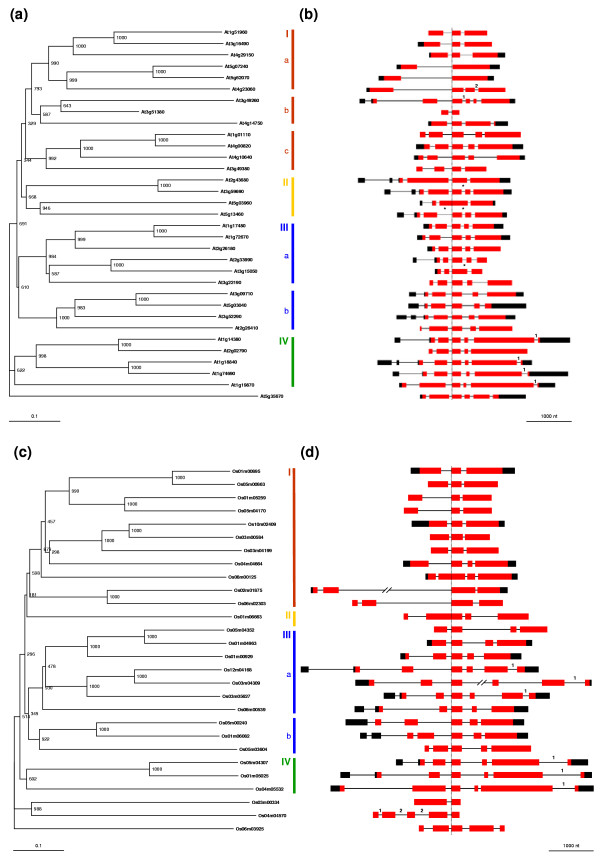
Phylogenetic analysis and exon-intron organization of IQD genes in Arabidopsis thaliana and Oryza sativa. Neighbor-joining trees of full-length amino acid sequences encoded by Arabidopsis (a) and rice (c) IQD genes are shown. The gene coding for the protein containing a C-terminally truncated IQ67 domain in Arabidopsis, At5g35670, and in rice, Osm0603925, was used as outgroup for each family. Bootstrap values (1,000 replicates) are placed at the nodes, and the scale bar corresponds to 0.1 estimated amino acid substitutions per site. Subfamilies and subgroups of IQD genes (I–IV) are highlighted by colored vertical bars on the right of the trees. The exon-intron organization of the corresponding IQD genes is shown for the Arabidopsis (b) and rice (d) gene family. Exons are depicted as boxes and introns as connecting thin lines. Protein-coding regions are colored in red, and non-translated regions, when supported by full-length cDNA sequences, are shown in black. The gene structures are drawn to scale and aligned along the left border (indicated by vertical dotted line) of the exon encoding amino acids 17–67 of the IQ67 domain, with the exception of At5g03960, Os08m00126 and Os01m06663 that have lost the respective intron. Additional intron losses are indicated by asterisks between Arabidopsis gene pairs. The exon-intron organization of the Arabidopsis IQD genes was taken from the TIGR Arabidopsis database, with the exception of At1g01110 for which the MIPS annotation was used as template. The presentation of the exon-intron organization of rice IQD genes was adapted to match the TIGR format of Arabidopsis IQD genes. The length of the second and third intron of Os02m01875 and Os03m04309 is 3.8 kb and 2.1 kb, respectively. Most introns of IQD genes are in phase-0. Six Arabidopsis and seven rice IQD genes contain phase-1 and phase-2 introns, which are labeled with the respective Arabic numeral. At2g02790, for which no full-length cDNA sequence is available, may also contain a phase-1 intron on its 3'end.
Figure 5
Figure 5
Chromosomal distribution and segmental duplication events for Arabidopsis IQD genes. The five chromosomes are indicated by Roman numerals and the centromeric regions by ellipses. Deduced chromosomal positions of the IQD genes are marked by horizontal bars and gene identification numbers (last five digits only). The scale is in megabases (Mb) and is adapted from the scale available on the TIGR database (see Materials and methods). Non-hidden duplicated chromosomal segments [48] that contain at least one retained IQD gene pair are color-coded. In three such segments (blue, brown, light blue), one sister IQD gene has been lost. Additional non-hidden duplicated segments that have lost sister IQD genes are shown in white and both segments are labeled with the same Arabic numeral. The duplicated segments of one such event (number 3) have likely experienced reciprocal IQD gene losses as the remaining genes, At3g22190 and At4g14750, are only distantly related (see Figure 1a). Numbers in italics at left indicate the estimated age (Myr) of the duplication event according to Simillion at al. [48]; the age estimates are given only once in the order of IQD gene location beginning with chromosome I.
Figure 3
Figure 3
Motif patterns in IQD proteins of Arabidopsis thaliana and Oryza sativa. The schematic IQD proteins of Arabidopsis (a) and rice (b) are aligned relative to the IQ67 domain (orange box). Total amino acid sequence length, boundaries of protein-coding exons (vertical tick marks), and length and position of separate and distinct MEME motifs (shown as color-coded boxes) are drawn to scale. Motifs shared by the primary structures of at least four Arabidopsis IQD proteins are depicted at the reference bar on top of each alignment and numbered consecutively, beginning with motifs most N-terminal in the protein. Motif numbers are cross-indexed in Table 5 that lists the multilevel consensus sequence for each MEME motif. The position of putative calmodulin-binding sites predicted by the Calmodulin Target Database [40] (see Table 4) is indicated by an asterisk above each protein model. IQD proteins are aligned in the same order as they appear in the phylogenetic trees (see Figure 1). Subfamilies and subgroups (I–IV) of IQD proteins are highlighted by colored vertical bars next to the gene identifiers.
Figure 4
Figure 4
Interaction of Arabidopsis IQD20 and calmodulin in vitro. Calmodulin-agarose beads were incubated in the presence of Ca2+ or absence of Ca2+ (+EGTA) with soluble proteins prepared from induced bacterial cultures expressing a T7-tagged IQD20 protein and treated as described in Methods. Proteins of the total bacterial extract, the supernatant fraction, the entire pellet (beads) fraction, and of the last wash were resolved by SDS-PAGE, transferred to a membrane, and probed with a HRP conjugated T7-Tag monoclonal antibody.
Figure 6
Figure 6
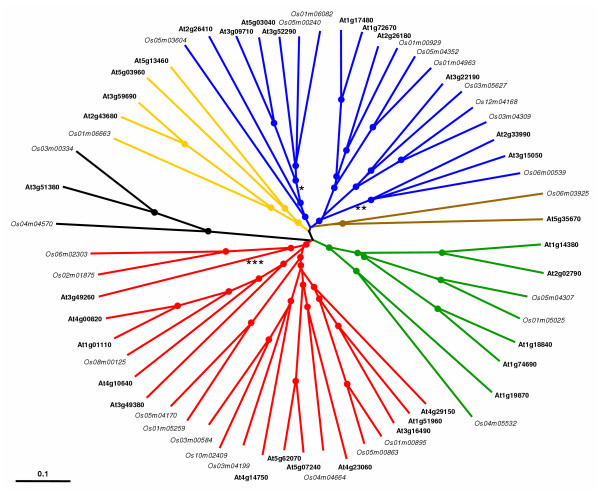
Phylogenetic relationships of Arabidopsis thaliana and Oryza sativa IQD proteins. The unrooted tree, constructed using ClustalX (1.81), summarizes the evolutionary relationship among the 61 members of both IQD protein families. The neighbor-joining tree was constructed using aligned full-length amino acid sequences. The scale bar corresponds to 0.1 estimated amino acid substitutions per site. Nodes supported by high bootstrap results (>75%) are indicated by dots. The same color code was used as in Figures 1 and 3 to highlight the different subfamilies (red, I; yellow, II; blue, III; green, IV; black, V [proteins with IQ67 domain on C-terminus]; brown, VI [proteins with truncated IQ67 domain]). The asterisks indicate the approximate position of branches corresponding to putative IQD proteins from pine (*TC522213, **TC41979, ***TC52519; Tentative Consensus of TIGR Unique Gene Indices).
Figure 7
Figure 7
Phylogenetic relationships of the IQ67 domains encoded by IQD genes from Arabidopsis thaliana, Oryza sativa, Pinus ssp. and Physcomitrella patens. The unrooted tree was constructed from the alignment shown in Figure 2 using PAUP* 4.0 and the neighbor-joining method. Numbers on branches indicate the percentage of 1000 bootstrap replicates that support the adjacent node; low bootstrap support (<50%) was not reported. Black braces and Arabic numerals at right indicate the three major subfamilies as defined by the phylogenetic analysis of the 72 IQ67 domain sequences. Gene identification and accession numbers are colored using the same code as in Figure 6 to denote the different subfamilies of the parental IQD proteins. Accession numbers of the putative pine and moss IQD proteins are given the prefixes 'Ps' and 'Pp', respectively. The asterisk denotes the putative rice IQD protein for which a full-length amino acid sequence could not be predicted (see Table 2).
Figure 8
Figure 8
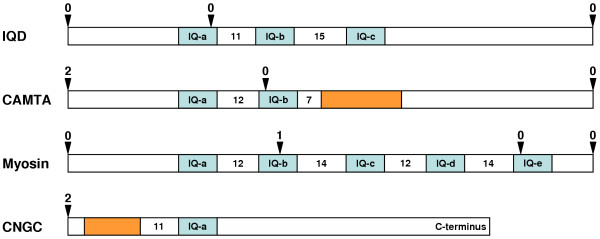
Organization of IQ motifs in major families of calmodulin-binding proteins. The scheme depicts the arrangement of the multiple IQ motifs present in proteins of the IQD family (this study; [37]), the CAMTA family of calmodulin-binding transcriptional activators [59-61], the myosin family [58], and the CNGC family of cyclic nucleotide gated channels [57, 104]. The IQ motifs are shown as light-blue boxes. Predicted and experimentally verified calmodulin-interacting peptide sequences are shown in orange. The numbers in the white spacers equal the number of separating amino acid residues. The triangles and numbers above each protein family model indicate the position and the phase of conserved introns, respectively. The positions of the left and right most introns are not drawn to scale.

References

    1. Rudd JJ, Franklin-Tong VE. Unravelling response-specificity in Ca2+-signaling pathways in plant cells. . New Phytologist. 2001;151:7–33. doi: 10.1046/j.1469-8137.2001.00173.x. - DOI - PubMed
    1. Evans NH, McAinsh MR, Hetherington AM. Calcium oscillations in higher plants. Curr Opin Plant Biol. 2001;4:415–420. doi: 10.1016/S1369-5266(00)00194-1. - DOI - PubMed
    1. Harper JF. Dissecting calcium oscillators in plant cells. Trends Plant Sci. 2001;6:395–397. doi: 10.1016/S1360-1385(01)02023-4. - DOI - PubMed
    1. Scrase-Field SA, Knight MR. Calcium: just a chemical switch? Curr Opin Plant Biol. 2003;6:500–506. doi: 10.1016/S1369-5266(03)00091-8. - DOI - PubMed
    1. Knight H, Knight MR. Abiotic stress signalling pathways: specificity and cross-talk. Trends Plant Sci. 2001;6:262–267. doi: 10.1016/S1360-1385(01)01946-X. - DOI - PubMed

Publication types