


MyD88-dependent pathways mediate resistance to Cryptosporidium parvum infection in mice
- PMID: 16369011
- PMCID: PMC1346622
- DOI: 10.1128/IAI.74.1.549-556.2006
MyD88-dependent pathways mediate resistance to Cryptosporidium parvum infection in mice
Abstract
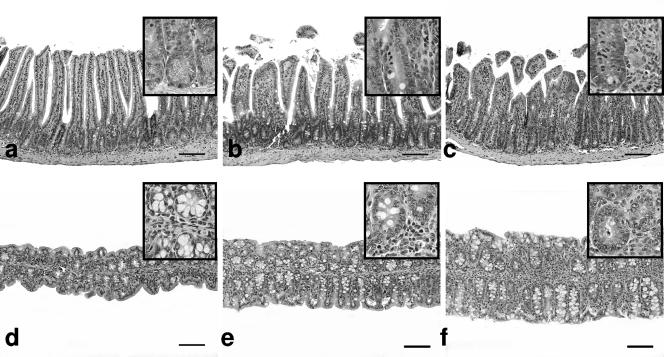
Cryptosporidium spp. cause diarrheal disease worldwide. Innate immune responses mediating resistance to this parasite are not completely understood. To determine whether MyD88-dependent pathways play a role in resistance to Cryptosporidium parvum, we compared the course of infection in MyD88(-/-) mice to that in their wild-type (WT) littermate controls. Three- to 4-week-old mice were infected with C. parvum, and infection was monitored by quantifying fecal oocyst shedding. Twelve days postinfection, the histology of the intestines was examined to quantify intestinal parasite burden and to determine if there were any pathological changes. Fecal oocyst shedding and intestinal parasite burden were significantly greater in MyD88(-/-) mice than in littermate controls. Nonetheless, both WT and MyD88(-/-) mice cleared the infection within 3 weeks. These results indicate that MyD88-dependent pathways are involved in mediating initial resistance to C. parvum. Since gamma interferon (IFN-gamma) is known to mediate resistance to C. parvum, we also studied infection in MyD88(-/-) mice and WT controls in which this cytokine was temporarily neutralized. Fecal oocyst shedding, as well as intestinal parasite burden, intestinal inflammation, and mortality, was significantly greater in MyD88(-/-) mice in which IFN-gamma was neutralized than in IFN-gamma-neutralized WT mice or in MyD88(-/-) mice in which this cytokine was active. These results suggest that MyD88 and IFN-gamma had an additive effect in conferring protection from C. parvum infection. While this study confirms the importance of IFN-gamma in conferring resistance to infection with C. parvum, it suggests that MyD88-mediated pathways also play a role in innate immunity to this parasite.
Figures



References
-
- Adachi, K., H. Tsutsui, S. Kashiwamura, E. Seki, H. Nakano, O. Takeuchi, K. Takeda, K. Okumura, L. Van Kaer, H. Okamura, S. Akira, and K. Nakanishi. 2001. Plasmodium berghei infection in mice induces liver injury by an IL-12- and toll-like receptor/myeloid differentiation factor 88-dependent mechanism. J. Immunol. 167:5928-5934. - PubMed
-
- Adachi, O., T. Kawai, K. Takeda, M. Matsumoto, H. Tsutsui, M. Sakagami, K. Nakanishi, and S. Akira. 1998. Targeted disruption of the MyD88 gene results in loss of IL-1- and IL-18-mediated function. Immunity 9:143-150. - PubMed
-
- Akira, S., K. Takeda, and T. Kaisho. 2001. Toll-like receptors: critical proteins linking innate and acquired immunity. Nat. Immunol. 2:675-680. - PubMed
-
- Campos, M. A., M. Closel, E. P. Valente, J. E. Cardoso, S. Akira, J. I. Alvarez-Leite, C. Ropert, and R. T. Gazzinelli. 2004. Impaired production of proinflammatory cytokines and host resistance to acute infection with Trypanosoma cruzi in mice lacking functional myeloid differentiation factor 88. J. Immunol. 172:1711-1718. - PubMed
-
- Checkley, W., L. D. Epstein, R. H. Gilman, R. E. Black, L. Cabrera, and C. R. Sterling. 1998. Effects of Cryptosporidium parvum infection in Peruvian children: growth faltering and subsequent catch-up growth. Am. J. Epidemiol. 148:497-506. - PubMed
Publication types
MeSH terms
Substances
Grants and funding
LinkOut - more resources
Full Text Sources
Medical
Molecular Biology Databases
Miscellaneous
