. 2006 Jan;74(1):711-20.
doi: 10.1128/IAI.74.1.711-720.2006.

Differentially expressed and secreted major immunoreactive protein orthologs of Ehrlichia canis and E. chaffeensis elicit early antibody responses to epitopes on glycosylated tandem repeats

Affiliations

Differentially expressed and secreted major immunoreactive protein orthologs of Ehrlichia canis and E. chaffeensis elicit early antibody responses to epitopes on glycosylated tandem repeats

C Kuyler Doyle et al. Infect Immun. 2006 Jan.

Abstract

Ehrlichia canis major immunoreactive proteins of 36 and 19 kDa elicit the earliest detectable antibody responses during the acute phase of canine monocytic ehrlichiosis. Genes encoding the major immunoreactive 36-kDa protein of E. canis and the corresponding ortholog of E. chaffeensis (47 kDa) were identified and the proteins characterized. The molecular masses of the strongly immunoreactive recombinant proteins were larger than predicted (26.7 and 32.9 kDa, respectively) but were consistent with those of the corresponding native proteins (36 and 47 kDa). Similar to other reported ehrlichial immunoreactive glycoproteins, carbohydrate was detected on the recombinant expressed proteins, indicating that they were glycoproteins. Both glycoproteins (gp36 and gp47) have carboxy-terminal serine/threonine-rich tandem repeat regions containing repeats that vary in number (4 to 16 repeats) and amino acid sequence among different isolates of each species. E. canis gp36 was recognized by early acute-phase antibodies (day 14), and species-specific antibody epitopes were mapped to C-terminal nonhomologous repeat units of gp36 and gp47. Periodate treatment of recombinant gp36 reduced the antibody reactivity, and nonglycosylated synthetic peptide repeat units from E. canis gp36 and E. chaffeensis gp47 were substantially less immunoreactive than corresponding recombinant peptides, demonstrating that glycans are important epitope determinants that are structurally conserved on the recombinant proteins expressed in Escherichia coli. E. canis gp36 and E. chaffeensis gp47 were differentially expressed only on the surface of dense-cored ehrlichiae and detected in the Ehrlichia-free supernatants, indicating that these proteins are released extracellularly during infection.


Figures
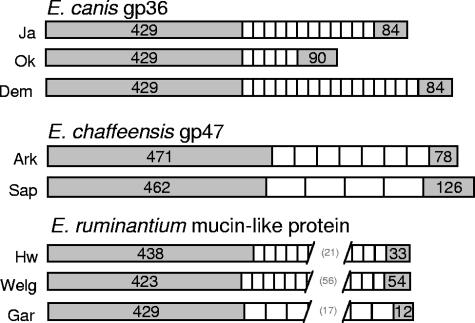
FIG. 1.
FIG. 1.
Genetic organization of the known mucin-like orthologs of E. canis, E. chaffeensis, and E. ruminantium. White bars represent the tandem repeat regions, and the gray bars represent length (base pairs) of regions upstream or downstream of the tandem repeats. E. canis strains illustrated include Jake (Ja), Oklahoma (Ok), and Demon (Dem); E. chaffeensis strains include Arkansas (Ark) and Sapulpa (Sap); and E. ruminantium strains include Highway (Hw), Welgevonden (Welg), and Gardel (Gar). Numbers in parentheses in the E. ruminantium repeat regions are the total number of repeat units present in each strain.
FIG. 2.
FIG. 2.
E. canis gp36 and E. chaffeensis gp47 immunoreactivity and carbohydrate detection. Western immunoblot of recombinant Jake strain gp36 reacted with anti-E. canis dog serum (#2995) (A); carbohydrate detection (B). Western immunoblot of recombinant Arkansas strain gp47 reacted with anti-E. chaffeensis dog serum (#2495) (C); carbohydrate detection (D).
FIG. 3.
FIG. 3.
(A) Western immunoblot of E. canis Jake strain lysate with anti-recombinant gp36 (lane 1) and anti-E. canis dog serum (lane 2). (B) Reactivity of E. chaffeensis Arkansas lysate with HME patient sera (lanes 1 to 10), mouse anti-recombinant E. chaffeensis gp47 serum, and anti-E. chaffeensis dog serum (#2251).
FIG. 4.
FIG. 4.
Kinetic antibody responses to E. canis Oklahoma strain gp36 (days [d] 0, 14, and 56) from 15 dogs (lanes 1 to 15) experimentally infected with E. canis.
FIG. 5.
FIG. 5.
Western immunoblots of thioredoxin control (A to C, lanes 1) and the E. canis gp36 single repeat fusion protein (9 amino acids) (A and B, lanes 2) reacted with anti-thioredoxin (panel A) and anti-E. canis dog serum (#2995) (panel B). (C) Western immunoblot of the E. chaffeensis Arkansas strain gp47 single repeat fusion protein (19 amino acids) (lane 2) reacted with anti-E. chaffeensis dog serum (#2495).
FIG. 6.
FIG. 6.
E. canis gp36 and E. chaffeensis gp47 species-specific epitopes. Western immunoblots of native E. canis Jake strain gp36 (lanes 1), gp36 single repeat recombinant protein (lanes 2), native E. chaffeensis Arkansas strain gp47 (lanes 3), and gp47 single repeat recombinant protein reacted with anti-recombinant gp36 (A) and anti-recombinant gp47 (B) sera.
FIG. 7.
FIG. 7.
Contribution of glycans to the antibody reactivity of E. canis Jake strain gp36 and E. chaffeensis gp47 as determined by ELISA. (A) Antibody reactivities of untreated and periodate-treated recombinant E. canis gp36 with anti-E. canis dog serum (#2995). (B) Immunoreactivities of the recombinant E. canis gp36 repeat fusion peptides containing the 9-mer, 12-mer, and 18-mer compared to those of aglycosylated synthetic peptides. (C) Immunoreactivities of the recombinant E. chaffeensis gp47 repeat fusion peptide (19-mer) and aglycosylated synthetic peptide with anti-E. chaffeensis dog serum (#2495). OD, optical density.
FIG. 8.
FIG. 8.
Immunogold-labeled electron micrographs of E. canis gp36 and E. chaffeensis gp47 localization. (A) E. canis morulae containing the reticulate (R) and dense-cored (DC) morphological forms. (B) E. chaffeensis morulae containing the reticulate and dense-cored morphological forms.
FIG. 9.
FIG. 9.
Confocal immunofluorescent photomicrographs of E. canis gp36 and E. chaffeensis gp47 expression. Cells infected with E. canis (A) or E. chaffeensis (B) were dually stained with anti-ehrlichial Dsb (18) (green; constitutive; top and bottom) and with anti-gp36 (red; top) or anti-gp47 (red; bottom) sera; merged photomicrographs demonstrate singly (green) and dually (yellow) labeled ehrlichiae.
FIG. 10.
FIG. 10.
Secreted E. canis and E. chaffeensis immunoreactive proteins. (A) Western immunoblots of concentrated supernatants from E. canis-infected DH82 cells with anti-E. canis dog serum (lane 1) and mouse anti-recombinant E. canis gp36 serum (lane 2). (B) Western immunoblots of supernatants from E. chaffeensis-infected DH82 cells with anti-E. chaffeensis dog serum (lane 1) and mouse anti-recombinant E. chaffeensis gp47 serum (lane 2).

References

    1. Andersson, S. G., and C. G. Kurland. 1998. Reductive evolution of resident genomes. Trends Microbiol. 6:263-268. - PubMed
    1. Barbet, A. F., W. M. Whitmire, S. M. Kamper, B. H. Simbi, R. R. Ganta, A. L. Moreland, D. M. Mwangi, T. C. McGuire, and S. M. Mahan. 2001. A subset of Cowdria ruminantium genes important for immune recognition and protection. Gene 275:287-298. - PubMed
    1. Benson, G. 1999. Tandem repeats finder: a program to analyze DNA sequences. Nucleic Acids Res. 27:573-580. - PMC - PubMed
    1. Benz, I., and M. A. Schmidt. 2002. Never say never again: protein glycosylation in pathogenic bacteria. Mol. Microbiol. 45:267-276. - PubMed
    1. Breitschwerdt, E. B., B. C. Hegarty, and S. I. Hancock. 1998. Sequential evaluation of dogs naturally infected with Ehrlichia canis, Ehrlichia chaffeensis, Ehrlichia equi, Ehrlichia ewingii, or Bartonella vinsonii. J. Clin. Microbiol. 36:2645-2651. - PMC - PubMed

Publication types

LinkOut - more resources
