


Toll-like receptor (TLR) polymorphisms in African children: Common TLR-4 variants predispose to severe malaria
- PMID: 16371473
- PMCID: PMC1324982
- DOI: 10.1073/pnas.0506803102
Toll-like receptor (TLR) polymorphisms in African children: Common TLR-4 variants predispose to severe malaria
Abstract
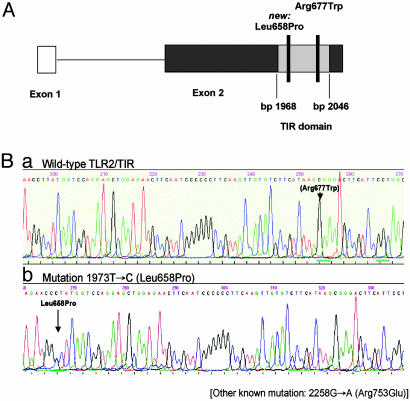
Genetic host factors play a substantial role in susceptibility to and severity of malaria, which continues to cause at least one million deaths per year. Recently, members of the toll-like receptor (TLR) family have been shown to be involved in recognition of the etiologic organism Plasmodium falciparum: The glycosylphosphatidylinositol anchor induces signaling in host cells via TLR-2 and -4, whereas hemozoin-induced immune activation involves TLR-9. Binding of microbial ligands to the respective TLRs triggers the release of proinflammatory cytokines via the TLR/IL-1 receptor (TIR) domain and may contribute to the host response in malaria, including cytokine induction and fever. In a case-control study among 870 Ghanaian children, we examined the influence of TLR-2, -4, and -9 polymorphisms in susceptibility to severe malaria. TLR-2 variants common in Caucasians and Asians were completely absent. However, we found a rare previously undescribed mutation (Leu658Pro), which impairs signaling via TLR-2. We failed to detect any polymorphisms within the TLR-9 Toll/IL-1 receptor domain. Two frequent TLR-9 promoter polymorphisms did not show a clear association with malaria severity. In contrast, the TLR-4-Asp299Gly variant occurred at a high rate of 17.6% in healthy controls and was even more frequent in severe malaria patients (24.1%, P < 0.05). Likewise, TLR-4-Thr399Ile was seen in 2.4% of healthy children and in 6.2% of patients (P = 0.02). TLR-4-Asp299Gly and TLR-4-Thr399Ile conferred 1.5- and 2.6-fold increased risks of severe malaria, respectively. These findings suggest TLR4-mediated responses to malaria in vivo and TLR-4 polymorphisms to be associated with disease manifestation.
Figures

References
-
- Greenwood, B. & Mutabingwa, T. (2002) Nature 415, 670–672. - PubMed
-
- Stevenson, M. M. & Riley, E. M. (2004) Nat. Rev. Immunol. 4, 169–180. - PubMed
-
- Schofield, L., Hewitt, M. C., Evans, K., Siomos, M. A. & Seeberger, P. H. (2002) Nature 418, 785–789. - PubMed
-
- Tachado, S. D., Gerold, P., McConville, M. J., Baldwin, T., Quilici, D., Schwarz, R. T. & Schofield, L. (1996) J. Immunol. 156, 1897–1907. - PubMed
-
- Schofield, L., Novakovic, S., Gerold, P., Schwarz, R. T., McConville, M. J. & Tachado, S. D. (1996) J. Immunol. 156, 1886–1896. - PubMed
Publication types
MeSH terms
Substances
LinkOut - more resources
Full Text Sources
Other Literature Sources
