


Effect of inspiratory muscle work on peripheral fatigue of locomotor muscles in healthy humans
- PMID: 16373384
- PMCID: PMC1796794
- DOI: 10.1113/jphysiol.2005.099697
Effect of inspiratory muscle work on peripheral fatigue of locomotor muscles in healthy humans
Abstract
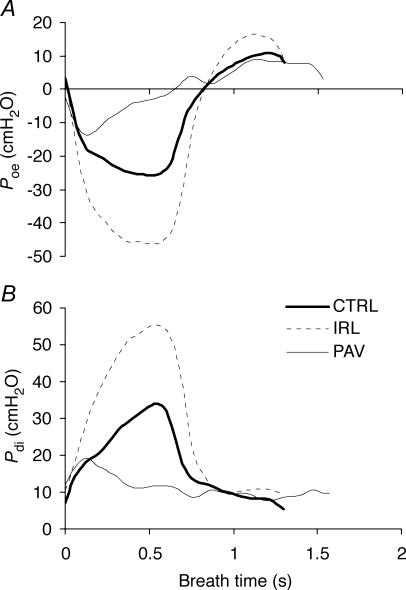
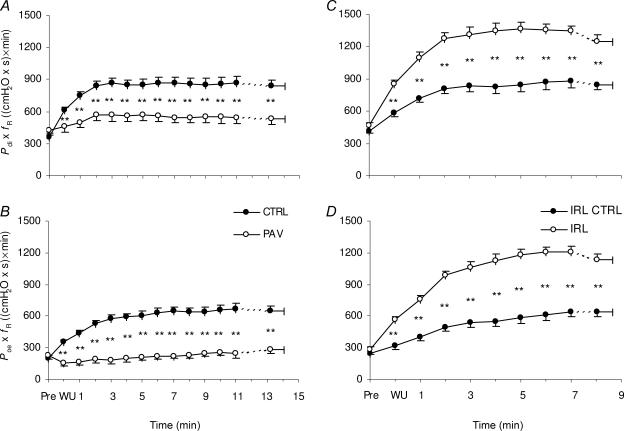
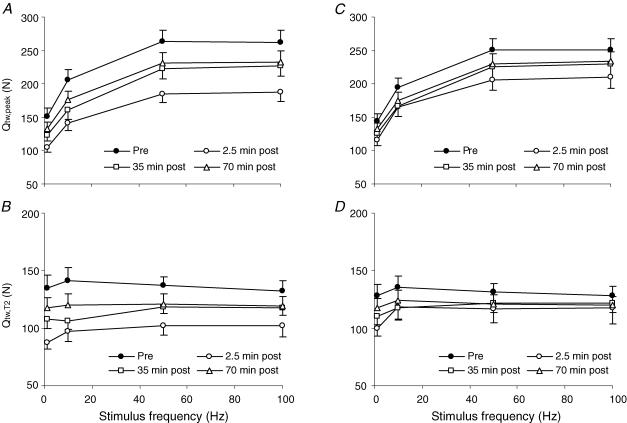
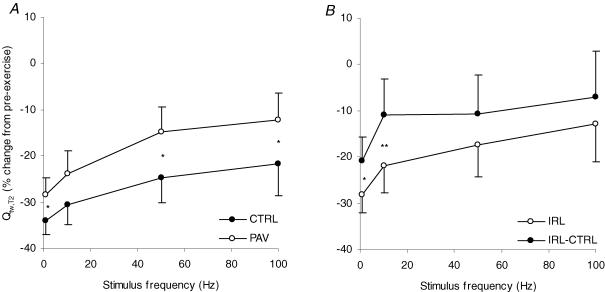
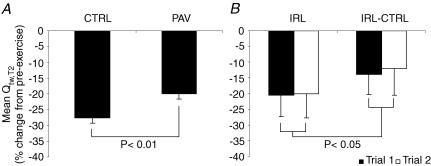
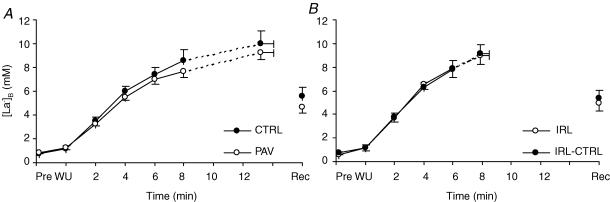
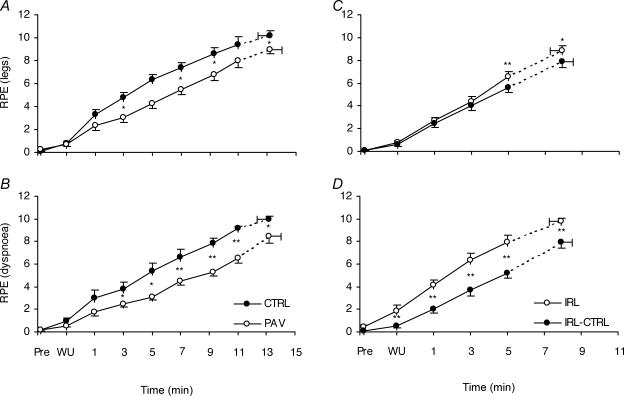
The work of breathing required during maximal exercise compromises blood flow to limb locomotor muscles and reduces exercise performance. We asked if force output of the inspiratory muscles affected exercise-induced peripheral fatigue of locomotor muscles. Eight male cyclists exercised at > or = 90% peak O2 uptake to exhaustion (CTRL). On a separate occasion, subjects exercised for the same duration and power output as CTRL (13.2 +/- 0.9 min, 292 W), but force output of the inspiratory muscles was reduced (-56% versus CTRL) using a proportional assist ventilator (PAV). Subjects also exercised to exhaustion (7.9 +/- 0.6 min, 292 W) while force output of the inspiratory muscles was increased (+80%versus CTRL) via inspiratory resistive loads (IRLs), and again for the same duration and power output with breathing unimpeded (IRL-CTRL). Quadriceps twitch force (Q(tw)), in response to supramaximal paired magnetic stimuli of the femoral nerve (1-100 Hz), was assessed pre- and at 2.5 through to 70 min postexercise. Immediately after CTRL exercise, Q(tw) was reduced -28 +/- 5% below pre-exercise baseline and this reduction was attenuated following PAV exercise (-20 +/- 5%; P < 0.05). Conversely, increasing the force output of the inspiratory muscles (IRL) exacerbated exercise-induced quadriceps muscle fatigue (Q(tw) = -12 +/- 8% IRL-CTRL versus-20 +/- 7% IRL; P < 0.05). Repeat studies between days showed that the effects of exercise per se, and of superimposed inspiratory muscle loading on quadriceps fatigue were highly reproducible. In conclusion, peripheral fatigue of locomotor muscles resulting from high-intensity sustained exercise is, in part, due to the accompanying high levels of respiratory muscle work.
Figures
References
-
- Aaron EA, Seow KC, Johnson BD, Dempsey JA. Oxygen cost of exercise hyperpnea: implications for performance. J Appl Physiol. 1992;72:1818–1825. - PubMed
-
- Babcock MA, Pegelow DF, Harms CA, Dempsey JA. Effects of respiratory muscle unloading on exercise-induced diaphragm fatigue. J Appl Physiol. 2002;93:201–206. - PubMed
-
- Babcock MA, Pegelow DF, Taha BH, Dempsey JA. High frequency diaphragmatic fatigue detected with paired stimuli in humans. Med Sci Sports Exerc. 1998;30:506–511. - PubMed
-
- Barclay JK. A delivery-independent blood flow effect on skeletal muscle fatigue. J Appl Physiol. 1986;61:1084–1090. - PubMed
-
- Baydur A, Behrakis PK, Zin WA, Jaeger M, Milic-Emili J. A simple method for assessing the validity of the esophageal balloon technique. Am Rev Respir Dis. 1982;126:788–791. - PubMed
Publication types
MeSH terms
Substances
Grants and funding
LinkOut - more resources
Full Text Sources
Medical
