. 2006 Jan;15(1):33-44.
doi: 10.1110/ps.051593306.

Enthalpic and entropic contributions mediate the role of disulfide bonds on the conformational stability of interleukin-4

Affiliations

Enthalpic and entropic contributions mediate the role of disulfide bonds on the conformational stability of interleukin-4

Daniela C Vaz et al. Protein Sci. 2006 Jan.

Abstract

The role of disulfide bridges in the structure, stability, and folding pathways of proteins has been the subject of wide interest in the fields of protein design and engineering. However, the relative importance of entropic and enthalpic contributions for the stabilization of proteins provided by disulfides is not always clear. Here, we perform a detailed analysis of the role of disulfides in the conformational stability of human Interleukin-4 (IL4), a four-helix bundle protein. In order to evaluate the contribution of two out of the three disulfides to the structure and stability of IL4, two IL4 mutants, C3T-IL4 and C24T-IL4, were used. NMR and ANS binding experiments were compatible with altered dynamics and an increase of the nonpolar solvent-accessible surface area of the folded state of the mutant proteins. Chemical and thermal unfolding experiments followed by fluorescence and circular dichroism revealed that both mutant proteins have lower conformational stability than the wild-type protein. Transition temperatures of unfolding decreased 14 degrees C for C3T-IL4 and 10 degrees C for C24T-IL4, when compared to WT-IL4, and the conformational stability, at 25 degrees C, decreased 4.9 kcal/mol for C3T-IL4 and 3.2 kcal/mol for C24T-IL4. Interestingly, both the enthalpy and the entropy of unfolding, at the transition temperature, decreased in the mutant proteins. Moreover, a smaller change in heat capacity of unfolding was also observed for the mutants. Thus, disulfide bridges in IL4 play a critical role in maintaining the thermodynamic stability and core packing of the helix bundle.


Figures
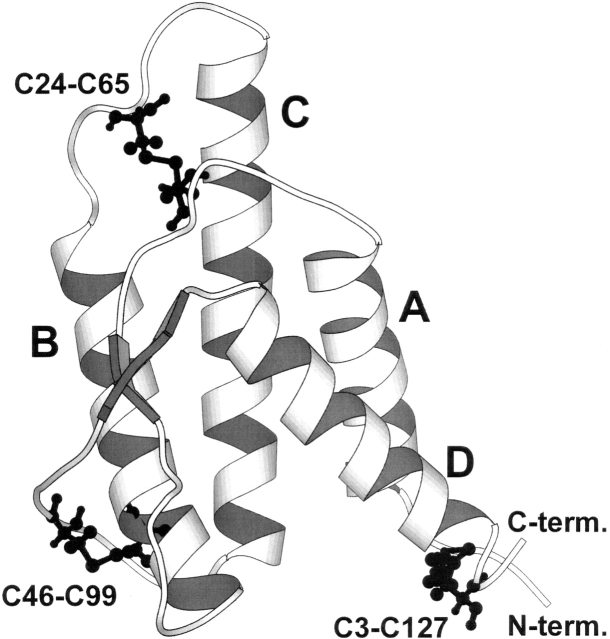
Figure 1.
Figure 1.
Ribbon representation of the tridimensional structure of human Interleukin-4, showing the four helices labeled A to D, a small anti-parallel β-sheet (arrows), and the three disulfide bridges C3–C127, C24–C65, and C46–C99. The representation was created with the program MOLSCRIPT (Kraulis 1991) using the coordinates of the NMR solution structure (1itm.pdb; Redfield et al. 1994).
Figure 2.
Figure 2.
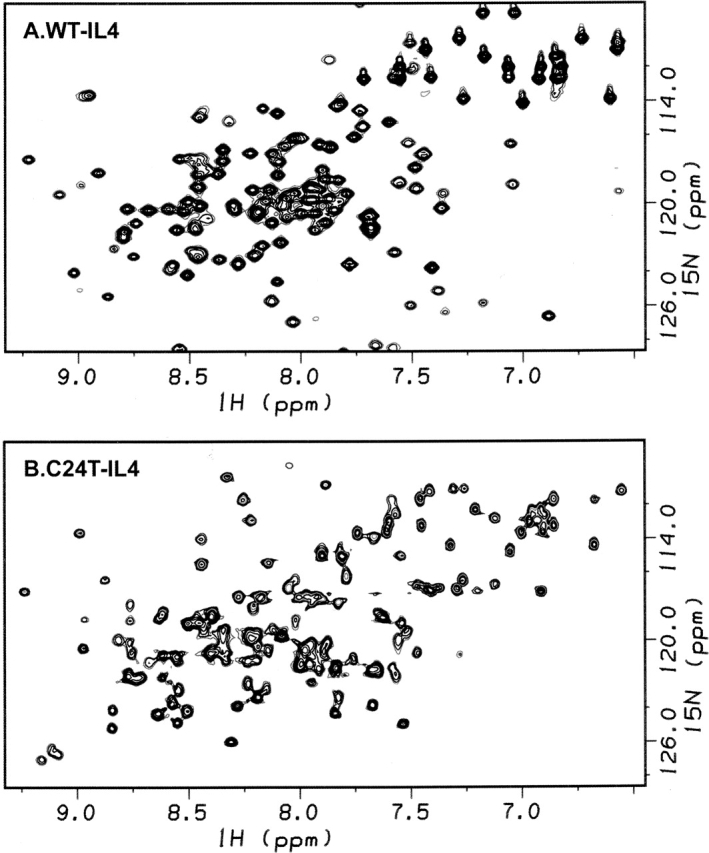
[1H-15N]HSQC NMR spectra of WT-IL4 (A) and C24T-IL4 (B) in 25 mM d3-acetic acid, 90% H2O, and 10% D2O (pH 5.1) at 25°C. The protein concentration was ~2 mM in both cases, and spectra were run at a 1H frequency of 500 MHz.
Figure 3.
Figure 3.
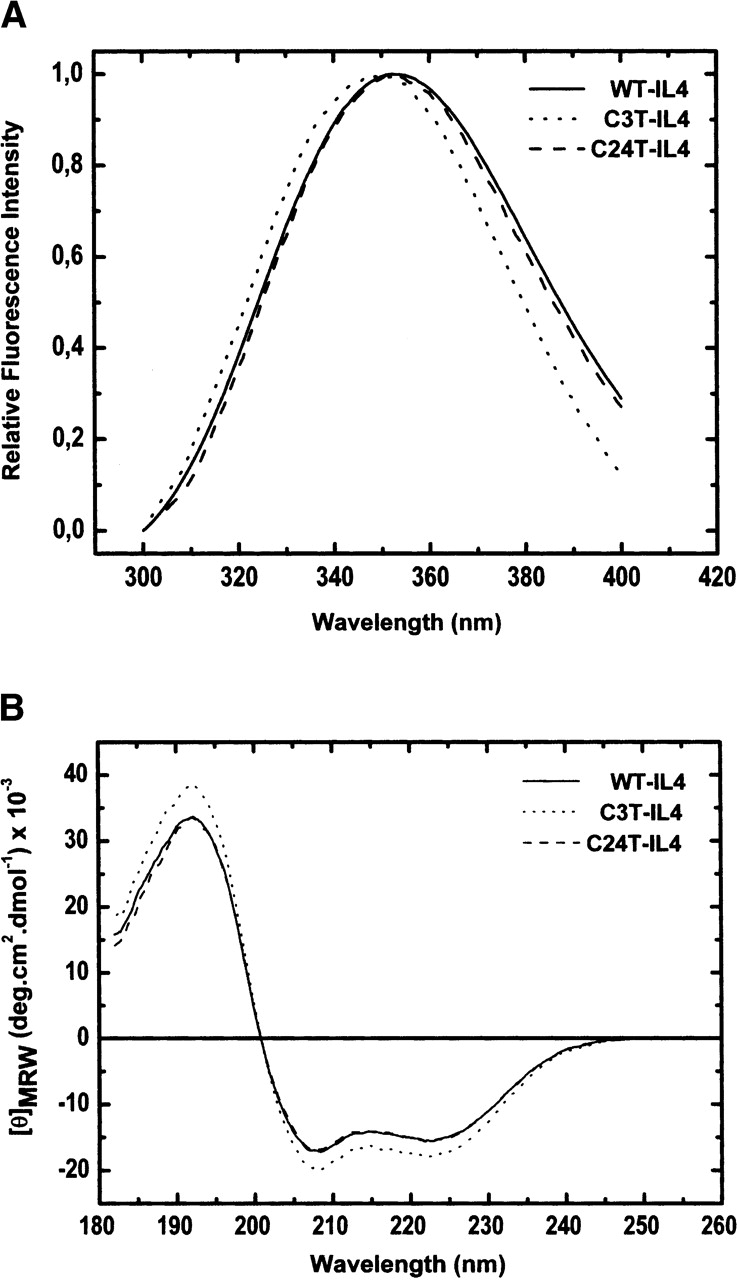
Fluorescence emission spectra (A) and far-UV CD spectra (B) of WT-, C3T-, and C24T-IL4, in 10 mM sodium phosphate buffer (pH 6.0) at 25°C. WT- and C24T-IL4 show fluorescence emission maxima at 352 nm, and C3T-IL4 at 347 nm. The double negative peak at 208 and 222 nm in the CD spectra indicates a high content of α-helix in the three proteins.
Figure 4.
Figure 4.
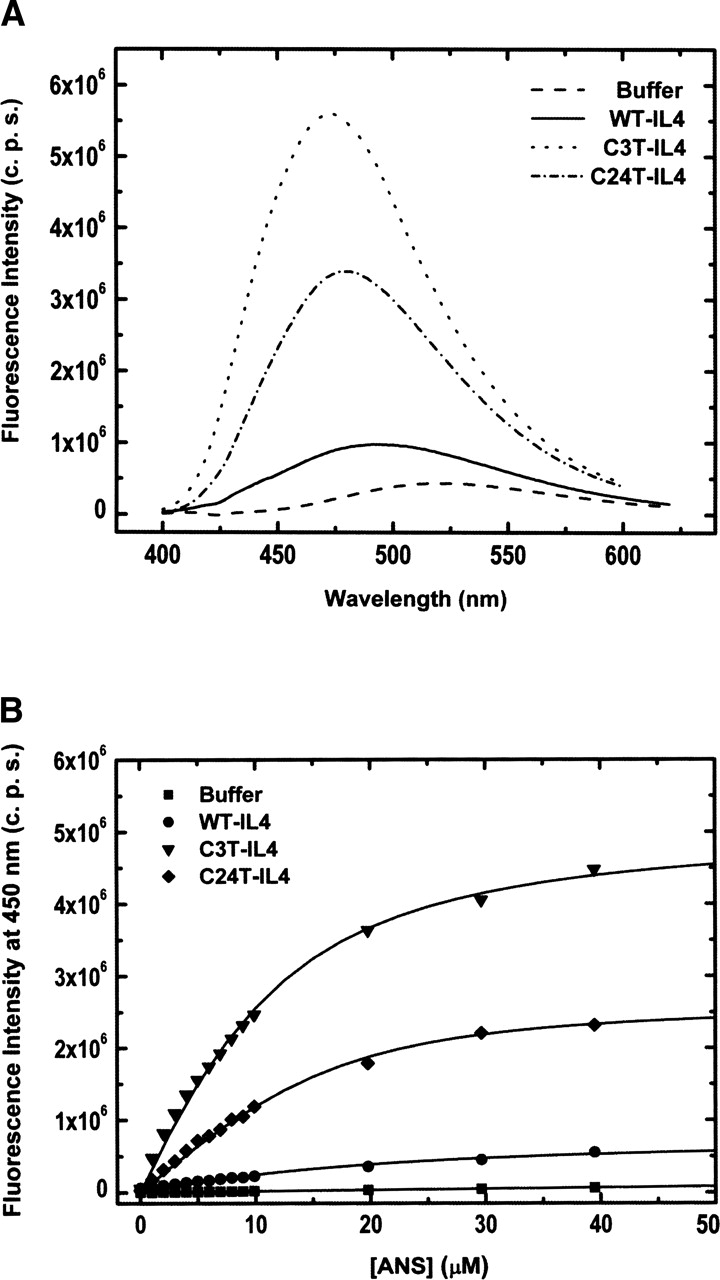
Titration of Interleukin-4 variants with ANS, followed by fluorescence spectroscopy. (A) Fluorescence emission spectra of 50 μM ANS free in solution and in the presence of 10 μM WT-, C3T-, and C24T-IL4. When bound to the IL4 mutants, the fluorescence intensity of the probe increases significantly and the emission maximum blue-shifts from 520 nm to ~475 nm. (B) ANS titration curves in 10 mM sodium phosphate (pH 6.0) at 25°C, using excitation and emission wavelengths of 370 and 450 nm, respectively. The lines are nonlinear least squares fits of Equations 1 and 2 (Materials and Methods) to the experimental data.
Figure 5.
Figure 5.
Chemical unfolding profiles of WT-IL4, C3T-IL4, and C24T-IL4, at 25°C, followed by intrinsic protein fluorescence. Fluorescence intensity was monitored at excitation and emission wavelengths of 280 and 380 nm, respectively. Protein concentrations were 10 μM, in 10 mM sodium phosphate (pH 6.0). Protein samples were incubated for 20 h at several urea concentrations. The lines are nonlinear least squares fits of Equation 3 (Materials and Methods) to the experimental data.
Figure 6.
Figure 6.
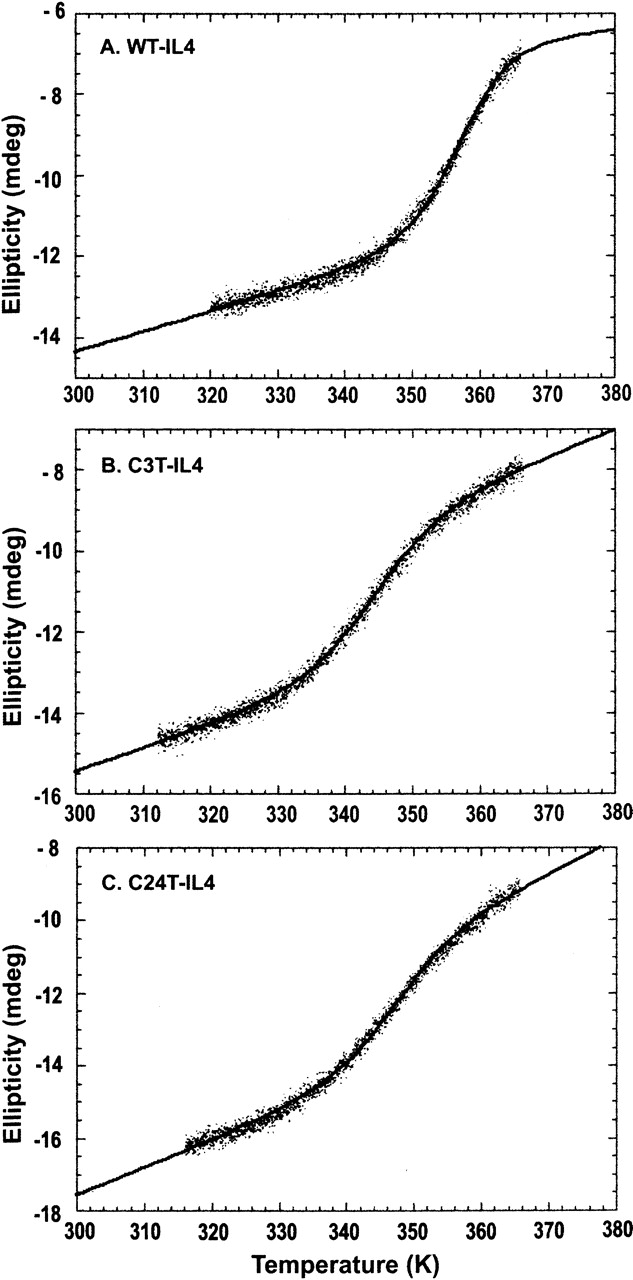
Thermal unfolding profiles of WT-IL4 (A), C3T-IL4 (B), and C24T-IL4 (C), followed by circular dichroism (CD). The ellipticity at 222 nm was monitored as a function of the temperature in the CD cuvette, every 5 sec, using a linear temperature ramp of 0.33°C/min. Protein concentrations were 6–8 μM in 10 mM sodium phosphate (pH 6.0). The lines are nonlinear least squares fits of Equation 7 (Materials and Methods) to the experimental data.
Figure 7.
Figure 7.
Conformational stability curves for WT-, C3T-, and C24T-IL4. Each curve combines the conformational stability values obtained in urea-induced unfolding experiments (filled symbols) and the conformational stability values in the transition region obtained in the thermal unfolding experiments (open symbols). The lines represent nonlinear least squares fits of the modified Gibbs-Helmholtz equation (Equation 6, Materials and Methods) to the experimental data. The fits allow the determination of ΔH at the transition temperature (ΔHm) and ΔCP associated with the unfolding process of each protein (Table 3).

References

    1. Alonso, D.O.V. and Dill, K.A. 1991. Solvent denaturation and stabilization of globular proteins. Biochemistry 30: 5974–5985. - PubMed
    1. Beldarrain, A., Lopez-Lacomba, J.L., Furrazola, G., Barberia, D., and Cortijo, M. 1999. Thermal denaturation of human γ-interferon. A calorimetric and spectroscopic study. Biochemistry 38: 7865–7873. - PubMed
    1. Bishop, B., Koay, D.C., Sartorelli, A.C., and Regan, L. 2001. Reengineering granulocyte colony-stimulating factor for enhanced stability. J. Biol. Chem. 276: 33465–33470. - PubMed
    1. Brems, D.N., Brown, P.L., and Becker, G.W. 1990. Equilibrium denaturation of human growth hormone and its cysteine-modified forms. J. Biol. Chem. 265: 5504–5511. - PubMed
    1. Cooper, A., Eyles, S.J., Radford, S.E., and Dobson, C.M. 1992. Thermo-dynamic consequences of the removal of a disulphide bridge from hen lysozyme. J. Mol. Biol. 225: 939–943. - PubMed

Publication types

LinkOut - more resources