Interventions for preventing or treating alcohol hangover: systematic review of randomised controlled trials
- PMID: 16373736
- PMCID: PMC1322250
- DOI: 10.1136/bmj.331.7531.1515
Interventions for preventing or treating alcohol hangover: systematic review of randomised controlled trials
Abstract
Objective: To assess the clinical evidence on the effectiveness of any medical intervention for preventing or treating alcohol hangover.
Data sources: Systematic searches on Medline, Embase, Amed, Cochrane Central, the National Research Register (UK), and ClincalTrials.gov (USA); hand searches of conference proceedings and bibliographies; contact with experts and manufacturers of commercial preparations. Language of publication was not restricted.
Study selection and data extraction: All randomised controlled trials of any medical intervention for preventing or treating alcohol hangover were included. Trials were considered if they were placebo controlled or controlled against a comparator intervention. Titles and abstracts of identified articles were read and hard copies were obtained. The selection of studies, data extraction, and validation were done independently by two reviewers. The Jadad score was used to evaluate methodological quality.
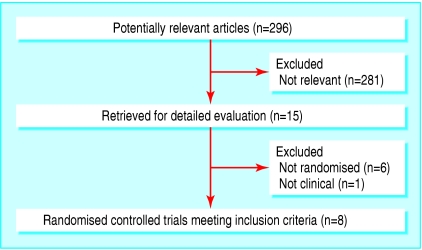
Results: Fifteen potentially relevant trials were identified. Seven publications failed to meet all inclusion criteria. Eight randomised controlled trials assessing eight different interventions were reviewed. The agents tested were propranolol, tropisetron, tolfenamic acid, fructose or glucose, and the dietary supplements Borago officinalis (borage), Cynara scolymus (artichoke), Opuntia ficus-indica (prickly pear), and a yeast based preparation. All studies were double blind. Significant intergroup differences for overall symptom scores and individual symptoms were reported only for tolfenamic acid, gamma linolenic acid from B officinalis, and a yeast based preparation.
Conclusion: No compelling evidence exists to suggest that any conventional or complementary intervention is effective for preventing or treating alcohol hangover. The most effective way to avoid the symptoms of alcohol induced hangover is to practise abstinence or moderation.
Figures
References
-
- Wiese JG, Shlipak MG, Browner WS. The alcohol hangover. Ann Intern Med 2000;132: 897-902. - PubMed
-
- Becker J. The alcohol hangover. Ann Intern Med 2001;134: 533-4. - PubMed
-
- Crofton J. Extent and costs of alcohol problems in employment: a review of British data. Alcohol Alcohol 1987;22: 321-5. - PubMed
-
- Pincock S. Binge drinking on rise in UK and elsewhere: government report shows increases in alcohol consumption, cirrhosis, and premature deaths. Lancet 2003;362: 1126-7. - PubMed
-
- Holland P, Mushinski M. Costs of alcohol and drug abuse in the United States, 1992. Stat Bull Metrop Insur Co 1999;80: 2-9. - PubMed
Publication types
MeSH terms
LinkOut - more resources
Full Text Sources
Other Literature Sources
Medical