. 2006 Feb;7(2):205-11.
doi: 10.1038/sj.embor.7400612.

Yeast Trf5p is a nuclear poly(A) polymerase

Affiliations

Yeast Trf5p is a nuclear poly(A) polymerase

Jonathan Houseley et al. EMBO Rep. 2006 Feb.

Abstract

Recent analyses have shown that the activity of the yeast nuclear exosome is stimulated by the Trf4p-Air1/2p-Mtr4p polyadenylation (TRAMP) complex. Here, we report that strains lacking the Rrp6p component of the nuclear exosome accumulate polyadenylated forms of many different ribosomal RNA precursors (pre-rRNAs). This polyadenylation is reduced in strains lacking either the poly(A) polymerase Trf4p or its close homologue Trf5p. In contrast, polyadenylation is enhanced by overexpression of Trf5p. Polyadenylation is also markedly increased in strains lacking the RNA helicase Mtr4p, indicating that it is required to couple poly(A) polymerase activity to degradation. Tandem affinity purification-tagged purified Trf5p showed polyadenylation activity in vitro, which was abolished by a double point mutation in the predicted catalytic site. Trf5p co-purified with Mtr4p and Air1p, indicating that it forms a complex, designated TRAMP5, that has functions that partially overlap with the TRAMP complex.


Figures

Figure 1
Figure 1
Both Trf4p and Trf5p participate in the polyadenylation of ribosomal RNA precursors. Otherwise isogenic strains were grown at 25°C. Strains with GAL-regulated alleles were grown on 2% galactose and shifted to 2% glucose for 24 h before analysis. A 5 μg portion of total RNA and poly(A)+ RNA recovered from 50 μg total RNA was loaded per lane on 1.2% agarose/glyoxal (AF) or 8% polyacrylamide/urea gels (GM). (AM) Northern hybridization with probes to pre-rRNA, rRNA and small nucleolar RNA species or the loading control TSA1, a highly expressed messenger RNA, the level of which is unaffected by exosome mutations. Probes used were (A) 003, (B) 020, (C) 004, (D) 007, (E) 008, (F) 499, (G) 020, (H) 015, (I) 041, (J) 499, (K) 202, (L) 214 and (M) 499. See supplementary Fig S1 online for descriptions of the pre-rRNA species and Supplementary Table S2 online for oligonucleotide probe sequences. RNA species marked with an asterisk are likely to represent as yet uncharacterized pre-rRNA degradation intermediates. (N) Graphs showing the fraction of each (pre-)rRNA species that is polyadenylated, calculated relative to the TSA1 mRNA control. The data are an average of three biological replicates; bars represent standard errors. Polyadenylated forms resolved on the polyacrylamide gels are indicated with pA. U24 is excised from the intron of the BEL1 pre-mRNA (Qu et al, 1995; Bousquet-Antonelli et al, 2000) and the band marked U24-int is likely to correspond to the species extended to the 5′ end of the intron (Qu et al, 1995; Bousquet-Antonelli et al, 2000).
Figure 2
Figure 2
Overexpression of Trf5p causes hyperadenylation. Trf5p was overexpressed in the absence of Trf4p and Rrp6p by growth of the GALtrf5, trf4Δ, rrp6Δ strain in galactose medium. (A,B) Polyadenylation of 5.8S+30 pre-ribosomal RNA. (C): Overexpression of TRF5 messenger RNA on galactose. Samples were processed as described in the legend to Fig 1. Probes used were (A) 020, (B) 499, (C) random primed probe to TRF5 open reading frame and (D) 403. (C,D) Poly(A)+ RNA only; PGK1 is an mRNA loading control.
Figure 3
Figure 3
Mtr4p connects polyadenylation to degradation. Depletion of Mtr4p by growth of the GALmtr4 strains on glucose medium results in RNA hyperadenylation. Strains were grown and analysed as described in Fig 1. Probes used were (A) 003, (B) 020, (C) 004, (D) 007, (E) 008, (F) 499, (G) 020, (H) 033, (I) 015, (J) 041, (K) 499 and (L) Phosphorlmager quantification of data from panel C.
Figure 4
Figure 4
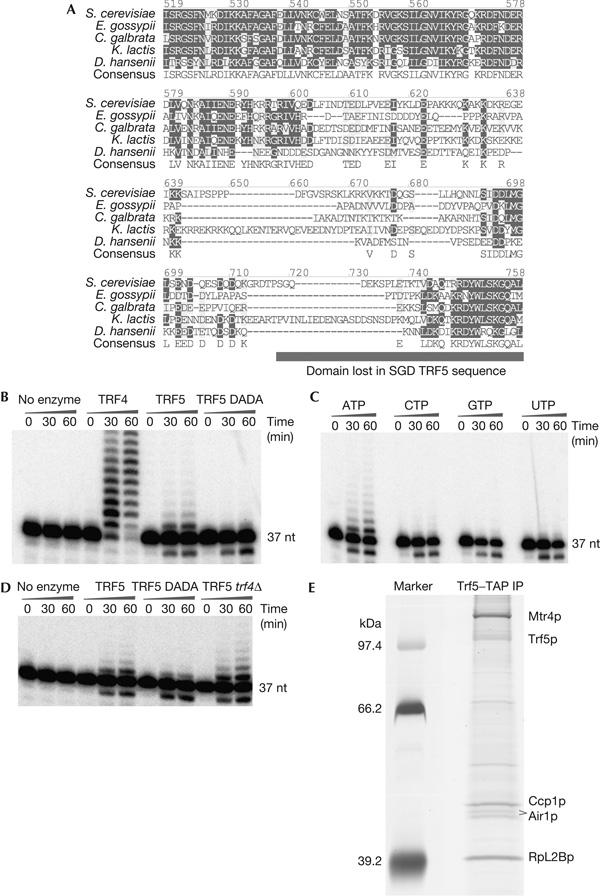
The TRAMP5 complex shows Trf5p-dependent polyadenylation activity. (A) The predicted sequence of the carboxy-terminal region of Saccharomyces cerevisiae Trf5p was compared with the predicted open reading frames from the genomes of related yeasts. (BD) In vitro poly(A) polymerase assays. (B) Comparison of the activity of purified Trf4p, Trf5p and the catalytically inactive Trf5p DADA mutant. (C) Comparison of polymerase activity with different nucleotide triphosphates. (D) Purified Trf5p retains poly(A) polymerase activity when purified from a strain lacking Trf4p. Proteins were isolated by means of C-terminal tandem affinity purification (TAP) tags from yeast grown to OD600 nm 1.0 at 25°C in YPD. Trf4–TAP and Trf5–TAP concentrations were normalized by western blotting of the immunoprecipitated (IP) fractions using an anti-TAP antibody that recognizes the calmodulin binding peptide region of the tag. The substrate is a 5′-labelled 37-nt transcript derived from the pBS linker. Samples were taken at the indicated time points and resolved on a 12% polyacrylamide/urea gel. (E) SDS gel analysis of proteins co-precipitated with Trf5p. Marker, molecular weight markers; Trf5–TAP IP, precipitated proteins. Species identified by mass spectrometry are labelled. Rpl2Bp and Ccp1p (cytochrome c peroxidase) are abundant proteins that are likely to be contaminants.

References

    1. Allmang C, Kufel J, Chanfreau G, Mitchell P, Petfalski E, Tollervey D (1999) Functions of the exosome in rRNA, snoRNA and snRNA synthesis. EMBO J 18: 5399–5410 - PMC - PubMed
    1. Bousquet-Antonelli C, Presutti C, Tollervey D (2000) Identification of a regulated pathway for nuclear pre-mRNA turnover. Cell 102: 765–775 - PubMed
    1. Castano IB, Heath-Pagliuso S, Sadoff BU, Fitzhugh DJ, Christman MF (1996) A novel family of TRF (DNA topoisomerase I-related function) genes required for proper nuclear segregation. Nucleic Acids Res 24: 2404–2410 - PMC - PubMed
    1. de la Cruz J, Kressler D, Tollervey D, Linder P (1998) Dob1p (Mtr4p) is a putative ATP-dependent RNA helicase required for the 3′ end formation of 5.8S rRNA in Saccharomyces cerevisiae. EMBO J 17: 1128–1140 - PMC - PubMed
    1. Gietz D, St Jean A, Woods RA, Schiestl RH (1992) Improved method for high efficiency transformation of intact yeast cells. Nucleic Acids Res 20: 1425. - PMC - PubMed

Publication types

MeSH terms