


Expanded tissue targets for foamy virus replication with simian immunodeficiency virus-induced immunosuppression
- PMID: 16378969
- PMCID: PMC1346877
- DOI: 10.1128/JVI.80.2.663-670.2006
Expanded tissue targets for foamy virus replication with simian immunodeficiency virus-induced immunosuppression
Abstract
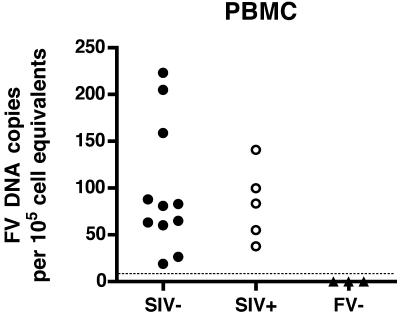
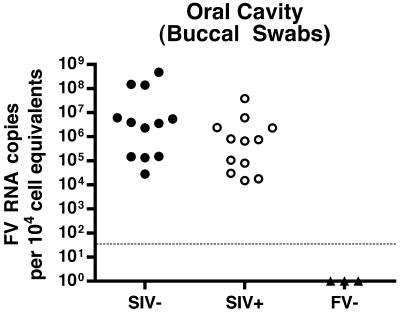
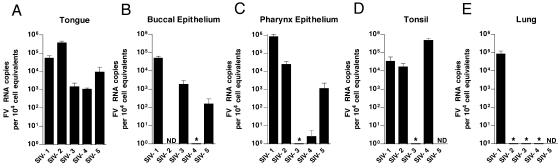
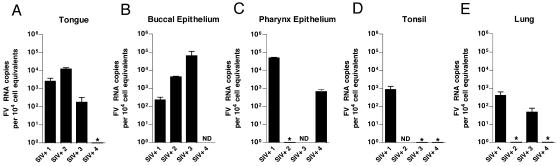
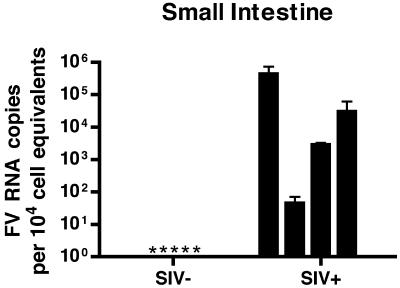
Foamy viruses (FV) are the oldest known genus of retroviruses and have persisted in nonhuman primates for over 60 million years. FV are efficiently transmitted, leading to a lifelong nonpathogenic infection. Transmission is thought to occur through saliva, but the detailed mechanism is unknown. Interestingly, this persistent infection contrasts with the rapid cytopathicity caused by FV in vitro, suggesting a host defense against FV. To better understand the tissue specificity of FV replication and host immunologic defense against FV cytopathicity, we quantified FV in tissues of healthy rhesus macaques (RM) and those severely immunosuppressed by simian immunodeficiency virus (SIV). Contrary to earlier findings, we find that all immunocompetent animals consistently have high levels of viral RNA in oral tissues but not in other tissues examined, including the small intestine. Strikingly, abundant viral transcripts were detected in the small intestine of all of the SIV-infected RM, which has been shown to be a major site of SIV (and human immunodeficiency virus)-induced CD4+ T-cell depletion. In contrast, there was a trend to lower viral RNA levels in oropharyngeal tissues of SIV-infected animals. The expansion of FV replication to the small intestine but not to other CD4+ T-cell-depleted tissues suggests that factors other than T-cell depletion, such as dysregulation of the jejunal microenvironment after SIV infection, likely account for the expanded tissue tropism of FV replication.
Figures
References
-
- Ahmed, R. K., G. Biberfeld, and R. Thorstensson. 2005. Innate immunity in experimental SIV infection and vaccination. Mol. Immunol. 42:251-258. - PubMed
-
- AVMA Panel on Euthanasia. American Veterinary Medical Association. 2001. 2000 report of the AVMA Panel on Euthanasia. J. Am. Vet. Med. Assoc. 218:669-696. - PubMed
-
- Blewett, E. L., D. H. Black, N. W. Lerche, G. White, and R. Eberle. 2000. Simian foamy virus infections in a baboon breeding colony. Virology 278:183-193. - PubMed
-
- Boneva, R. S., A. J. Grindon, S. L. Orton, W. M. Switzer, V. Shanmugam, A. I. Hussain, V. B. Bhullar, M. E. Chamberland, W. Heneine, T. M. Folks, and L. E. Chapman. 2002. Simian foamy virus infection in a blood donor. Transfusion 42:886-891. - PubMed
-
- Bosinger, S. E., K. A. Hosiawa, M. J. Cameron, D. Persad, L. Ran, L. Xu, M. R. Boulassel, M. Parenteau, J. Fournier, E. W. Rud, and D. J. Kelvin. 2004. Gene expression profiling of host response in models of acute HIV infection. J. Immunol. 173:6858-6863. - PubMed
Publication types
MeSH terms
Substances
Associated data
- Actions
- Actions
- Actions
- Actions
- Actions
- Actions
- Actions
- Actions
Grants and funding
LinkOut - more resources
Full Text Sources
Other Literature Sources
Research Materials
