


Naïve and memory cell turnover as drivers of CCR5-to-CXCR4 tropism switch in human immunodeficiency virus type 1: implications for therapy
- PMID: 16378982
- PMCID: PMC1346847
- DOI: 10.1128/JVI.80.2.802-809.2006
Naïve and memory cell turnover as drivers of CCR5-to-CXCR4 tropism switch in human immunodeficiency virus type 1: implications for therapy
Abstract
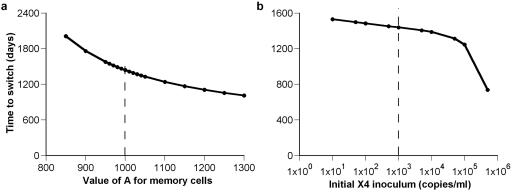
Early human immunodeficiency virus infection is characterized by the predominance of CCR5-tropic (R5) virus. However, in many individuals CXCR4-tropic (X4) virus appears in late infection. The reasons for this phenotypic switch are unclear. The patterns of chemokine receptor expression suggest that X4 and R5 viruses have a preferential tropism for naïve and memory T cells, respectively. Since memory cells divide approximately 10 times as often as naïve cells in uninfected individuals, a tropism for memory cells in early infection may provide an advantage. However, with disease progression both naïve and memory cell division frequencies increase, and at low CD4 counts, the naïve cell division frequency approaches that of memory cells. This may provide a basis for the phenotypic switch from R5 to X4 virus observed in late infection. We show that a model of infection using observed values for cell turnover supports this mechanism. The phenotypic switch from R5 to X4 virus occurs at low CD4 counts and is accompanied by a rapid rise in viral load and drop in CD4 count. Thus, low CD4 counts are both a cause and an effect of X4 virus dominance. We also investigate the effects of different antiviral strategies. Surprisingly, these results suggest that both conventional antiretroviral regimens and CCR5 receptor-blocking drugs will promote R5 virus over X4 virus.
Figures


References
-
- Arron, S. T., R. M. Ribeiro, A. Gettie, R. Bohm, J. Blanchard, J. Yu, A. S. Perelson, D. D. Ho, and L. Zhang. 2005. Impact of thymectomy on the peripheral T cell pool in rhesus macaques before and after infection with simian immunodeficiency virus. Eur. J. Immunol. 35:46-55. - PubMed
-
- Benito, J. M., J. M. Zabay, J. Gil, M. Bermejo, A. Escudero, E. Sanchez, and E. Fernandez-Cruz. 1997. Quantitative alterations of the functionally distinct subsets of CD4 and CD8 T lymphocytes in asymptomatic HIV infection: changes in the expression of CD45RO, CD45RA, CD11b, CD38, HLA-DR, and CD25 antigens. J. Acquir. Immune Defic. Syndr. Hum. Retrovirol. 14:128-135. - PubMed
-
- Berger, E. A., P. M. Murphy, and J. M. Farber. 1999. Chemokine receptors as HIV-1 coreceptors: roles in viral entry, tropism, and disease. Annu. Rev. Immunol. 17:657-700. - PubMed
-
- Blaak, H., A. B. van't Wout, M. Brouwer, B. Hooibrink, E. Hovenkamp, and H. Schuitemaker. 2000. In vivo HIV-1 infection of CD45RA+CD4+ T cells is established primarily by syncytium-inducing variants and correlates with the rate of CD4+ T cell decline. Proc. Natl. Acad. Sci. USA 97:1269-1274. - PMC - PubMed
Publication types
MeSH terms
Substances
Grants and funding
LinkOut - more resources
Full Text Sources
Medical
Research Materials
