


DBTSS: DataBase of Human Transcription Start Sites, progress report 2006
- PMID: 16381981
- PMCID: PMC1347491
- DOI: 10.1093/nar/gkj129
DBTSS: DataBase of Human Transcription Start Sites, progress report 2006
Abstract
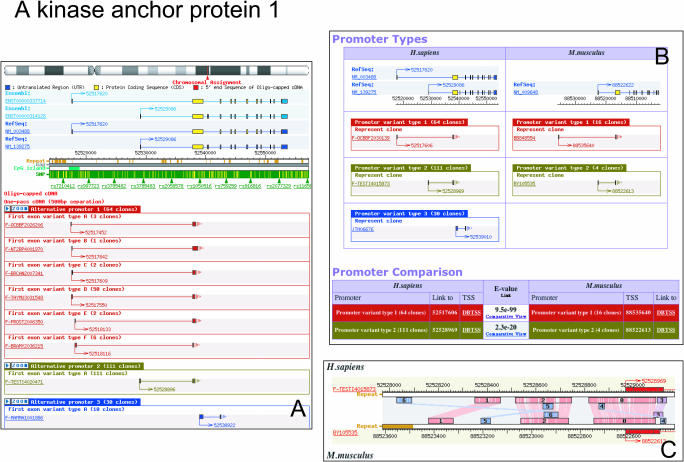
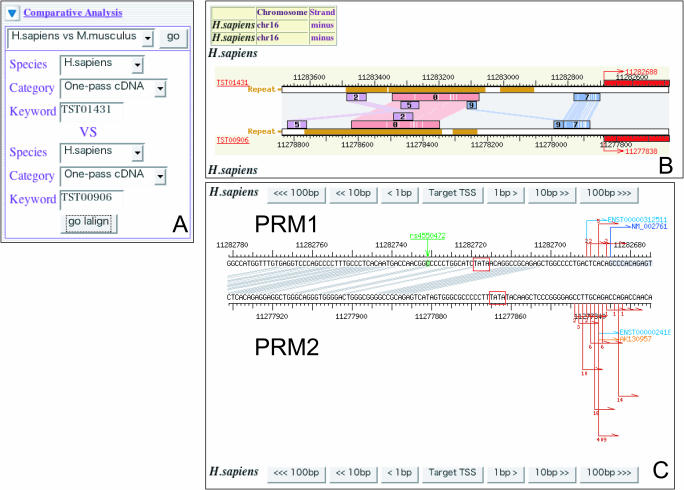
DBTSS was first constructed in 2002 based on precise, experimentally determined 5' end clones. Several major updates and additions have been made since the last report. First, the number of human clones has drastically increased, going from 190,964 to 1,359,000. Second, information about potential alternative promoters is presented because the number of 5' end clones is now sufficient to determine several promoters for one gene. Namely, we defined putative promoter groups by clustering transcription start sites (TSSs) separated by <500 bases. A total of 8308 human genes and 4276 mouse genes were found to have putative multiple promoters. Third, DBTSS provides detailed sequence comparisons of user-specified TSSs. Finally, we have added TSS information for zebrafish, malaria and schyzon (a red algae model organism). DBTSS is accessible at http://dbtss.hgc.jp.
Figures
References
-
- Bajic V.B., Tan S.L., Suzuki Y., Sugano S. Promoter prediction analysis on the whole human genome. Nat. Biotechnol. 2004;22:1467–1473. - PubMed
-
- Maruyama K., Sugano S. Oligo-capping: a simple method to replace the cap structure of eukaryotic mRNAs with oligoribonucleotides. Gene. 1994;138:171–174. - PubMed
Publication types
MeSH terms
LinkOut - more resources
Full Text Sources
Other Literature Sources
