. 2006 Jan;188(2):556-68.
doi: 10.1128/JB.188.2.556-568.2006.

Identification of Listeria monocytogenes genes contributing to intracellular replication by expression profiling and mutant screening

Affiliations

Identification of Listeria monocytogenes genes contributing to intracellular replication by expression profiling and mutant screening

Biju Joseph et al. J Bacteriol. 2006 Jan.

Abstract

A successful transition of Listeria monocytogenes from the extracellular to the intracellular environment requires a precise adaptation response to conditions encountered in the host milieu. Although many key steps in the intracellular lifestyle of this gram-positive pathogen are well characterized, our knowledge about the factors required for cytosolic proliferation is still rather limited. We used DNA microarray and real-time reverse transcriptase PCR analyses to investigate the transcriptional profile of intracellular L. monocytogenes following epithelial cell infection. Approximately 19% of the genes were differentially expressed by at least 1.6-fold relative to their level of transcription when grown in brain heart infusion medium, including genes encoding transporter proteins essential for the uptake of carbon and nitrogen sources, factors involved in anabolic pathways, stress proteins, transcriptional regulators, and proteins of unknown function. To validate the biological relevance of the intracellular gene expression profile, a random mutant library of L. monocytogenes was constructed by insertion-duplication mutagenesis and screened for intracellular-growth-deficient strains. By interfacing the results of both approaches, we provide evidence that L. monocytogenes can use alternative carbon sources like phosphorylated glucose and glycerol and nitrogen sources like ethanolamine during replication in epithelial cells and that the pentose phosphate cycle, but not glycolysis, is the predominant pathway of sugar metabolism in the host environment. Additionally, we show that the synthesis of arginine, isoleucine, leucine, and valine, as well as a species-specific phosphoenolpyruvate-dependent phosphotransferase system, play a major role in the intracellular growth of L. monocytogenes.


Figures

FIG. 1.
FIG. 1.
Changes in expression of genes belonging to functional groups. The bars show the percentages of listerial genes in each group that exhibit altered expression inside epithelial cells. The white bars indicate the proportion of genes that are down-regulated, and the black bars represent the proportion of up-regulated genes for each functional group. The total number of genes per functional category is shown in parentheses and is equivalent to 100%.
FIG. 2.
FIG. 2.
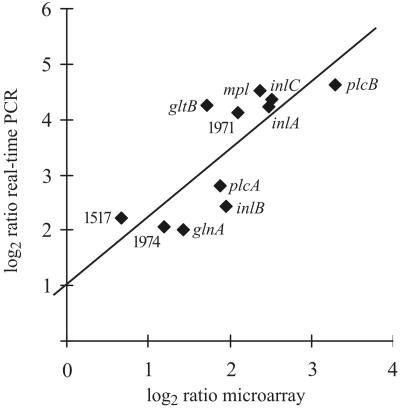
Correlation of microarray and real-time RT-PCR analyses of selected genes. The changes in intracellular gene expression compared to that in BHI (RNACaco/RNABHI) were log transformed. The relative expression of the genes studied was normalized to the expression of the housekeeping gene rpoB as described elsewhere (28, 41). The genes studied included lmo1517 (1517), lmo1974 (1974), and lmo1971 (1971). Six independent real-time RT-PCR experiments were performed.
FIG. 3.
FIG. 3.
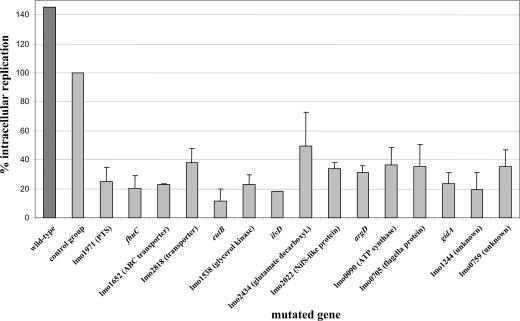
Effects of insertional knockouts on the intracellular replication of L. monocytogenes. Caco-2 cells were infected with either the wild-type strain or insertional mutants as described in Materials and Methods. Mutated genes are in the same order as in Table 2, and putative functions are indicated in parentheses. The number of CFU recovered after 7 hours was determined, and reduced survival of the mutants was calculated as a percentage compared to the control group. The control group comprised 107 insertional mutants whose intracellular growth was not significantly affected. Error bars represent the standard deviations from the mean (n ≥ 3 for insertional mutants; n = 13 for the wild type). The significance level was ≤0.02 according to Student's t test. lmo2434 encodes a glutamate decarboxylase (glutamate decarb.).
FIG. 4.
FIG. 4.
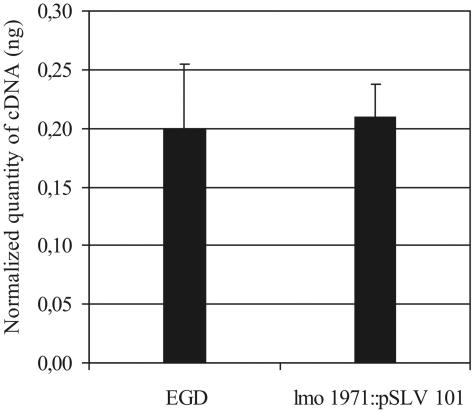
Real-time RT-PCR to study the effects of pLSV101 insertion on the transcription of genes located downstream. cDNAs obtained from wild-type strain EGD (Wt Egd) and mutant EGD-lmo1971::pLSV101 (lmo 1971 :: pLSV 101) were used as a template for real-time RT-PCR with oligonucleotides specific for lmo1968. The quantity of lmo1968-specific cDNA was normalized to the quantity of rpoB cDNA, indicating that the concentration of lmo1968-specific cDNA and thus mRNA is not reduced in the mutant strain.
FIG. 5.
FIG. 5.
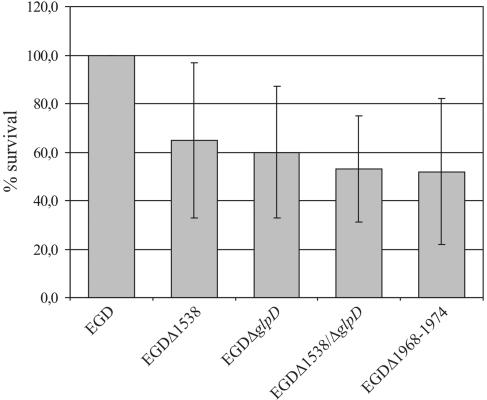
Effects of nonpolar deletions of glpD (lmo1293), lmo1538, and lmo1968-1974 on the intracellular replication of L. monocytogenes. Caco-2 cells were infected with either the wild-type strain (EGD) or the mutants to an MOI of 6 to 14, and the numbers of bacteria recovered after 7 hours of infection were determined. Mutant strains with deletions of lmo1538 (Δ1538), glpDglpD), lmo1538 and glpD (Δ1538/ΔglpD), and lmo1968-1974 (Δ1968-1974) were studied. Eleven independent infections were performed for each strain. Error bars represent the standard deviations from the means. The application of the Student t test and the use of pair differences revealed significant differences in the replication efficiencies of the tested mutants from that of the wild-type strain.
FIG. 6.
FIG. 6.
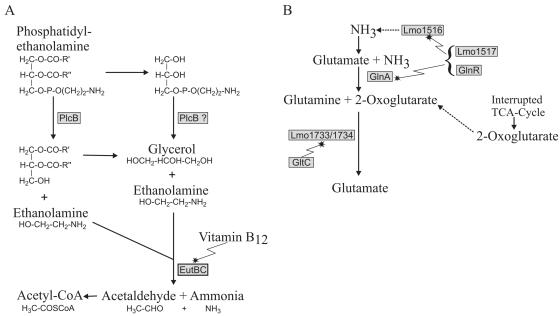
(A) Proposed model for the interaction of phospholipases with eut genes to provide alternative C and N sources to intracellular L. monocytogenes. Phosphatidylethanolamine derived from phospholipids of host cell membranes could be broken down by the listerial phospholipase PlcB (which is highly active intracellularly) into glycerol and ethanolamine which then provides additional C or N sources by the action of the EutBC (ethanolamine ammonia-lyase). Acetyl-CoA, acetyl coenzyme A. (B) Proposed model for the regulation and fine tuning of nitrogen metabolism by L. monocytogenes for intracellular proliferation. TCA-cycle, tricarboxylic acid cycle.

References

    1. Beauregard, K. E., K. D. Lee, R. J. Collier, and J. A. Swanson. 1997. pH-dependent perforation of macrophage phagosomes by listeriolysin O from Listeria monocytogenes. J. Exp. Med. 186:1159-1163. - PMC - PubMed
    1. Borezee, E., E. Pellegrini, and P. Berche. 2000. OppA of Listeria monocytogenes, an oligopeptide-binding protein required for bacterial growth at low temperature and involved in intracellular survival. Infect. Immun. 68:7069-7077. - PMC - PubMed
    1. Bubert, A., Z. Sokolovic, S. K. Chun, L. Papatheodorou, A. Simm, and W. Goebel. 1999. Differential expression of Listeria monocytogenes virulence genes in mammalian host cells. Mol. Gen. Genet. 261:323-336. - PubMed
    1. Buchrieser, C., C. Rusniok, F. Kunst, P. Cossart, and P. Glaser. 2003. Comparison of the genome sequences of Listeria monocytogenes and Listeria innocua: clues for evolution and pathogenicity. FEMS Immunol. Med. Microbiol. 35:207-213. - PubMed
    1. Burkovski, A. 2003. Ammonium assimilation and nitrogen control in Corynebacterium glutamicum and its relatives: an example for new regulatory mechanisms in actinomycetes. FEMS Microbiol. Rev. 27:617-628. - PubMed

Publication types

LinkOut - more resources