. 2006 Jan;188(2):702-10.
doi: 10.1128/JB.188.2.702-710.2006.

Electron transport in the pathway of acetate conversion to methane in the marine archaeon Methanosarcina acetivorans

Affiliations

Electron transport in the pathway of acetate conversion to methane in the marine archaeon Methanosarcina acetivorans

Qingbo Li et al. J Bacteriol. 2006 Jan.

Abstract

A liquid chromatography-hybrid linear ion trap-Fourier transform ion cyclotron resonance mass spectrometry approach was used to determine the differential abundance of proteins in acetate-grown cells compared to that of proteins in methanol-grown cells of the marine isolate Methanosarcina acetivorans metabolically labeled with 14N versus 15N. The 246 differentially abundant proteins in M. acetivorans were compared with the previously reported 240 differentially expressed genes of the freshwater isolate Methanosarcina mazei determined by transcriptional profiling of acetate-grown cells compared to methanol-grown cells. Profound differences were revealed for proteins involved in electron transport and energy conservation. Compared to methanol-grown cells, acetate-grown M. acetivorans synthesized greater amounts of subunits encoded in an eight-gene transcriptional unit homologous to operons encoding the ion-translocating Rnf electron transport complex previously characterized from the Bacteria domain. Combined with sequence and physiological analyses, these results suggest that M. acetivorans replaces the H2-evolving Ech hydrogenase complex of freshwater Methanosarcina species with the Rnf complex, which generates a transmembrane ion gradient for ATP synthesis. Compared to methanol-grown cells, acetate-grown M. acetivorans synthesized a greater abundance of proteins encoded in a seven-gene transcriptional unit annotated for the Mrp complex previously reported to function as a sodium/proton antiporter in the Bacteria domain. The differences reported here between M. acetivorans and M. mazei can be attributed to an adaptation of M. acetivorans to the marine environment.


Figures
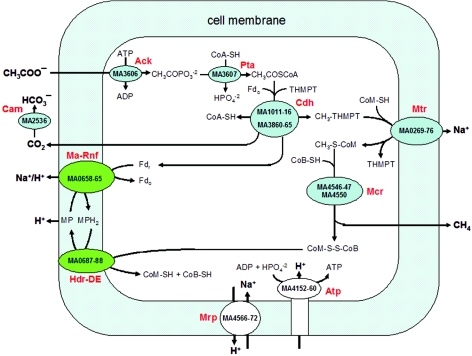
FIG. 1.
FIG. 1.
Pathway proposed for the conversion of acetate to methane by M. acetivorans. Ack, acetate kinase; Pta, phosphotransacetylase; CoA-SH, coenzyme A; THMPT, tetrahydromethanopterin; Fdr, reduced ferredoxin; Fdo, oxidized ferredoxin; Cdh, CO dehydrogenase/acetyl-CoA synthase; CoM-SH, coenzyme M; Mtr, methyl-THMPT:CoM-SH methyltransferase; CoB-SH, coenzyme B; Cam, carbonic anhydrase; Ma-Rnf, M. acetivorans Rnf; MP, methanophenazine; Hdr-DE, heterodisulfide reductase; Mrp, multiple resistance/pH regulation Na+/H+ antiporter; Atp, H+-transporting ATP synthase. Carbon transfer reactions are catalyzed by the enzymes shown in blue (see text). Electron transfer reactions are catalyzed by enzymes shown in green.
FIG. 2.
FIG. 2.
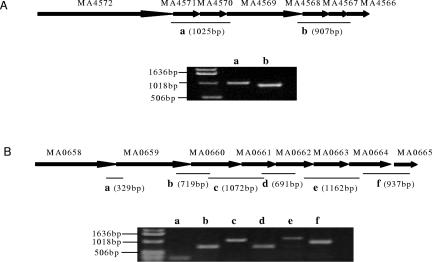
Transcriptional mapping of M. acetivorans gene clusters by RT-PCR. (A) MA4566-MA4572. (B) MA0658-MA0665. Arrows represent genes and direction of transcription. Predicted RT-PCR products are represented by lines under the genes and are labeled with letters. Predicted RT-PCR product sizes are shown in parentheses. Letters above the gel lanes correspond to predicted RT-PCR products. RT-PCR was performed with total RNA from acetate-grown M. acetivorans cells.
FIG. 3.
FIG. 3.
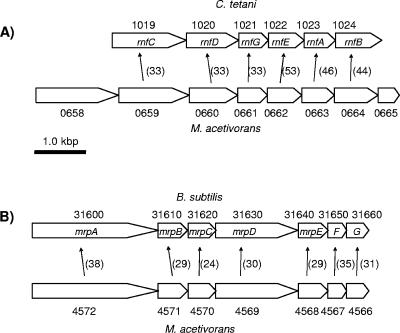
Gene organization and sequence comparisons of M. acetivorans genes with rnf and mrp genes from the Bacteria domain. (A) Comparison of the M. acetivorans MA0658-0665 transcription unit with the C. tetani rnfCDGEAB cluster (5). (B) Comparison of the M. acetivorans MA4566-4572 transcription unit with the B. subtilis mrpABCDEFG operon (19). The numbers in parentheses are percent identities between the proteins encoded by the genes as indicated by the arrows.
FIG. 4.
FIG. 4.
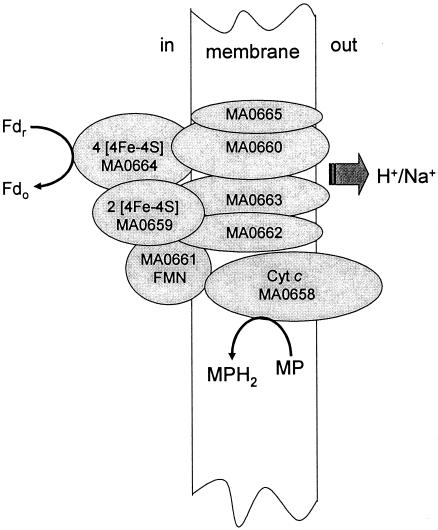
Topology and function predicted for the MA0658-0665 gene products of M. acetivorans. Fdr, reduced ferredoxin; Fdo, oxidized ferredoxin; Cyt c, cytochrome c; MP, methanophenazine.
FIG. 5.
FIG. 5.
Comparison of amino acid sequences deduced from MA0658-0665 with sequences of the Rnf subunits from Rhodobacter capsulatus (21). Identical residues are indicated asterisks. Cysteine motifs are in reverse contrast in panels A and B. The threonine postulated to covalently bind FMN is indicated by the arrow below the sequence in panel C. Numbers on the right indicate the amino acid positions. Truncated sequences are indicated by +. Sequences were aligned with ClustalW.
FIG. 6.
FIG. 6.
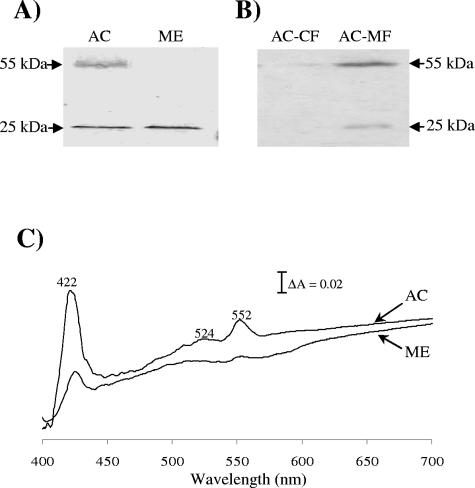
Analysis of c-type cytochromes in M. acetivorans. (A) SDS-PAGE-separated and heme-stained proteins from whole-cell lysates (35 μg) of acetate-grown (AC) and methanol-grown (ME) cells. (B) SDS-PAGE-separated and heme-stained proteins (18 μg) from the cytoplasmic (AC-CF) and membrane (AC-MF) fractions of acetate-grown cells. (C) Reduced-minus-oxidized-difference spectrum of the membrane fractions of acetate- and methanol-grown cells. Each membrane suspension contained 2 mg/ml of protein. Arrows indicate the approximate molecular mass of each band determined after staining with Coomassie brilliant blue R.

References

    1. Alber, B. E., and J. G. Ferry. 1994. A carbonic anhydrase from the archaeon Methanosarcina thermophila. Proc. Natl. Acad. Sci. USA 91:6909-6913. - PMC - PubMed
    1. Andreev, V. P., Z. Zang, T. Rejtar, S. Pillai, L. Li, Y. Wang, S.-W. Wu, and B. L. Karger. 2005. A new algorithm for quantitation of LC-MS proteomic data. Proceedings of the 53rd ASMS Conference on Mass Spectrometry and Allied Topics. The American Society for Mass Spectrometry, San Antonio, Tex.
    1. Barquera, B., C. C. Hase, and R. B. Gennis. 2001. Expression and mutagenesis of the NqrC subunit of the NQR respiratory Na+ pump from Vibrio cholerae with covalently attached FMN. FEBS Lett. 492:45-49. - PubMed
    1. Beattie, P., K. Tan, R. M. Bourne, D. Leach, P. R. Rich, and F. B. Ward. 1994. Cloning and sequencing of four structural genes for the Na+-translocating NADH-ubiquinone oxidoreductase of Vibrio alginolyticus. FEBS Lett. 356:333-338. - PubMed
    1. Brüggemann, H., S. Bäumer, W. F. Fricke, A. Wiezer, H. Liesegang, I. Decker, C. Herzberg, R. Martinez-Arias, R. Merkl, A. Henne, and G. Gottschalk. The genome sequence of Clostridium tetani, the causative agent of tetanus disease. Proc. Natl. Acad. Sci. USA 100:1316-1321. - PMC - PubMed

Publication types

LinkOut - more resources