. 2006;39(3):464-75.
doi: 10.1016/j.jbiomech.2004.12.013.

A mixture theory analysis for passive transport in osmotic loading of cells

Affiliations

A mixture theory analysis for passive transport in osmotic loading of cells

Gerard A Ateshian et al. J Biomech. 2006.

Abstract

The theory of mixtures is applied to the analysis of the passive response of cells to osmotic loading with neutrally charged solutes. The formulation, which is derived for multiple solute species, incorporates partition coefficients for the solutes in the cytoplasm relative to the external solution, and accounts for cell membrane tension. The mixture formulation provides an explicit dependence of the hydraulic conductivity of the cell membrane on the concentration of permeating solutes. The resulting equations are shown to reduce to the classical equations of Kedem and Katchalsky in the limit when the membrane tension is equal to zero and the solute partition coefficient in the cytoplasm is equal to unity. Numerical simulations demonstrate that the concentration-dependence of the hydraulic conductivity is not negligible; the volume response to osmotic loading is very sensitive to the partition coefficient of the solute in the cytoplasm, which controls the magnitude of cell volume recovery; and the volume response is sensitive to the magnitude of cell membrane tension. Deviations of the Boyle-van't Hoff response from a straight line under hypo-osmotic loading may be indicative of cell membrane tension.


Figures
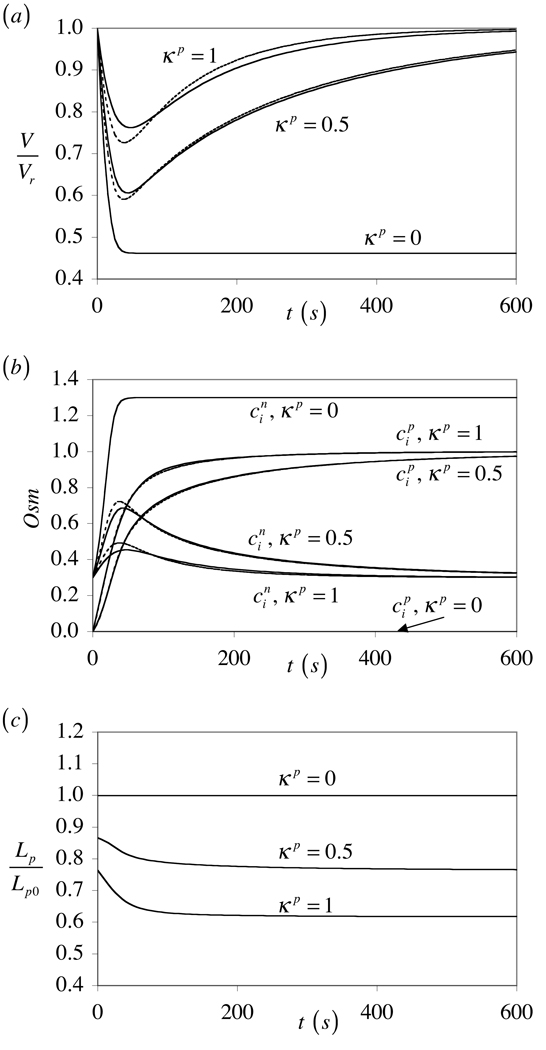
Figure 1
Figure 1
Comparison of cell response to hyper-osmotic loading, when the hydraulic conductivity Lp is taken to be concentration-dependent (solid lines) [Eq.(41)] or assumed constant (dashed lines) [Lp = Lp0], for various values of the solute partition coefficient in the membrane, κp. The case κp = 0 is equivalent to hyper-osmotic loading with a non-permeating solute. (a) Relative cell volume response, V/Vr. (b) Internal concentration of permeating solute, cip, and non-permeating solute, cin. (c) Concentration-dependent normalized membrane hydraulic conductivity, Lp/Lp0.
Figure 2
Figure 2
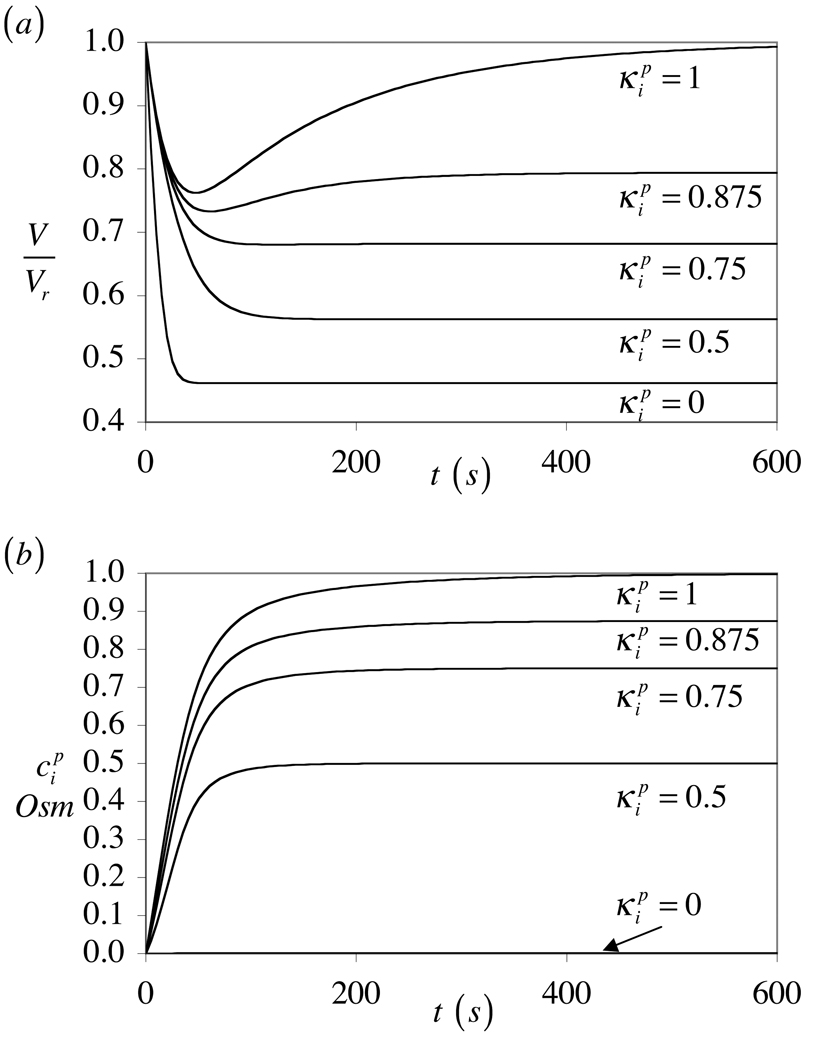
Response to hyper-osmotic loading for various values of the solute partition coefficient in the cytoplasm, κip: (a) Relative cell volume V/Vr, and (b) internal concentration of permeating solute, cip.
Figure 3
Figure 3
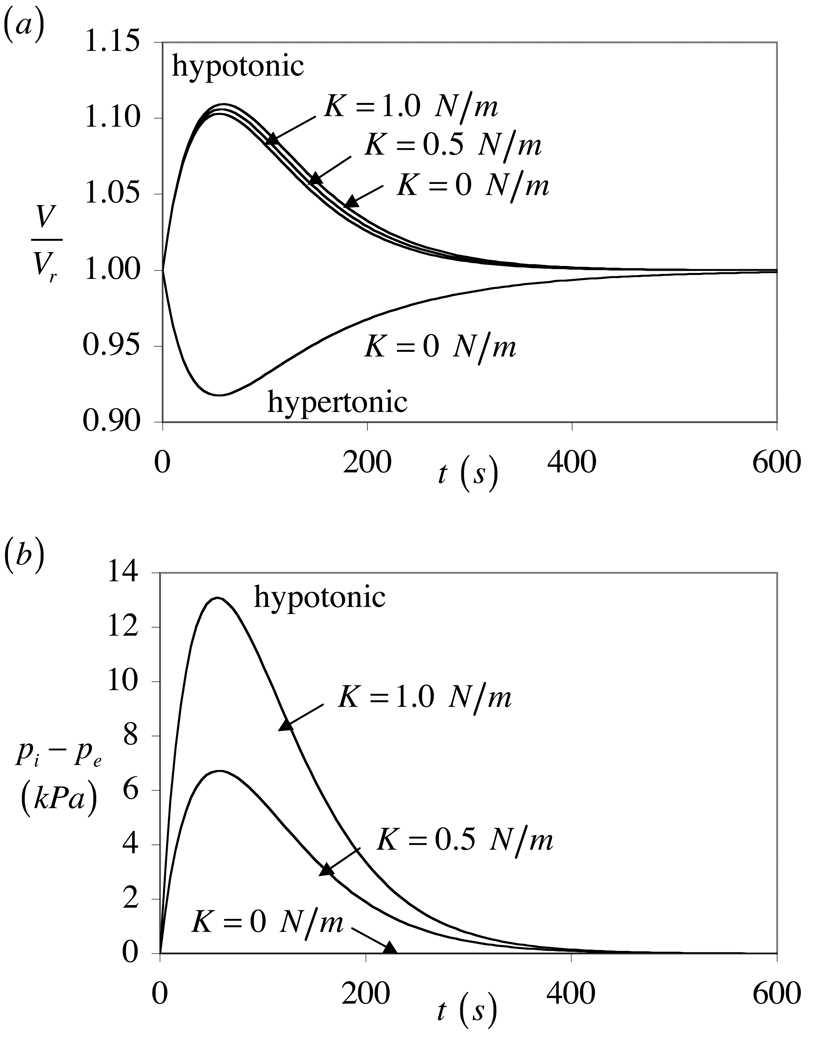
Response to hyper-osmotic and hypo-osmotic loading with a permeating solute, for various values of the area expansion modulus K. Membrane tension occurs only under hypo-osmotic loading in this example. (a) Relative cell volume V/Vr, and (b) pressure difference between the inside and outside of the cell, pipe.
Figure 4
Figure 4
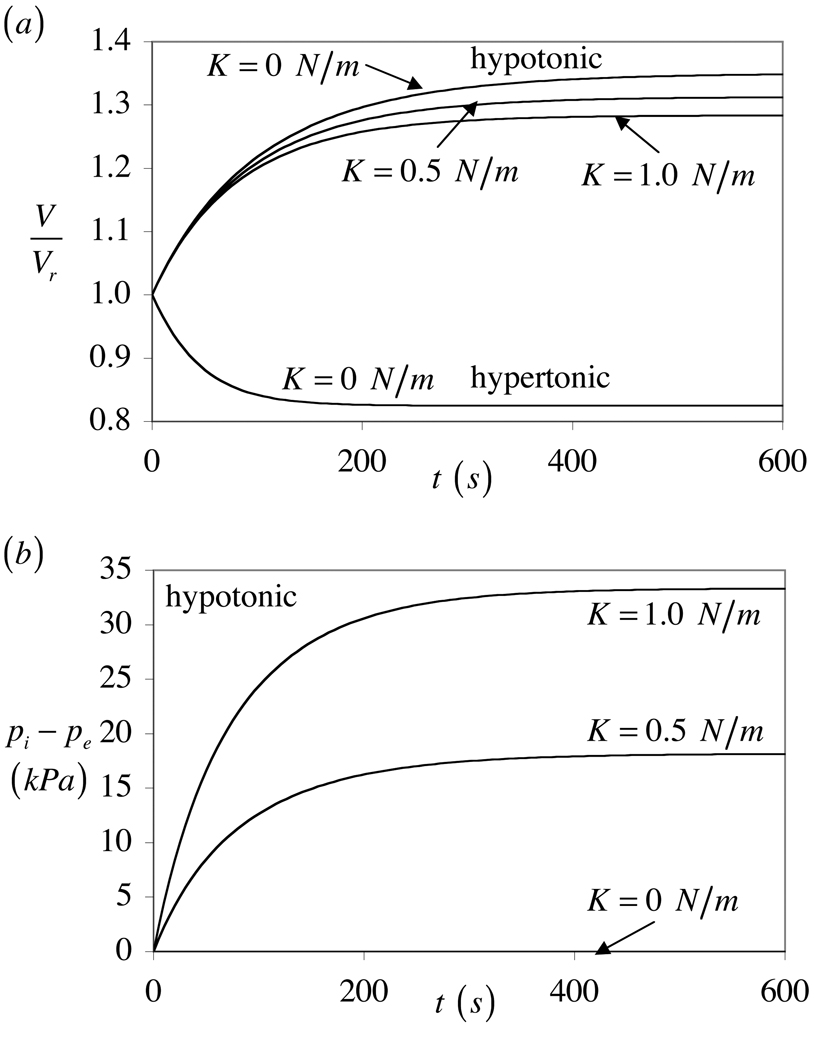
Response to hyper-osmotic and hypo-osmotic loading with a non-permeating solute, for various values of the area expansion modulus K. (a) Relative cell volume V/Vr, and (b) pressure difference between the inside and outside of the cell, pipe.
Figure 5
Figure 5
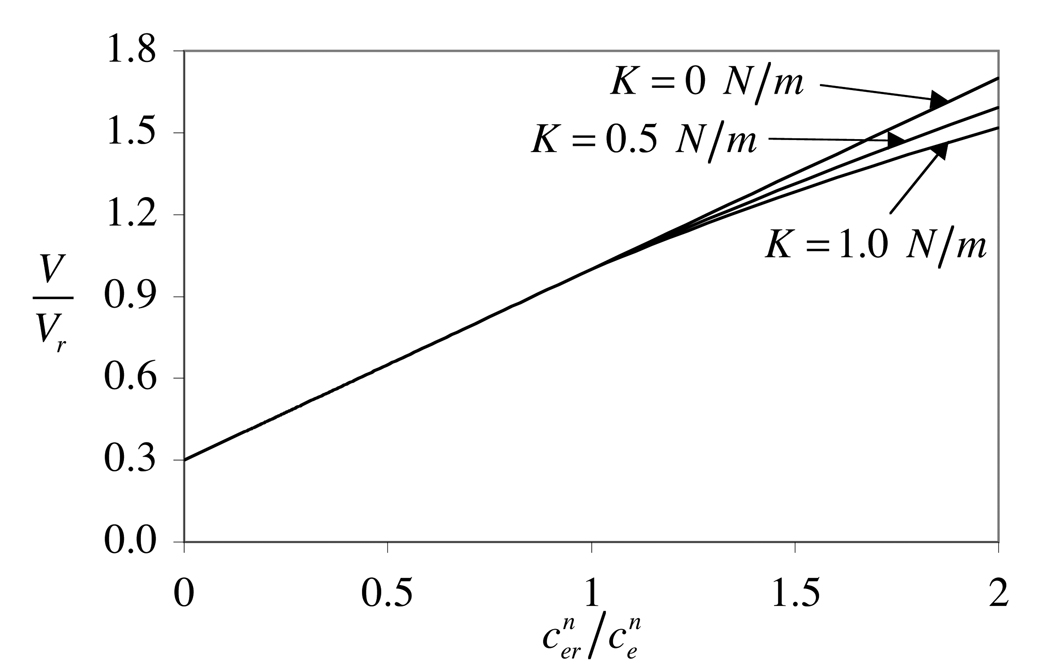
Equilibrium response of V/Vr for various values of the area expansion modulus K. When K > 0, a transition occurs from a linear to a non-linear response at cen=cern=0.3 Osm.
Figure 6
Figure 6
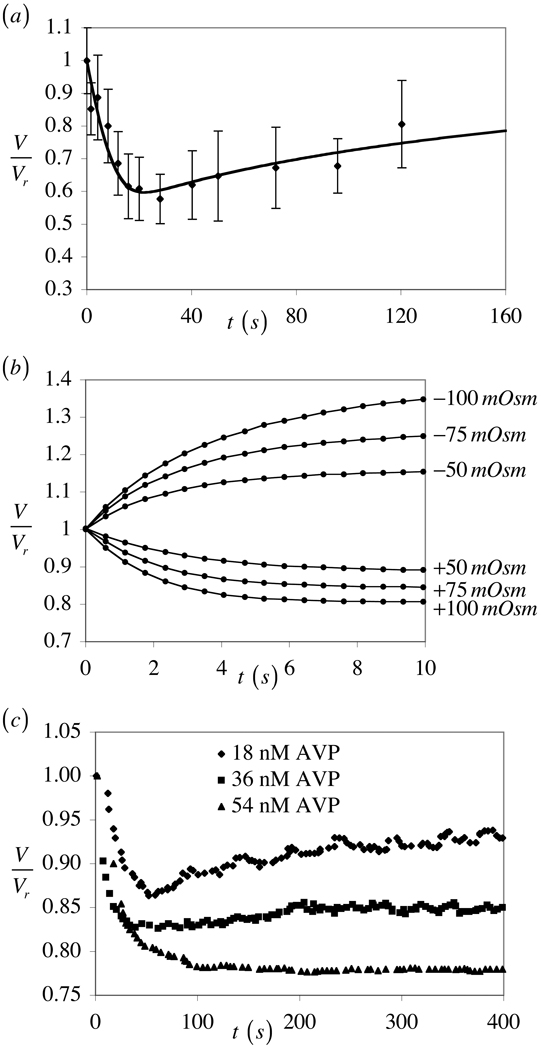
(a) Hyper-osmotic loading of bovine chondrocytes with a permeating solute (1.4 M glycerol) at 21°C, with solid curve representing prediction from K-K model (Reprinted from Med Eng Phys, Vol. 25, Xu, X., Cui, Z., Urban, J. P., Measurement of the chondrocyte membrane permeability to Me2SO, glycerol and 1,2-propanediol, pp. 573–579, Copyright (2003), with permission from The Institute of Engineering and Physics in Medicine); (b) Osmotic loading of rabbit spermatozoa at 25°C with non-permeating solutes (sucrose for hyper-osmotic loading and dilution of cell culture media with distilled water for hypo-osmotic loading) (Reprinted from Cryobiology, Vol. 41, Curry, M. R., Kleinhans, F. W., Watson, P. F., Measurement of the water permeability of the membranes of boar, ram, and rabbit spermatozoa using concentration-dependent self-quenching of an entrapped fluorophore, pp. 167–173, Copyright (2000), with permission from Elsevier); (c) Hyper-osmotic loading of Madin Darby canine kidney cell with sodium chloride in the presence of different concentrations of the hormone vasopressin, at 25°C (Reprinted figure with permission from Lucio, A. D., Santos, R. A., Mesquita, O. N., Phys Rev E Stat Nonlin Soft Matter Phys 68, 041906, 2003. Copyright 2003 by the American Physical Society).

References

    1. Atkin RJ, Craine RE. Continuum Theories of Mixtures: Basic Theory and Historical Development. Q J Mech Appl Math. 1976;29:209–244.
    1. Bowen RM. Incompressible porous media models by use of the theory of mixtures. International Journal of Engineering Science. 1980;18:1129–1148.
    1. Conte SD, De Boor C. Elementary numerical analysis: an algorithmic approach. New York: McGraw-Hill; 1980.
    1. Curry MR, Kleinhans FW, Watson PF. Measurement of the water permeability of the membranes of boar, ram, and rabbit spermatozoa using concentration-dependent self-quenching of an entrapped fluorophore. Cryobiology. 2000;41:167–173. - PubMed
    1. Evans EA, Waugh R, Melnik L. Elastic area compressibility modulus of red cell membrane. Biophys J. 1976;16:585–595. - PMC - PubMed

Publication types

LinkOut - more resources