


A phase I trial of pox PSA vaccines (PROSTVAC-VF) with B7-1, ICAM-1, and LFA-3 co-stimulatory molecules (TRICOM) in patients with prostate cancer
- PMID: 16390546
- PMCID: PMC1360095
- DOI: 10.1186/1479-5876-4-1
A phase I trial of pox PSA vaccines (PROSTVAC-VF) with B7-1, ICAM-1, and LFA-3 co-stimulatory molecules (TRICOM) in patients with prostate cancer
Abstract
Purpose: Based on previous studies that demonstrated the safety profile and preliminary clinical activity of prostate specific antigen (PSA) targeted therapeutic vaccines, as well as recent laboratory data supporting the value of the addition of co-stimulatory molecules B7-1, ICAM-1, and LFA-3 (designated TRICOM) to these vaccines, we conducted a Phase I study to evaluate the safety and immunogenicity of a novel vaccinia and fowlpox vaccine incorporating the PSA gene sequence and TRICOM.
Methods: In this study, ten patients with androgen independent prostate cancer with or without metastatic disease were enrolled. Patients were treated with 2 x l0(8) pfu of a recombinant vaccinia virus vaccine (PROSTVAC-V) followed by 1 x 10(9) pfu of the booster recombinant fowlpox virus (PROSTVAC-F) both with gene sequences for PSA and TRICOM. The mean age of patients enrolled in the study was 70 (range 63 to 79). The mean PSA at baseline was 434 (range 9-1424).
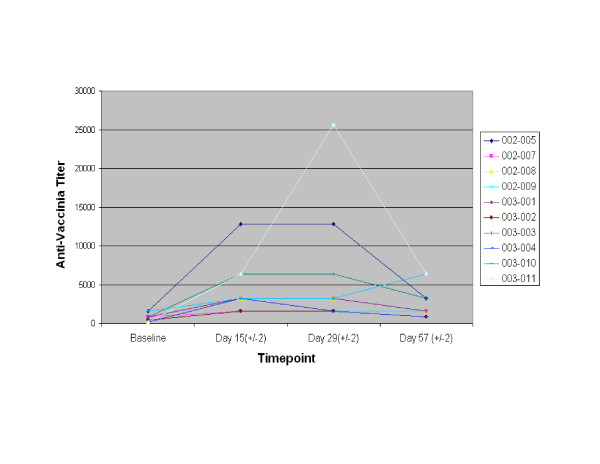
Results: There were no deaths, and no Grade 3 or 4 adverse events. The most commonly reported adverse events, regardless of causality, were injection site reactions and fatigue. One serious adverse event (SAE) occurred that was unrelated to vaccine; this patient developed progressive disease with a new sphenoid metastasis. PSA was measured at week 4 and week 8. Four patients had stable disease (with less than 25% increase in PSA) through the week 8 study period. Anti-PSA antibodies were not induced with therapy: however, anti-vaccinia titers increased in all patients.
Conclusion: This study demonstrated that vaccination with PROSTVAC-V and PROSTVAC-F combined with TRICOM is well-tolerated and generated an immune response to vaccinia. Therefore, PROSTVAC-VF/TRICOM represents a feasible therapeutic approach for further phase II and III study in patients with prostate cancer.
Figures
References
-
- Littrup PJ. The American Cancer Society's National Prostate Cancer Detection Project. Can J Oncol. 1994;4:65–69. - PubMed
-
- Petrylak DP, Tangen CM, Hussain MH, Lara PN, Jr, Jones JA, Taplin ME, Burch PA, Berry D, Moinpour C, Kohli M, Benson MC, Small EJ, Raghavan D, Crawford ED. Docetaxel and estramustine compared with mitoxantrone and prednisone for advanced refractory prostate cancer. N Engl J Med. 2004;351:1513–1520. doi: 10.1056/NEJMoa041318. - DOI - PubMed
-
- Eder JP, Kantoff PW, Roper K, Xu GX, Bubley GJ, Boyden J, Gritz L, Mazzara G, Oh WK, Arlen P, Tsang KY, Panicali D, Schlom J, Kufe DW. A phase I trial of a recombinant vaccinia virus expressing prostate-specific antigen in advanced prostate cancer. Clin Cancer Res. 2000;6:1632–1638. - PubMed
-
- Gulley J, Chen AP, Dahut W, Arlen PM, Bastian A, Steinberg SM, Tsang K, Panicali D, Poole D, Schlom J, Michael Hamilton J. Phase I study of a vaccine using recombinant vaccinia virus expressing PSA (rV-PSA) in patients with metastatic androgen-independent prostate cancer. Prostate. 2002;53:109–117. doi: 10.1002/pros.10130. - DOI - PubMed
LinkOut - more resources
Full Text Sources
Other Literature Sources
Medical
Research Materials
Miscellaneous
