. 2006 Jan;72(1):192-9.
doi: 10.1128/AEM.72.1.192-199.2006.

New insights into the lifestyle of the cold-loving SM1 euryarchaeon: natural growth as a monospecies biofilm in the subsurface

Affiliations

New insights into the lifestyle of the cold-loving SM1 euryarchaeon: natural growth as a monospecies biofilm in the subsurface

Ruth Henneberger et al. Appl Environ Microbiol. 2006 Jan.

Abstract

In the surface waters of sulfidic springs near Regensburg, Bavaria, Germany, the SM1 euryarchaeon, together with filamentous bacteria, forms the recently described unique string-of-pearls community. In addition to naturally occurring string-of-pearls communities, the growth of these communities was also observed on polyethylene nets provided as an artificial attachment material in the streamlets of springs. In order to learn more about the distribution and origin of the SM1 euryarchaeon and its possible occurrence in the subsurface, polyethylene nets were incubated as deeply as possible in different spring holes. After a short residence time, slime-like, milky drops, almost completely composed of SM1 euryarchaeon, were attached to the nets, indicating that this organism grows independent of a partner in deeper earth layers. A newly designed in situ biofilm trapping system allowed the quantitative harvesting of organisms exhibiting this newly discovered lifestyle of the SM1 euryarchaeon for detailed biological studies. The discovery of naturally occurring archaeal biofilms extends our knowledge of the biology and ecological significance of archaea in their environments.


Figures
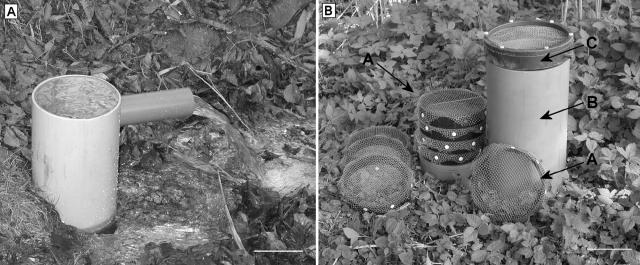
FIG. 1.
FIG. 1.
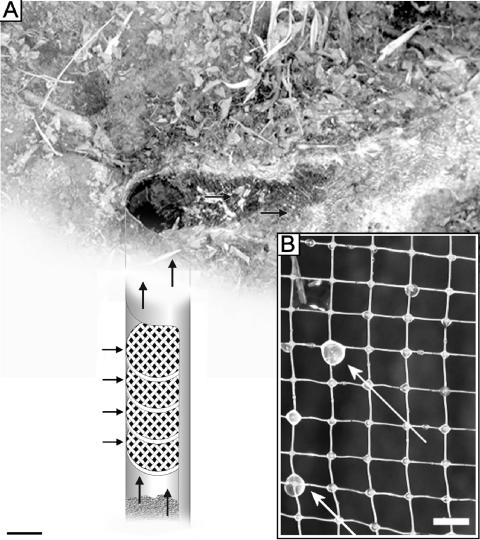
(A) Water collector. The funnel with attached tube was used to plug the drill hole, collect the emerging water, and estimate the flow rate of the springwater. Bar, 10 cm. (B) Biofilm trapping system. Frames covered with polyethylene nets (arrow A) were arranged within a plastic tube (diameter, 17 cm; length, 35 cm) (B) and fixed with a screwed-frame construction (arrow C). Bar, 10 cm.
FIG. 2.
FIG. 2.
(A) Biofilm trapping system (scheme) within the drilling hole of the Islinger Mühlbach spring. Horizontal arrows point to plastic rings covered with polyethylene nets. The other arrows indicate the water flow. Bar, 10 cm. (B) Small, slime-like biomaterial droplets with a milky appearance (white arrows) sticking strongly to polyethylene nets after a short incubation time in the sulfidic water flow (see Fig. 1A). Bar, 0.5 cm.
FIG. 3.
FIG. 3.
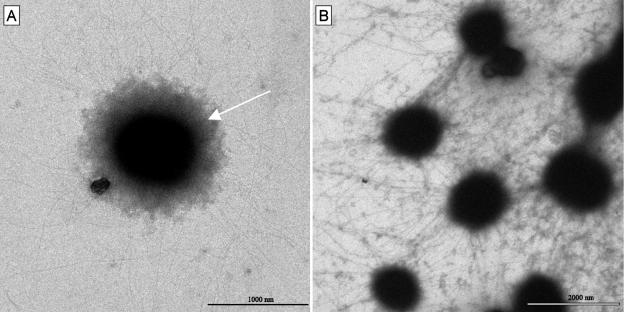
Electron micrographs of SM1 cells from a negatively stained biofilm. (A) Single SM1 cell with hami and an electron-dense corona surrounding the cell (arrow). (B) Entangled web of SM1 hami within the biofilm.
FIG. 4.
FIG. 4.
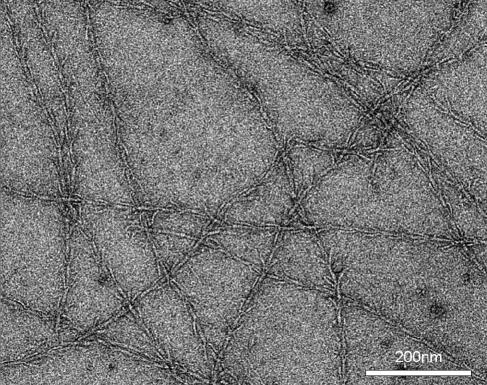
Electron micrograph of negatively stained SM1 hami within the biofilm.
FIG. 5.
FIG. 5.
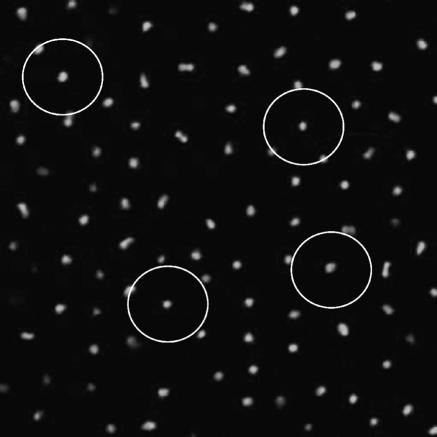
Confocal laser scanning micrograph of a layer of the SM1 biofilm. The FISH-stained SM1 cells (ARCHmix) show a constant and regular three-dimensional arrangement. Each cell has a distance of about 4 μm to its neighbors. The circles have a diameter of 8 μm.

References

    1. Allison, D. G., B. Riz, A. SanJose, and P. Gilbert. 1998. Extracellular products as mediators of the formation and detachment of Pseudomonas fluorescens biofilms. FEMS Microbiol. Lett. 167:179-184. - PubMed
    1. Amann, R. I., B. J. Binder, R. J. Olson, S. W. Chisholm, R. Devereux, and D. A. Stahl. 1990. Combination of 16S rRNA-targeted oligonucleotide probes with flow cytometry for analyzing mixed microbial populations. Appl. Environ. Microbiol. 56:1919-1925. - PMC - PubMed
    1. Antón, J., I. Meseger, and F. Rodríguez-Valera. 1988. Production of an extracellular polysaccharide by Haloferax mediterranei. Appl. Environ. Microbiol. 54:2381-2386. - PMC - PubMed
    1. Antunes, A., W. Eder, P. Fareleira, H. Santos, and R. Huber. 2003. Salinisphaera shabanensis gen. nov., sp. nov., a novel, moderately halophilic bacterium from the brine-seawater interface of the Shaban Deep, Red Sea. Extremophiles 7:29-34. - PubMed
    1. Battin, T. J., A. Wille, B. Sattler, and R. Psenner. 2001. Phylogenetic and functional heterogeneity of sediment biofilms along environmental gradients in a glacial stream. Appl. Environ. Microbiol. 67:799-807. - PMC - PubMed

Publication types

LinkOut - more resources