


Effects of Lactococcus lactis on composition of intestinal microbiota: role of nisin
- PMID: 16391049
- PMCID: PMC1352298
- DOI: 10.1128/AEM.72.1.239-244.2006
Effects of Lactococcus lactis on composition of intestinal microbiota: role of nisin
Abstract
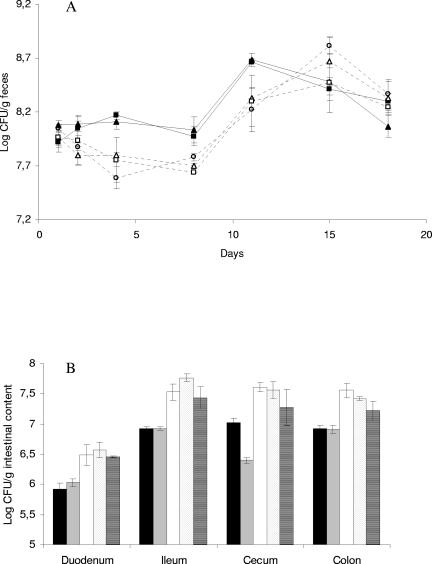
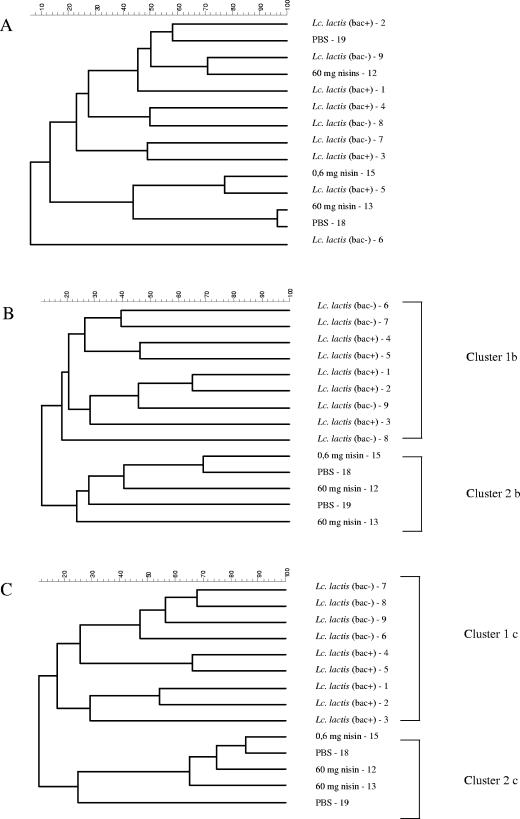
This study examined the ability of (i) pure nisin, (ii) nisin-producing Lactococcus lactis strain CHCC5826, and (iii) the non-nisin-producing L. lactis strain CHCH2862 to affect the composition of the intestinal microbiota of human flora-associated rats. The presence of both the nisin-producing and the non-nisin-producing L. lactis strains significantly increased the number of Bifidobacterium cells in fecal samples during the first 8 days but decreased the number of enterococci/streptococci in duodenum, ileum, cecum, and colon samples as detected by selective cultivation. No significant changes in the rat fecal microbiota were observed after dosage with nisin. Pearson cluster analysis of denaturing gradient gel electrophoresis profiles of the 16S rRNA genes present in the fecal microbial population revealed that the microbiota of animals dosed with either of the two L. lactis strains were different from that of control animals dosed with saline. However, profiles of the microbiota from animals dosed with nisin did not differ from the controls. The concentrations of nisin estimated by competitive enzyme-linked immunosorbent assay (ELISA) were approximately 10-fold higher in the small intestine and 200-fold higher in feces than the corresponding concentrations estimated by a biological assay. This indicates that nisin was degraded or inactivated in the gastrointestinal tract, since fragments of this bacteriocin are detected by ELISA while an intact molecule is needed to retain biological activity.
Figures
References
-
- Bennik, M. H., B. Vanloo, R. Brasseur, L. G. Gorris, and E. J. Smid. 1998. A novel bacteriocin with a YGNGV motif from vegetable-associated Enterococcus mundtii: full characterization and interaction with target organisms. Biochim. Biophys. Acta 1373:47-58. - PubMed
-
- Bouksaim, M., C. Lacroix, R. Bazin, and R. E. Simard. 1999. Production and utilization of polyclonal antibodies against nisin in an ELISA and for immuno-location of nisin in producing and sensitive bacterial strains. J. Appl. Microbiol. 87:500-510. - PubMed
-
- Daoudi, L., C. Turcotte, C. Lacroix, and I. Fliss. 2001. Production and characterization of anti-nisin Z monoclonal antibodies: suitability for distinguishing active from inactive forms through a competitive enzyme immunoassay. Appl. Microbiol. Biotechnol. 56:114-119. - PubMed
-
- Fowler, G. G., B. Jarvis, and J. Tramer. 1975. The assay of nisin in foods, p.91-105. In R. G. Board and D. G. Lovelock (ed.), Some methods for microbiological assay. Academic Press, London, United Kingdom.
Publication types
MeSH terms
Substances
LinkOut - more resources
Full Text Sources
Other Literature Sources
