


Perinatal environmental tobacco smoke exposure in rhesus monkeys: critical periods and regional selectivity for effects on brain cell development and lipid peroxidation
- PMID: 16393655
- PMCID: PMC1332653
- DOI: 10.1289/ehp.8286
Perinatal environmental tobacco smoke exposure in rhesus monkeys: critical periods and regional selectivity for effects on brain cell development and lipid peroxidation
Abstract
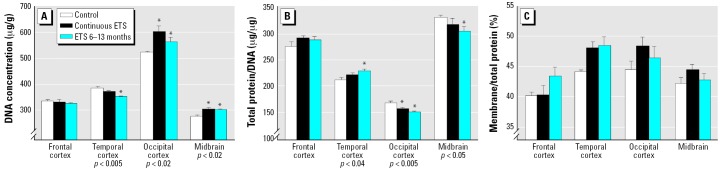
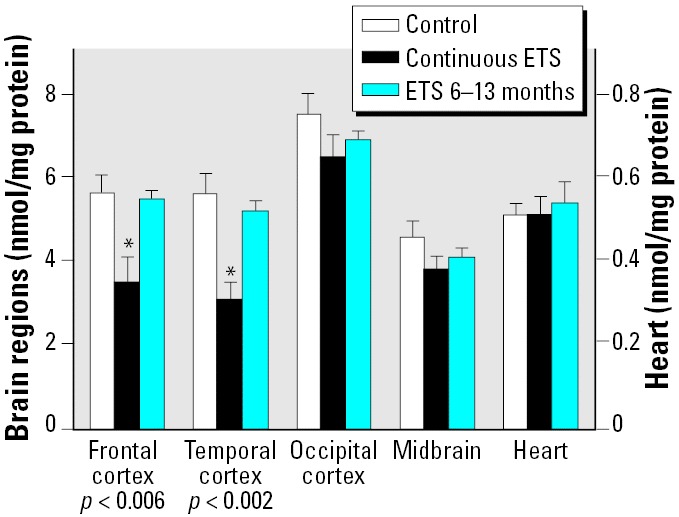
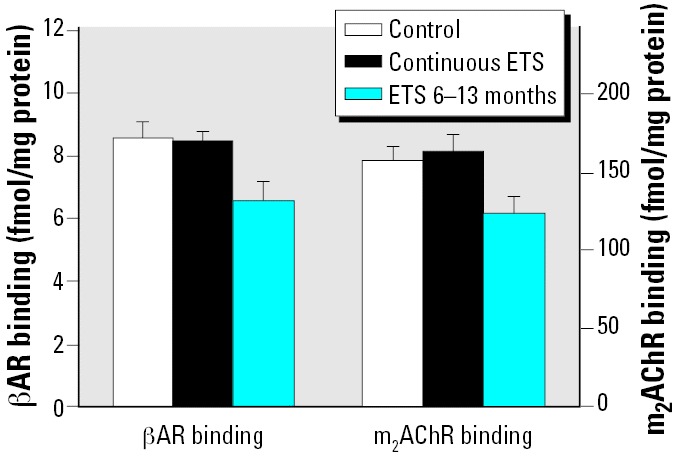
Perinatal environmental tobacco smoke (ETS) exposure in humans elicits neurobehavioral deficits. We exposed rhesus monkeys to ETS during gestation and through 13 months postnatally, or postnatally only (6-13 months). At the conclusion of exposure, we examined cerebrocortical regions and the midbrain for cell damage markers and lipid peroxidation. For perinatal ETS, two archetypal patterns were seen in the various regions, one characterized by cell loss (reduced DNA concentration) and corresponding increases in cell size (increased protein/DNA ratio), and a second pattern suggesting replacement of larger neuronal cells with smaller and more numerous glia (increased DNA concentration, decreased protein/DNA ratio). The membrane/total protein ratio, a biomarker of neurite formation, also indicated potential damage to neuronal projections, accompanied by reactive sprouting. When ETS exposure was restricted to the postnatal period, the effects were similar in regional selectivity, direction, and magnitude. These patterns resemble the effects of prenatal nicotine exposure in rodent and primate models. Surprisingly, perinatal ETS exposure reduced the level of lipid peroxidation as assessed by the concentration of thiobarbituric acid reactive species, whereas postnatal ETS did not. The heart, a tissue that, like the brain, has high oxygen demand, displayed a similar but earlier decrease (2-3 months) in lipid peroxidation in the perinatal exposure model, whereas values were reduced at 13 months with the postnatal exposure paradigm. Our results provide a mechanistic connection between perinatal ETS exposure and neurobehavioral anomalies, reinforce the role of nicotine in these effects, and buttress the importance of restricting or eliminating ETS exposure in young children.
Figures
References
-
- Bell JM, Whitmore WL, Queen KL, Orband-Miller L, Slotkin TA. Biochemical determinants of growth sparing during neonatal nutritional deprivation or enhancement: ornithine decarboxylase, polyamines, and macromolecules in brain regions and heart. Pediatr Res. 1987;22:599–604. - PubMed
-
- Bhagwat SV, Vijayasarathy C, Raza H, Mullick J, Avadhani NG. Preferential effects of nicotine and 4-(N-methyl-N-nitrosamino)-1-(3-pyridyl)-1-butanone on mitochondrial glutathione S-transferase A4-4 induction and increased oxidative stress in the rat brain. Biochem Pharmacol. 1998;56:831–839. - PubMed
-
- Eliopoulos C, Klein J, Chitayat D, Greenwald M, Koren G. Nicotine and cotinine in maternal and neonatal hair as markers of gestational smoking. Clin Invest Med. 1996;19:231–242. - PubMed
-
- Eskenazi B, Trupin LS. Passive and active maternal smoking during pregnancy, as measured by serum cotinine, and postnatal smoke exposure. 2. effect on neurodevelopment at age 5 years. Am J Epidemiol. 1995;142:S19–S29. - PubMed
Publication types
MeSH terms
Substances
Grants and funding
LinkOut - more resources
Full Text Sources
Medical