Comparative Study
. 2006 Jan 25;25(2):346-56.
doi: 10.1038/sj.emboj.7600927. Epub 2006 Jan 5.

DnaA couples DNA replication and the expression of two cell cycle master regulators

Affiliations
Comparative Study

DnaA couples DNA replication and the expression of two cell cycle master regulators

Justine Collier et al. EMBO J. .

Abstract

Cell cycle progression in Caulobacter is driven by the master transcriptional regulators CtrA and GcrA. The cellular levels of CtrA and GcrA are temporally and spatially out-of-phase during the cell cycle, with CtrA repressing gcrA transcription and GcrA activating ctrA transcription. Here, we show that DnaA, a protein required for the initiation of DNA replication, also functions as a transcriptional activator of gcrA, which in turn activates multiple genes, notably those involved in chromosome replication and segregation. The cellular concentration of DnaA is cell cycle-controlled, peaking at the time of replication initiation and gcrA induction. Regulated proteolysis of GcrA contributes to the cell cycle variations in GcrA abundance. We propose that DnaA couples DNA replication initiation with the expression of the two oscillating regulators GcrA and CtrA and that the DnaA/GcrA/CtrA regulatory cascade drives the forward progression of the Caulobacter cell cycle.


Figures
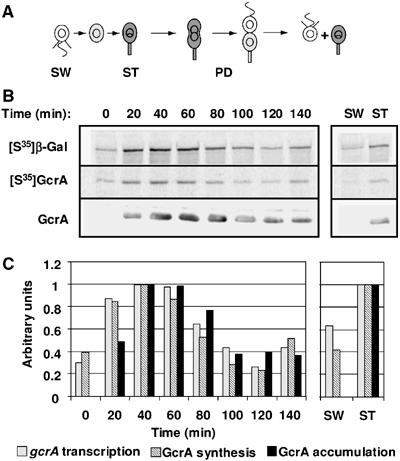
Figure 1
Figure 1
Cell cycle expression of gcrA. (A) Schematic of the Caulobacter cell cycle. Gray indicates accumulation of GcrA. Theta structures indicate replicating DNA. SW, swarmer cell; ST, stalked cell; PD, predivisional cell. (B) From the same synchronized LS4220 (gcrA+ gcrAP(−507…+92)-lacZ) strain culture, aliquots were taken at the times indicated and were either pulse-labelled with [35S]methionine to follow β-galactosidase synthesis or GcrA synthesis using either anti-β-galactosidase or anti-GcrA immunoprecipitation, or immunobloted with anti-GcrA. Autoradiograms from the immunoprecipitation of labelled β-galactosidase ([35S]β-Gal) and GcrA ([35S]GcrA), and immunoblots with anti-GcrA (GcrA) are shown. Also shown are autoradiograms and immunoblots from cell extracts from newly divided stalked and swarmer cells harvested at the end of the cell cycle. (C) Histograms of the relative rates of gcrA transcription (β-galactosidase synthesis), GcrA synthesis and GcrA accumulation as measured by phosphorimaging or densitometric scanning of immunoblots. Values were normalized to the maximum value of each experiment (at 40 min from 0 to 140 min and in stalked progenies).
Figure 2
Figure 2
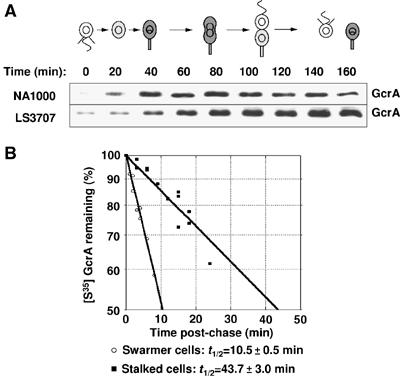
Proteolysis of GcrA is cell cycle regulated. (A) GcrA accumulation when gcrA is transcribed constitutively. Immunoblots of cell extracts from a synchronized NA1000 and LS3707 (ΔgcrA PxylXgcrA) culture using GcrA antibodies at the indicated times of the cell cycle. In the schematic of the Caulobacter cell cycle, gray indicates accumulation of GcrA in the NA1000 cells. (B) Stability of GcrA synthesized in swarmer and stalked LS3707 cells. A synchronized population of LS3707 swarmer cells was allowed to proceed through the cell cycle. At 5 (swarmer cells) and 30 min (swarmer-to-stalked cell transition), aliquots of the culture were pulse-labelled with [35S]methionine and chased for increasing amounts of time. Aliquots were taken at the times indicated and the remaining radiolabelled GcrA was determined by immunoprecipitation using GcrA antibodies, followed by SDS–PAGE and phosphorimaging. The t1/2 corresponds to the calculated half-life of GcrA in each cell type, along with the calculated standard deviation from three independent LS3707 populations.
Figure 3
Figure 3
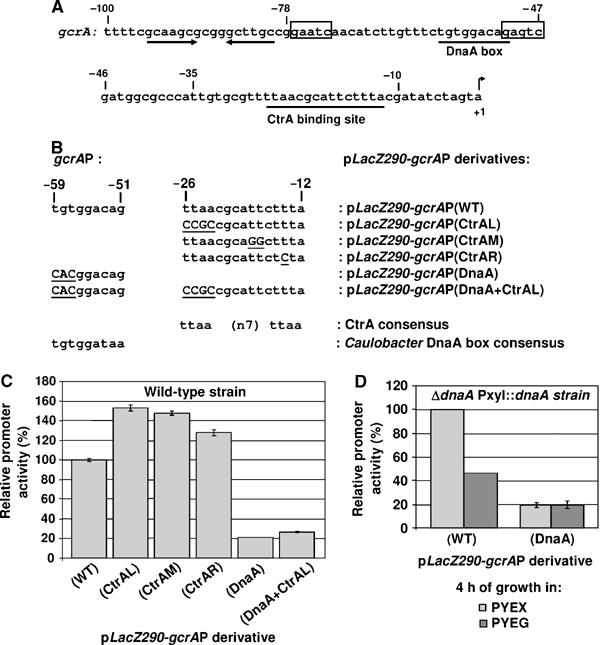
Opposite effects of CtrA and DnaA on gcrA transcription. (A) The nucleotide sequence of the gcrA promoter is shown. The transcriptional +1 start site (Holtzendorff et al, 2004), the CtrA-binding site (underlined) (Holtzendorff et al, 2004), the two putative DNA methylation sites (boxes), the putative DnaA box (underlined) and a putative hairpin structure (two arrows) are indicated. (B) The sequence of the CtrA-binding site and the DnaA box within the gcrA promoter (gcrAP) are shown and compared to the consensus CtrA-binding site and DnaA box in Caulobacter. Mutations introduced in the gcrAP are underlined and in capital letters. The names of the pLacZ290 derivatives carrying the unmodified and the mutated gcrAP fused to lacZ are also shown. (C) The graph shows the relative β-galactosidase activities from the six plasmids in (B) in an unsynchronized NA1000 strain. (D) The graph shows the relative β-galactosidase activities from pLacZ290-gcrAP(WT) and pLacZ290-gcrAP(DnaA) in an unsynchronized GM2471 (ΔdnaA∷Ω PxylX∷dnaA) strain, upon depletion of DnaA 4 h after a shift from PYE+xylose (PYEX) to PYE+glucose (PYEG). Activities in Miller units were normalized so that the activity of the gcrAP(WT) equals 100% in PYE (NA1000) or PYEX (GM2471), to facilitate comparison. Errors bars indicate the standard deviations (when they were more than 1%).
Figure 4
Figure 4
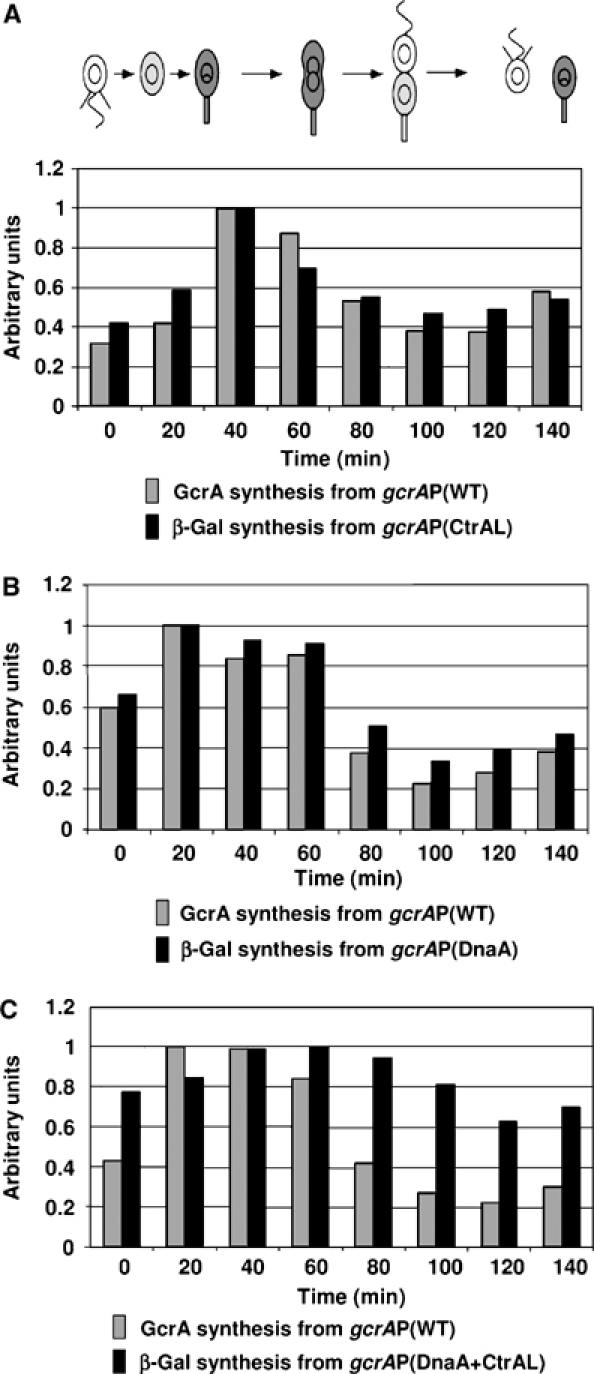
Effects of CtrA and DnaA on gcrA cell cycle transcription. Cell cycle activities of the mutated gcrA promoters were measured by immunoprecipitation of β-galactosidase from pulse-labelled samples of synchronized Caulobacter cultures. To compare with the activity of the gcrAP(WT), radiolabelled GcrA was also immunoprecipitated from the same synchrony. Relative rates of gcrA transcription from the mutated gcrA promoter and GcrA synthesis from the wild-type gcrA promoter at the indicated times of the cell cycle were measured by phosphorimaging and were normalized so that the maximum value of each experiment equals 1. The averages of the results of multiple independent experiments are shown. In the schematic of the Caulobacter cell cycle, gray indicates accumulation of GcrA in the NA1000 cells. (A) The LS4224 (gcrA+ gcrAP(CtrAL)-lacZ) strain was used to compare the cell cycle activity of the gcrAP(CtrAL) with the cell cycle activity of the gcrAP(WT). (B) The NA1000 (gcrA+) strain carrying the pLacZ290-gcrAP(DnaA) plasmid was used to compare the cell cycle activity of the gcrAP(DnaA) with the cell cycle activity of the gcrAP(WT). (C) The NA1000 (gcrA+) strain carrying the pLacZ290-gcrAP(DnaA+CtrAL) plasmid was used to compare the cell cycle activity of the gcrAP(DnaA+CtrAL) with the cell cycle activity of the gcrAP(WT).
Figure 5
Figure 5
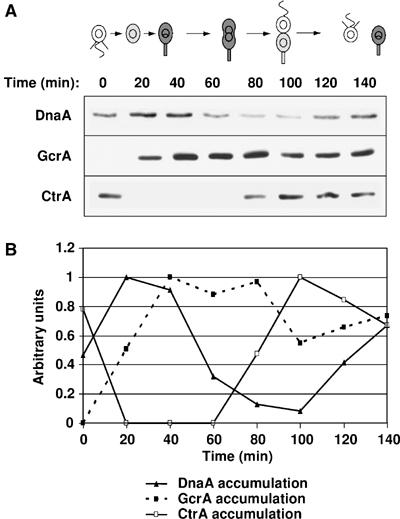
DnaA is cell cycle regulated, accumulating before GcrA. (A) Immunoblots of cell extracts from a synchronized NA1000 culture using DnaA, GcrA and CtrA antibodies at the indicated times in the cell cycle. Cultures were adjusted to the same A660 for all lanes of each gel. (B) DnaA (plain triangles, plain line), GcrA (plain squares, dashed line) and CtrA (open squares, plain line) protein levels at the indicated times of the cell cycle from densitometry graphs of the DnaA, GcrA and CtrA immunoblots. Values were normalized so that the maximum value of each immunoblot equals 1. In the schematic of the Caulobacter cell cycle, gray indicates accumulation of GcrA.
Figure 6
Figure 6
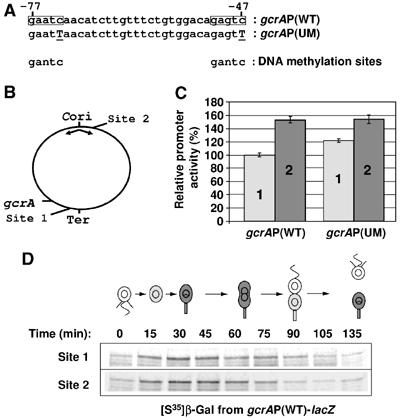
Effect of gcrAP methylation on gcrA transcription. (A) The sequences of the two putative methylation sites (boxes) within the gcrA promoter (gcrAP) are shown and compared to the consensus DNA methylation sites in Caulobacter. Mutations introduced in the gcrAP(−507…+92) methylation sites are underlined and in capital letters. (B) Diagram of the Caulobacter chromosome showing the locations of the origin of replication (Cori), the terminus region (Ter), the gcrA gene and the trpE (site 1) and hrcA (site 2) integration sites. (C) Activities of the wild-type gcrAP(WT) fused to lacZ and integrated at site 1 or site 2 (strains LS4220 and LS4221, respectively) and the unmethylatable gcrAP(UM) fused to lacZ integrated at site 1 or site 2 (strains LS4222 and LS4223, respectively) were determined by β-galactosidase assays. The activities of the control LS3321 and LS3323 strains were subtracted from the activities of the gcrAP-lacZ constructs. Activities were normalized so that the activity of the gcrAP(WT) at site 1 equals 100%. Errors bars indicate the standard deviations from three independent experiments. (D) Cell cycle gcrAP(WT) activities at site 1 and site 2 were measured by immunoprecipitation of β-galactosidase from pulse-labelled samples of synchronized LS4220 and LS4221 strains cultures, respectively. Autoradiograms from the immunoprecipitations of labelled β-galactosidase are shown. In the schematic of the Caulobacter cell cycle, gray indicates accumulation of GcrA in the NA1000 cells.
Figure 7
Figure 7
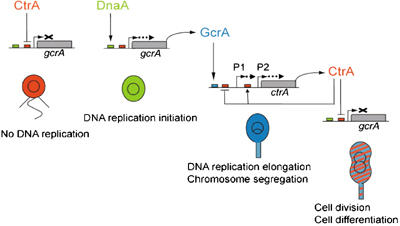
Model for the control of the Caulobacter cell cycle by sequential accumulation of the DnaA, GcrA and CtrA global cell cycle regulators. In swarmer cells, CtrA represses gcrA transcription and GcrA protein is very unstable, so GcrA does not accumulate. During the swarmer to stalked cell differentiation, CtrA is degraded and DnaA accumulates, which allows gcrA transcription to be turned on. Since GcrA is more stable in stalked cells, GcrA can accumulate efficiently. When cell division is initiated, ctrA transcription is turned back on (notably by accumulated GcrA), and DnaA is degraded and probably inactivated. Accumulation of CtrA and disappearance of active DnaA turns off gcrA transcription in predivisional cells. In the schematic of the Caulobacter cell cycle, red, green and blue indicate accumulation of CtrA, DnaA and GcrA, respectively.

References

    1. Bramhill D, Kornberg A (1988) Duplex opening by DnaA protein at novel sequences in initiation of replication at the origin of the E. coli chromosome. Cell 52: 743–755 - PubMed
    1. Domian IJ, Reisenauer A, Shapiro L (1999) Feedback control of a master bacterial cell-cycle regulator. Proc Natl Acad Sci USA 96: 6648–6653 - PMC - PubMed
    1. Domian IJ, Quon KC, Shapiro L (1997) Cell type-specific phosphorylation and proteolysis of a transcriptional regulator controls the G1-to-S transition in a bacterial cell cycle. Cell 90: 415–424 - PubMed
    1. Evinger M, Agabian N (1977) Envelope-associated nucleoid from Caulobacter crescentus stalked and swarmer cells. J Bacteriol 132: 294–301 - PMC - PubMed
    1. Fuller RS, Funnell BE, Kornberg A (1984) The DnaA protein complex with the E. coli chromosomal replication origin (oriC) and other DNA sites. Cell 38: 889–900 - PubMed

Publication types

MeSH terms