. 2006 Feb;133(3):395-406.
doi: 10.1242/dev.02215. Epub 2006 Jan 5.

lessen encodes a zebrafish trap100 required for enteric nervous system development

Affiliations

lessen encodes a zebrafish trap100 required for enteric nervous system development

Jacy Pietsch et al. Development. 2006 Feb.

Abstract

The zebrafish enteric nervous system (ENS), like those of all other vertebrate species, is principally derived from the vagal neural crest. The developmental controls that govern the specification and patterning of the ENS are not well understood. To identify genes required for the formation of the vertebrate ENS, we preformed a genetic screen in zebrafish. We isolated the lessen (lsn) mutation that has a significant reduction in the number of ENS neurons as well as defects in other cranial neural crest derived structures. We show that the lsn gene encodes a zebrafish orthologue of Trap100, one of the subunits of the TRAP/mediator transcriptional regulation complex. A point mutation in trap100 causes a premature stop codon that truncates the protein, causing a loss of function. Antisense-mediated knockdown of trap100 causes an identical phenotype to lsn. During development trap100 is expressed in a dynamic tissue-specific expression pattern consistent with its function in ENS and jaw cartilage development. Analysis of neural crest markers revealed that the initial specification and migration of the neural crest is unaffected in lsn mutants. Phosphohistone H3 immunocytochemistry revealed that there is a significant reduction in proliferation of ENS precursors in lsn mutants. Using cell transplantation studies, we demonstrate that lsn/trap100 acts cell autonomously in the pharyngeal mesendoderm and influences the development of neural crest derived cartilages secondarily. Furthermore, we show that endoderm is essential for ENS development. These studies demonstrate that lsn/trap100 is not required for initial steps of cranial neural crest development and migration, but is essential for later proliferation of ENS precursors in the intestine.


Figures
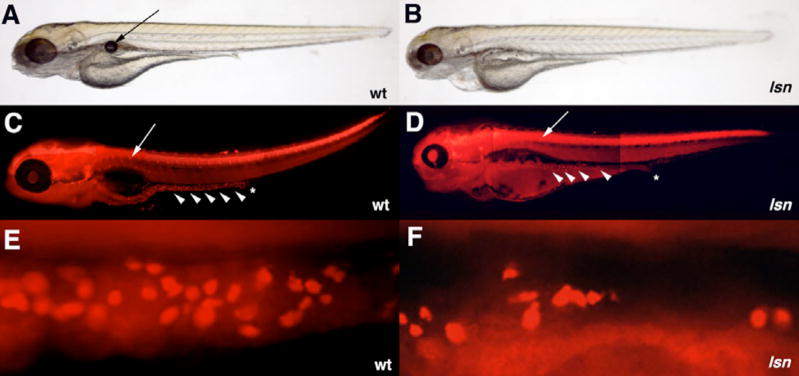
Figure 1
Figure 1. lsn-mutant phenotype
(A, B) Lateral views of live larvae at 96hpf, showing the abnormal development of the jaw, eye and heart in lsn (B) as compared to wild-type (A) as well the lack of swim bladder in lsn. Arrow in (A) indicates the swim bladder. (C, D) Lateral views of 96hpf embryos stained with anti-Hu antibody to shows normal DRG development in lsn but reduced number of enteric neurons that are absent form the distal end of the gut tube. Stars (C, D) indicate the end of the gut tube. Arrows (C, D) indicate DRGs. Arrow heads (C, D) indicate enteric neurons. (E, D) Lateral views of the gut tube of 96hpf embryos stained with anti-Hu antibody showing reduced number of neurons in lsn.
Figure 2
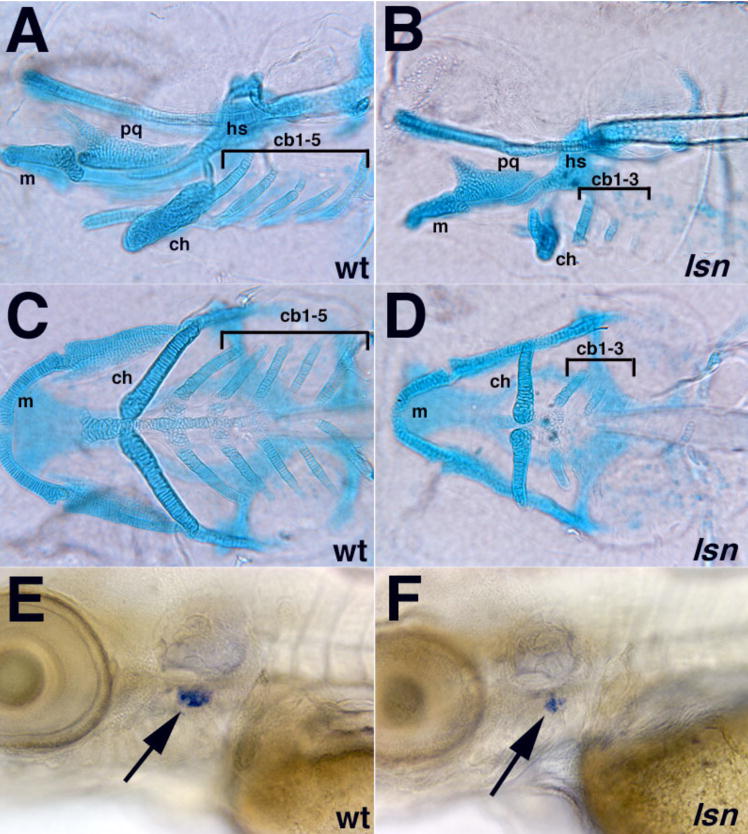
Figure 2. lsn mutation affects both craniofacial and thymus development
(A–D) Alcian blue staining showing pharyngeal cartilages in120hpf wildtype (A, C) and lsn mutant (B, D) larvae shown in lateral (A, B) and ventral (C, D) views. In lsn pharyngeal cartilages develop is abnormal. Notably the ceratobranchials 4 and 5 are absent in lsn. cb 1–5, ceratobranchial cartilages 1–5; ch, ceratohyal cartilage; hs, hyosymplectic cartilage; m, Meckel’s cartilage; pq, palatoquadrate cartilage. (G and H) rag-1 expression at 96hpf in wildtype (E) and lsn mutant (F) larvae shows that lsn embryos have a significantly reduced thymic primordia (arrows).
Figure 3
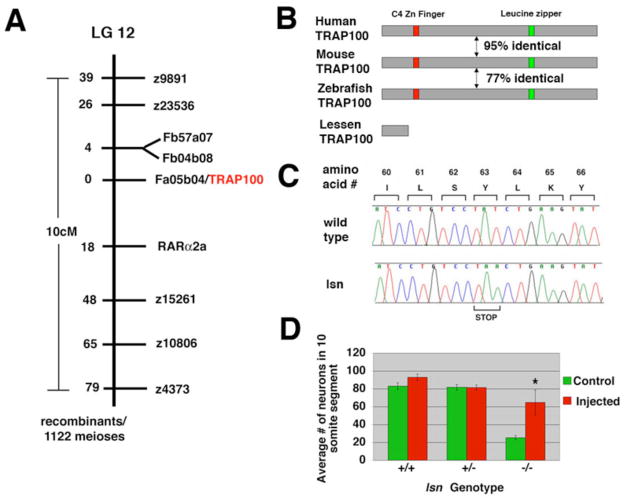
Figure 3. Positional cloning of lsn
(A) lsnw24 maps on to linkage group 12 between markers z9891 and z4373. No recombinants were found between lsnw24 and a SSCP marker in the 3′ UTR of an EST (Fa05b04) that encodes for a zebrafish Trap100. We isolated a full-length cDNA corresponding to Trap100 from homozygous-lsn mutant and wild type embryos and twelve independent clones were completely sequenced in both directions. A T to A (encoding Y to stop) mutation was identified in Trap100 cDNAs derived from homozygous-lsn mutants (B) A schematic illustrating the overall structure and percentage similarity between human, mouse and zebrafish TRAP100 and the predicted truncated TRAP100 in lsn mutants. (C) Sequence tracing of one of the 12 independent clones derived from genomic PCR of genomic DNA from mutant and wild type embryos showing TAT (Y) to TAA (stop) mutation. (D) A bar graph showing rescue of the lsn homozygous mutant enteric phenotype by injection of wild type Trap100 mRNA. Embryos derived from an incross of heetrozygote lsn fish were injected with 50pg of Trap100 mRNA, fixed and stained with anti-Hu antibody at 96hpf and genotyped. Control represents genotyped uninjected embryos from the same cross. Total number of enteric neurons in a 10-somite segment of the intestine were counted. Numbers represent the mean number of enteric neurons in this 10-somite segment ± s.e.m. for 15 embryos of each genotype for each condition. * Significantly different from control (Student’s t-test P<0.001).
Figure 4
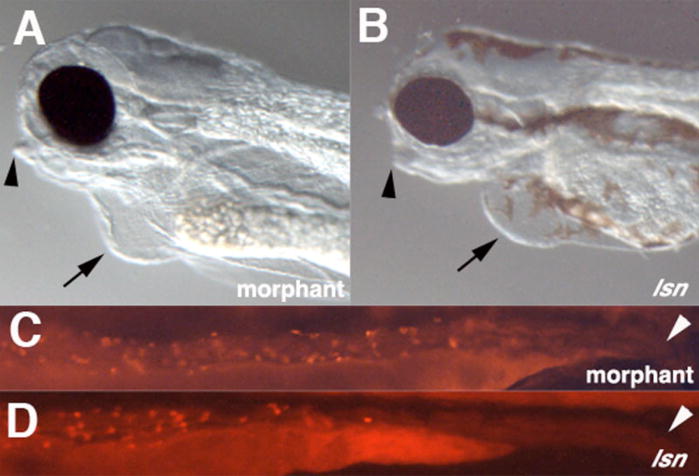
Figure 4. Effect of Trap100 antisense morpholino oligonucleotide injection on jaw, heart and enteric neuron development
(A, B) Lateral views of the heads of embryos 96 hpf Trap 100 morphant embryos (A) and lsn mutant embryos. (C, D) Lateral views of the intestines of 96hpf embryos stained with anti-Hu antibody. Arrowheads in (A) and (B) indicate the recessed jaw in morphant and mutant embryos. Arrows in (A) and (B) indicate cardiac edema in morphant and mutant embryos. Arrow heads in (C) and (D) indicate the end of the intestine. Lack of melanophores in morphant embryos is not due the injected embryos were embryos obtained from an incross of nacre embryos (Lister et al., 1999).
Figure 5
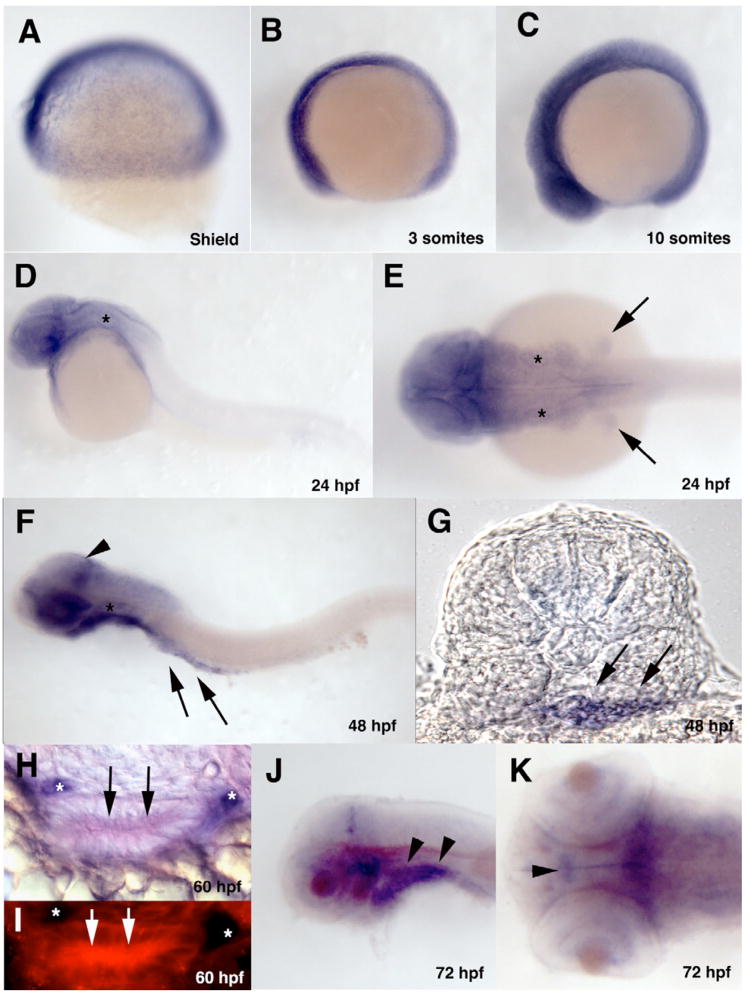
Figure 5. Developmental expression pattern of Trap100.
(A–F, J, K) Wholemount in situ hybridized embryos hybridized with a Trap100 antisense probe at the indicated developmental stages. (A, B, C, D, F, J) Lateral views. (E) Dorsal view of 24hpf embryo. (G) A transverse section taken through 48hpf embryo at the level of somite 4 showing expression through the intestinal mesendoderm. (H) A transverse section taken trough the gut tube at 60hpf after double in situ hybridization with a Trap100 fluorescein antisense probe (red) and a phox2b digoxigenin antisense probe (purple) showing intestinal epithelia expression of Trap100. (I) Same section as (H) showing Trap100 expression using fluorescence in the intestinal epithelia cells. (K) Dorsal view of the head of 72hpf embryo. (F, K, J) yolk has been removed. Arrows in (E) indicate fin buds. Arrowhead in (F) indicates increased expression of Trap100 in the posterior mesencephalon. Arrows in (F, G, H, I) indicate intestinal mesendodermal expression of Trap100. Arrowheads (J) indicate pharyngeal arch mesendodermal expression. Arrowhead (K) indicates ventral diencephalon cells expressing neurons expressing Trap100. * (D, E F) indicates the otic vesicle. * (H, I) indicates phox2b positive ENS precursors. In all wholemounts (A–F, J, K) anterior is to the left.
Figure 6
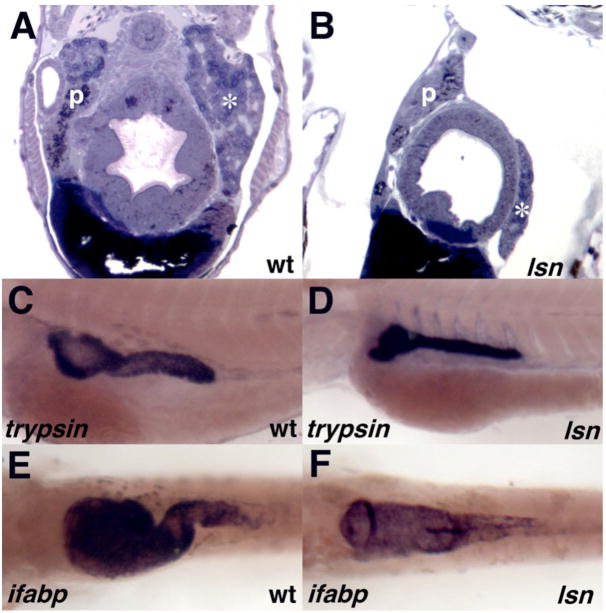
Figure 6. Trap100 is required for normal intestinal development but is not required for endoderm-intestine transition
(A, B) Cross sections of 120hpf wild type (A) and lsn mutant (B) embryos stained with Toluidine Blue. (C, D) trypsin expression at 96hpf in wholemount in situ hybridized wild type (C) and lsn mutant (D) embryos. (E, F) ifabp expression at 96hpf in wholemount in situ hybridized wild type (E) and lsn mutant (F) embryos. p, pancreas; * liver.
Figure 7
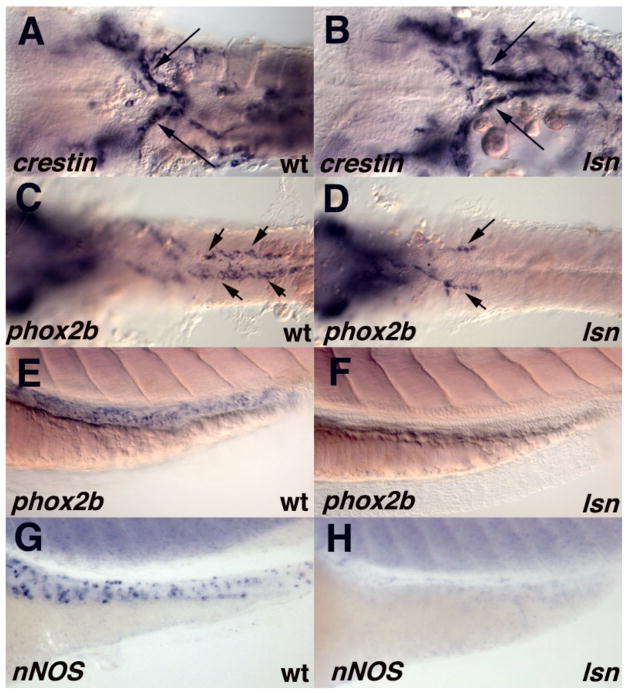
Figure 7. lsn mutation causes a failure of enteric precursors to populate the entire length of the intestine but does not perturb the initial migration of vagal neural crest to the anterior gut
(A, C, E, G) wild-type embryos and (B, D, F, H) lsn mutants embryos. (A, B) Ventral view of the vagal region of 36hpf embryos that have been hybridized with riboprobes for crestin. (C, D) Ventral view of the vagal region to somite 10 of 48hpf embryos that have been hybridized with riboprobes for phox2b showing a failure to of phox2b expressing cells populate the entire length of the intestine. (E, H) lateral views of the intestine 72hpf wild type (E, G) and lsn mutant (F, H) embryos that have been hybridized with riboprobes for phox2b (E, F) and nNOS (G, H). Arrows indicate the migrating enteric precursors. The yolk has been removed the embryos (A–D). Anterior is to the left.
Figure 8
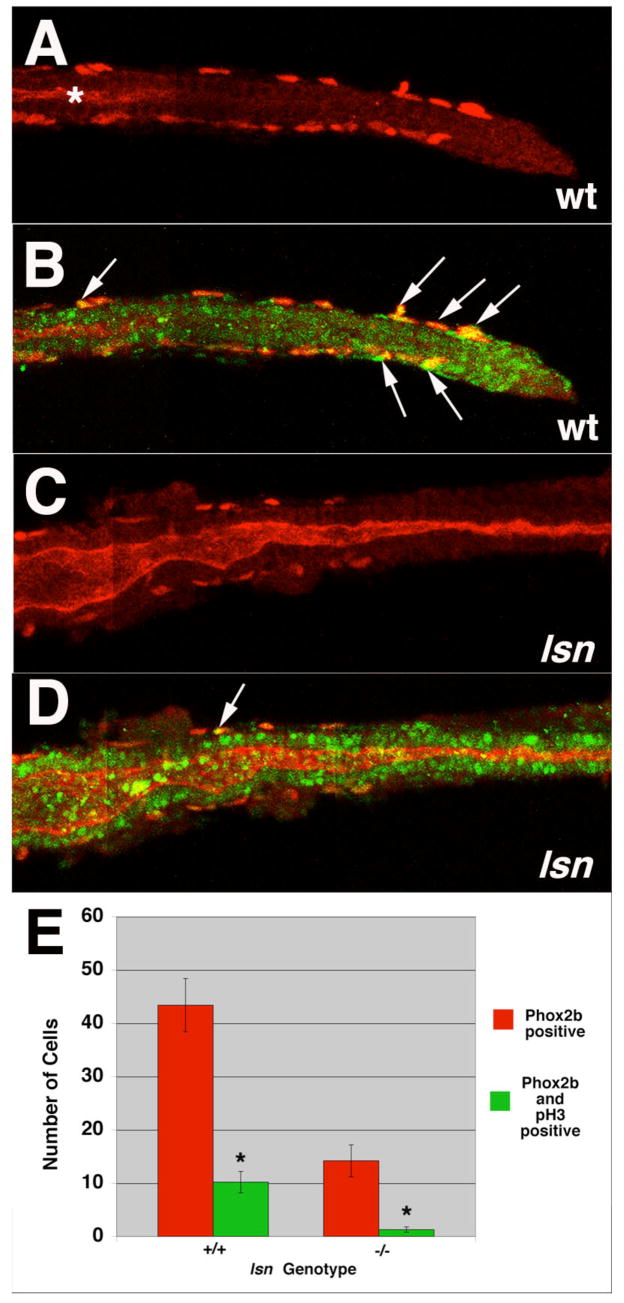
Figure 8. lsn mutants have reduced ENS precursor proliferation
(A–D) Confocal images of dissected intestines from 48 hpf wild-type (A, B) and lsn (C, D) embryos that have been immunocytochemically stained with anti-Phox2b antibody and anti-phosphohistoneH3 antibody. (A, C) anti-Phox2b immunoreactivity in wild type (A) and lsn (C) showing the most posterior point along the gut tube that Phox2b positive cells can be identified. (B, D) Merged images of the same intestines in (A) and (C) showing anti-Phox2b and anti-phosphohistone H3 immunoreactivity in wild type (B) and lsn (D). * in (A) indicates the end of the gut lumen which has not opened all the way to the distal end of the gut tube at this developmental age. Arrows in (B) and (D) indicate double labeled cells. (E) A bar graph showing the mean number of Phox2b immunoreactive cells (red) and double-labeled Phox2b/phosphohistone H3 positive cells (green) present along the entire length of the intestine 48 hpf wild type and homozygous mutant lsn embryos. Embryos derived from an incross of heterozygote lsn fish were fixed and stained with anti-Phox2b and anti-phosphohistone H3 antibodies at 96hpf and genotyped. The intestines were then dissected from these genotyped embryos, imaged and the number of Phox2b positive cells and Phox2b + phosphohistone H3 double labeled cells were counted. Numbers represent the mean number of immunopositive cells ± s.e.m. for 10 embryos of each genotype. The difference between * was statistically significant (Student’s t-test P< 0.001).
Figure 9
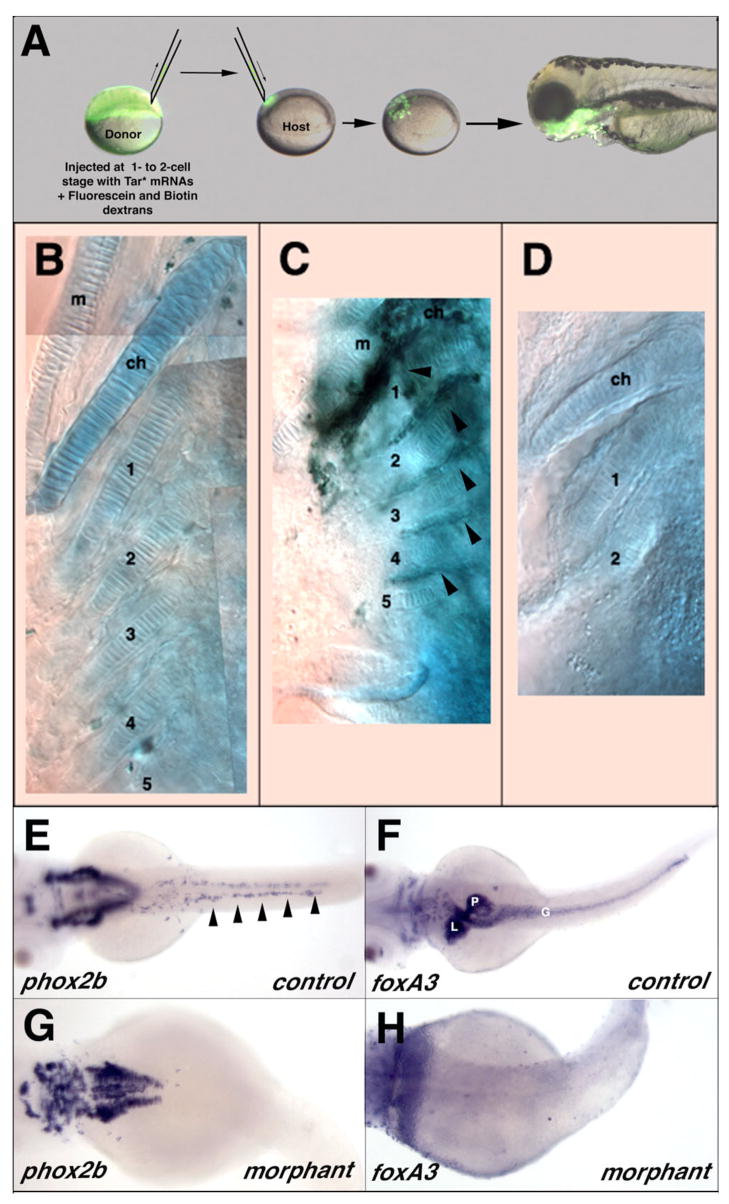
Figure 9. Transplants suggest that lsnw24 functions cell autonomously in the endoderm and endoderm is required for ENS development
(A–D) Transplantation of wild type endodermal cells partially rescues posterior arch cartilage formation in lsn mutants. (A) At blastula stage fluorescein-dextran labeled wild type cells expressing Tar* were transplanted into host and allowed to develop. The lateral view of the head region at 72 hpf shows grafted cells (green) have differentiated into pharyngeal endoderm derivatives. (B–D) Ventral views of 5dpf larvae stained with Alcian Blue to show cartilages. (B) Wild type control. All lower jaw cartilages are clearly identifiable. (C) lsn mutant larvae transplanted with wild type cells showing rescue of posterior ceratobranchial (3–5) in the vicinity of transplanted Tar*-expressing wild type cells (black staining) in the pharyngeal arch endoderm (arrowheads). (D) lsn mutant that lacks posterior ceratobranchials. (E–H) Casanova morphant embryos have no intestinal endoderm and no migrating ENS precursors. (E–H) Dorsal views of 48 hpf control embryos (E, F) and cas morphant embryos (G, H) that have been hybridized with riboprobes for phox2b (E, G) or foxA3 (F, H) showing a complete lack of phox2b expressing cells in the region of the intestine of morphant embryos (G) that also completely lack intestinal endoderm (H). Arrowheads (E) indicate migrating ENS precursors. m, Meckel’s cartilage of the mandibular arch; ch, ceratohyal cartilage; 1–5 ceratobranchial cartilages; G, intestine; L, liver, P, pancreas.

References

    1. Ajiro K, Yoda K, Utsumi K, Nishikawa Y. Alteration of cell cycle-dependent histone phosphorylations by okadaic acid. Induction of mitosis-specific H3 phosphorylation and chromatin condensation in mammalian interphase cells. J Biol Chem. 1996;271:13197–201. - PubMed
    1. Akimenko MA, Ekker M, Wegner J, Lin W, Westerfield M. Combinatorial expression of three zebrafish genes related to distal- less: part of a homeobox gene code for the head. J Neurosci. 1994;14:3475–86. - PMC - PubMed
    1. Akoulitchev S, Chuikov S, Reinberg D. TFIIH is negatively regulated by cdk8-containing mediator complexes. Nature. 2000;407:102–6. - PubMed
    1. Alexander J, Rothenberg M, Henry GL, Stainier DY. casanova plays an early and essential role in endoderm formation in zebrafish. Dev Biol. 1999;215:343–57. - PubMed
    1. Amiel J, Lyonnet S. Hirschsprung disease, associated syndromes, and genetics: a review. J Med Genet. 2001;38:729–39. - PMC - PubMed

Publication types

MeSH terms