


Absolute values of immunoglobulin free light chains are prognostic in patients with primary systemic amyloidosis undergoing peripheral blood stem cell transplantation
- PMID: 16397135
- PMCID: PMC1895763
- DOI: 10.1182/blood-2005-07-2922
Absolute values of immunoglobulin free light chains are prognostic in patients with primary systemic amyloidosis undergoing peripheral blood stem cell transplantation
Abstract
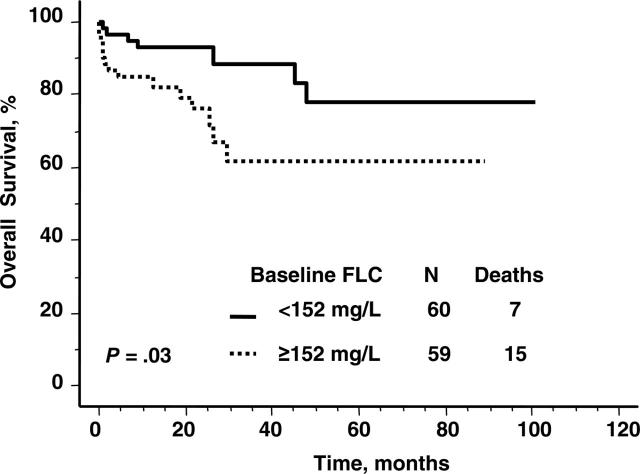
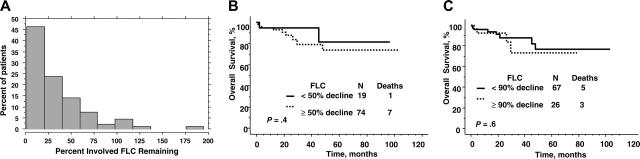
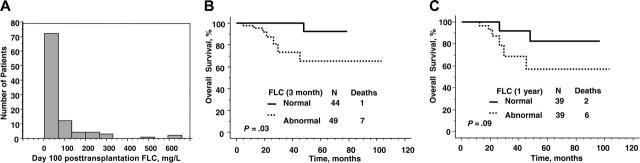
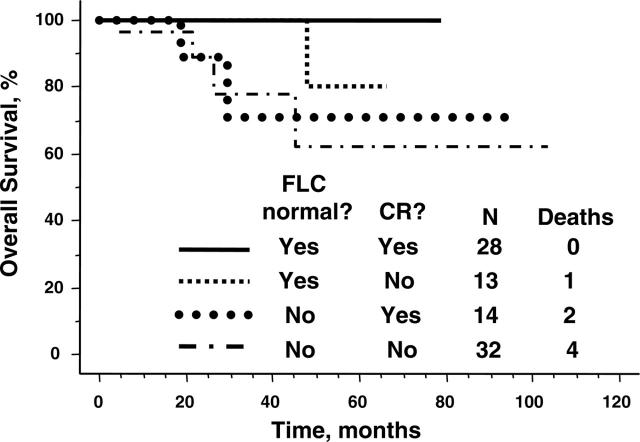
The immunoglobulin free light chain (FLC) is the precursor protein of amyloid in primary systemic amyloidosis (AL). Historically, the ability to monitor the amyloid protein precursor protein has been crude. We evaluated the utility of the FLC assay in a retrospective analysis of patients with AL undergoing peripheral blood stem cell transplantation (PBSCT). Ninety-three such patients had serial FLC measurements performed. The prognostic effects of the initial concentration and the extent of reduction of monoclonal FLC on survival were studied. There was a significantly higher risk of death in patients with higher baseline FLC (hazard ratio 2.6, P < .04). Baseline FLC correlated with serum cardiac troponin levels, and higher FLC levels were associated with more organs involved by amyloid, suggesting that high FLC levels may be associated with more advanced disease. The percent FLC reduction did not predict for survival, but the absolute level of FLC achieved after therapy did. Normalization of FLC level after PBSCT predicted for both organ response and complete hematologic response. Achievement of FLC response was a better predictor of survival than achievement of complete hematologic response or normalization of the FLC ratio. FLC measurements both before and after PBSCT are important predictors of patient outcome.
Figures
References
-
- Kyle RA, Gertz MA. Primary systemic amyloidosis: clinical and laboratory features in 474 cases. Semin Hematol. 1995;32: 45-59. - PubMed
-
- Merlini G, Bellotti V. Molecular mechanisms of amyloidosis. N Engl J Med. 2003;349: 583-596. - PubMed
-
- Brenner DA, Jain M, Pimentel DR, et al. Human amyloidogenic light chains directly impair cardiomyocyte function through an increase in cellular oxidant stress. Circ Res. 2004;94: 1008-1010. - PubMed
-
- Comenzo RL, Vosburgh E, Falk RH, et al. Dose-intensive melphalan with blood stem-cell support for the treatment of AL (amyloid light-chain) amyloidosis: survival and responses in 25 patients. Blood. 1998;91: 3662-3670. - PubMed
-
- Gertz MA, Kyle RA, Greipp PR. Response rates and survival in primary systemic amyloidosis. Blood. 1991;77: 257-262. - PubMed
