


Mechanochemical analysis of DNA gyrase using rotor bead tracking
- PMID: 16397501
- PMCID: PMC1440892
- DOI: 10.1038/nature04319
Mechanochemical analysis of DNA gyrase using rotor bead tracking
Abstract
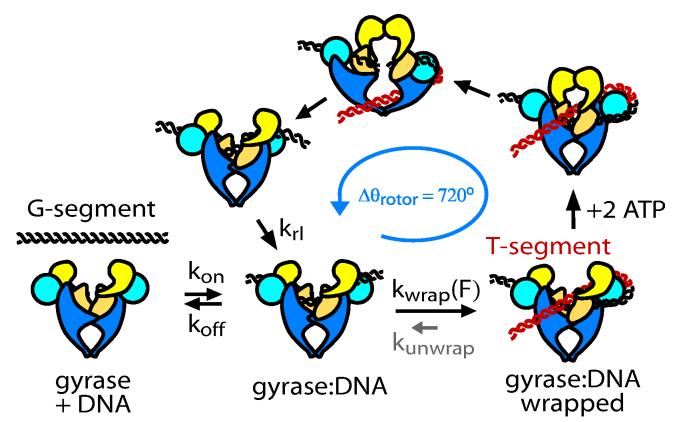
DNA gyrase is a molecular machine that uses the energy of ATP hydrolysis to introduce essential negative supercoils into DNA. The directionality of supercoiling is ensured by chiral wrapping of the DNA around a specialized domain of the enzyme before strand passage. Here we observe the activity of gyrase in real time by tracking the rotation of a submicrometre bead attached to the side of a stretched DNA molecule. In the presence of gyrase and ATP, we observe bursts of rotation corresponding to the processive, stepwise introduction of negative supercoils in strict multiples of two. Changes in DNA tension have no detectable effect on supercoiling velocity, but the enzyme becomes markedly less processive as tension is increased over a range of only a few tenths of piconewtons. This behaviour is quantitatively explained by a simple mechanochemical model in which processivity depends on a kinetic competition between dissociation and rapid, tension-sensitive DNA wrapping. In a high-resolution variant of our assay, we directly detect rotational pauses corresponding to two kinetic substeps: an ATP-independent step at the end of the reaction cycle, and an ATP-binding step in the middle of the cycle, subsequent to DNA wrapping.
Figures



References
-
- Champoux JJ. DNA topoisomerases: structure, function, and mechanism. Annu Rev Biochem. 2001;70:369–413. - PubMed
-
- Corbett KD, Berger JM. Structure, molecular mechanisms, and evolutionary relationships in DNA topoisomerases. Annu Rev Biophys Biomol Struct. 2004;33:95–118. - PubMed
-
- Liu LF, Wang JC. DNA-DNA gyrase complex: the wrapping of the DNA duplex outside the enzyme. Cell. 1978;15:979–84. - PubMed
Publication types
MeSH terms
Substances
Grants and funding
LinkOut - more resources
Full Text Sources
Other Literature Sources
Molecular Biology Databases
