doi: 10.1371/journal.pmed.0030029.
Epub 2006 Jan 10.
Do we need to put society first? The potential for tragedy in antimicrobial resistance
Affiliations
- PMID: 16398572
- PMCID: PMC1325265
- DOI: 10.1371/journal.pmed.0030029
Item in Clipboard
Do we need to put society first? The potential for tragedy in antimicrobial resistance
PLoS Med.
2006 Feb.
Abstract
Antimicrobial use presents a dilemma, say Foster and Grundmann. Appropriate use can benefit individual patients but carries a cost to society by selecting for resistant strains that are difficult to treat.
Conflict of interest statement
The authors declare that they have no competing interests.
Figures
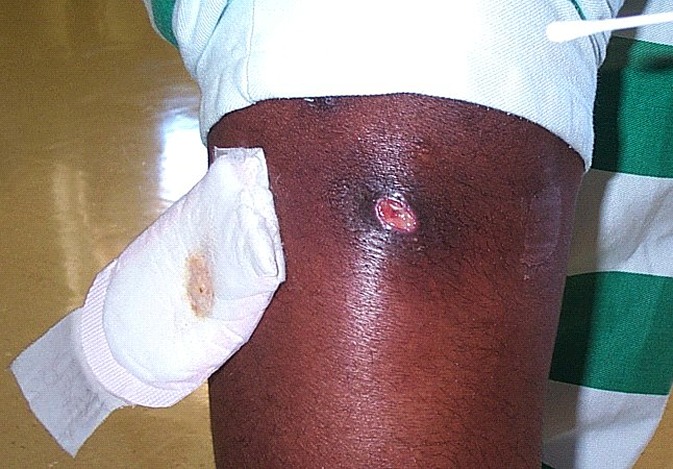
MRSA is resistant to many common antibiotics, making it difficult to treat. (Photo: CDC/Bruno Coignard/Jeff Hageman)
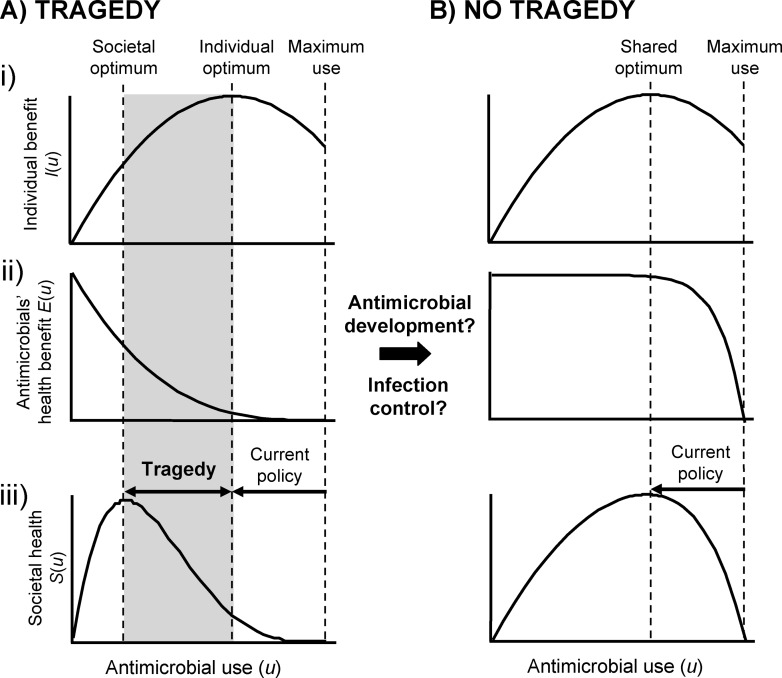
(A) Tragedy scenario. A simple model that illustrates the potential for moral dilemma in antimicrobial use. Optimizing antimicrobial use (u) for the good of all requires consideration of both society and the individual patient. (i) Individual health benefit from antimicrobial use I(u). (ii) Cost to societal health from decreased effectiveness of antimicrobials E(u) as a result of the evolution of antimicrobial-resistant pathogens. We assume that the societal benefit from reducing transmission rates is small and do not include it here. iii) Overall effect of antimicrobial use on societal health S(u) = I(u)E(u). Ensuring that antimicrobials are only used for infections they can treat is a technical solution that will only take us to the individual optimum, which in this illustrative example is far from the real optimum. (B) Best-case scenario. Low to moderate antimicrobial use has little impact on our ability to treat later infections and is only weakly costly to societal health E(u). This means there is no tragedy. The true nature of E(u) is unknown but it is a function of investment in both new antimicrobials and infection control, which may be able to shift us from scenario A to scenario B.
References
-
- Alekshun MN. New advances in antibiotic development and discovery. Expert Opin Investig Drugs. 2005;14:117–134. - PubMed
-
- Infectious Diseases Society of America. Bag bugs, no drugs. Alexandria (Virginia): Infectious Diseases Society of America; 2004. Available: http://www.idsociety.org/pa/IDSA_Paper4_final_web.pdf. Accessed 30 November 2005.
-
- Finch RG, Metlay JP, Davey PG, Baker LJ. Educational interventions to improve antibiotic use in the community: Report from the International Forum on Antibiotic Resistance (IFAR) colloquium, 2002. Lancet Infect Dis. 2004;4:44–53. - PubMed
-
- Hardin G. The tragedy of the commons. Science. 1968;162:1243–1244. - PubMed
MeSH terms
Substances
LinkOut - more resources
Full Text Sources
Medical