Genome-based approaches to understanding phosphorus deprivation responses and PSR1 control in Chlamydomonas reinhardtii
- PMID: 16400166
- PMCID: PMC1360252
- DOI: 10.1128/EC.5.1.26-44.2006
Genome-based approaches to understanding phosphorus deprivation responses and PSR1 control in Chlamydomonas reinhardtii
Abstract
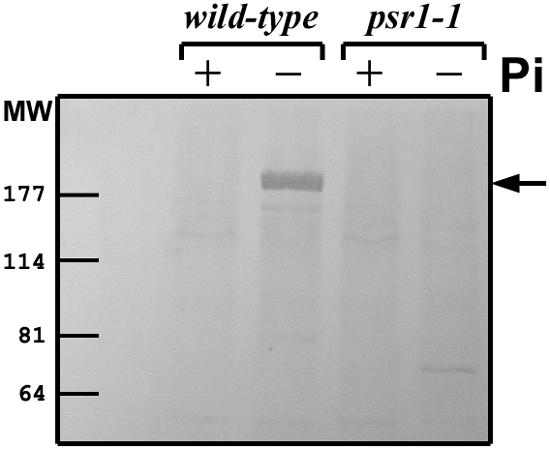
The Chlamydomonas reinhardtii transcription factor PSR1 is required for the control of activities involved in scavenging phosphate from the environment during periods of phosphorus limitation. Increased scavenging activity reflects the development of high-affinity phosphate transport and the expression of extracellular phosphatases that can cleave phosphate from organic compounds in the environment. A comparison of gene expression patterns using microarray analyses and quantitative PCRs with wild-type and psr1 mutant cells deprived of phosphorus has revealed that PSR1 also controls genes encoding proteins with potential "electron valve" functions--these proteins can serve as alternative electron acceptors that help prevent photodamage caused by overexcitation of the photosynthetic electron transport system. In accordance with this finding, phosphorus-starved psr1 mutants die when subjected to elevated light intensities; at these intensities, the wild-type cells still exhibit rapid growth. Acclimation to phosphorus deprivation also involves a reduction in the levels of transcripts encoding proteins involved in photosynthesis and both cytoplasmic and chloroplast translation as well as an increase in the levels of transcripts encoding stress-associated chaperones and proteases. Surprisingly, phosphorus-deficient psr1 cells (but not wild-type cells) also display expression patterns associated with specific responses to sulfur deprivation, suggesting a hitherto unsuspected link between the signal transduction pathways involved in controlling phosphorus and sulfur starvation responses. Together, these results demonstrate that PSR1 is critical for the survival of cells under conditions of suboptimal phosphorus availability and that it plays a key role in controlling both scavenging responses and the ability of the cell to manage excess absorbed excitation energy.
Figures




References
-
- Benjamini, Y., and Y. Hochberg. 1995. Controlling the false discovery rate: a practical and powerful approach to multiple testing. J. R. Stat. Soc. Ser. B 57:289-300.
-
- Berhe, A., U. Fristedt, and B. L. Persson. 1995. Expression and purification of the high-affinity phosphate transporter of Saccharomyces cerevisiae. Eur. J. Biochem. 227:566-572. - PubMed
-
- Bieleski, R. L. 1973. Phosphate pools, phosphate transport, and phosphorus availability. Annu. Rev. Plant Physiol. Plant Mol. Biol. 24:225-252.
-
- Brooks, A.. 1996. Effects of phosphorus nutrition on ribulose-1,5-bisphosphate carboxylase activation, photosynthetic quantum yield and amounts of some Calvin cycle metabolites in spinach leaves. Aust. J. Plant Physiol. 13:221-237.
Publication types
MeSH terms
Substances
LinkOut - more resources
Full Text Sources
Other Literature Sources
Molecular Biology Databases