


Muscle fiber-type distribution predicts weight gain and unfavorable left ventricular geometry: a 19 year follow-up study
- PMID: 16403232
- PMCID: PMC1382267
- DOI: 10.1186/1471-2261-6-2
Muscle fiber-type distribution predicts weight gain and unfavorable left ventricular geometry: a 19 year follow-up study
Abstract
Background: Skeletal muscle consists of type-I (slow-twitch) and type-II (fast-twitch) fibers, with proportions highly variable between individuals and mostly determined by genetic factors. Cross-sectional studies have associated low percentage of type-I fibers (type-I%) with many cardiovascular risk factors.
Methods: We investigated whether baseline type-I% predicts left ventricular (LV) structure and function at 19-year follow-up, and if so, which are the strongest mediating factors. At baseline in 1984 muscle fiber-type distribution (by actomyosin ATPase staining) was studied in 63 healthy men (aged 32-58 years). The follow-up in 2003 included echocardiography, measurement of obesity related variables, physical activity and blood pressure.
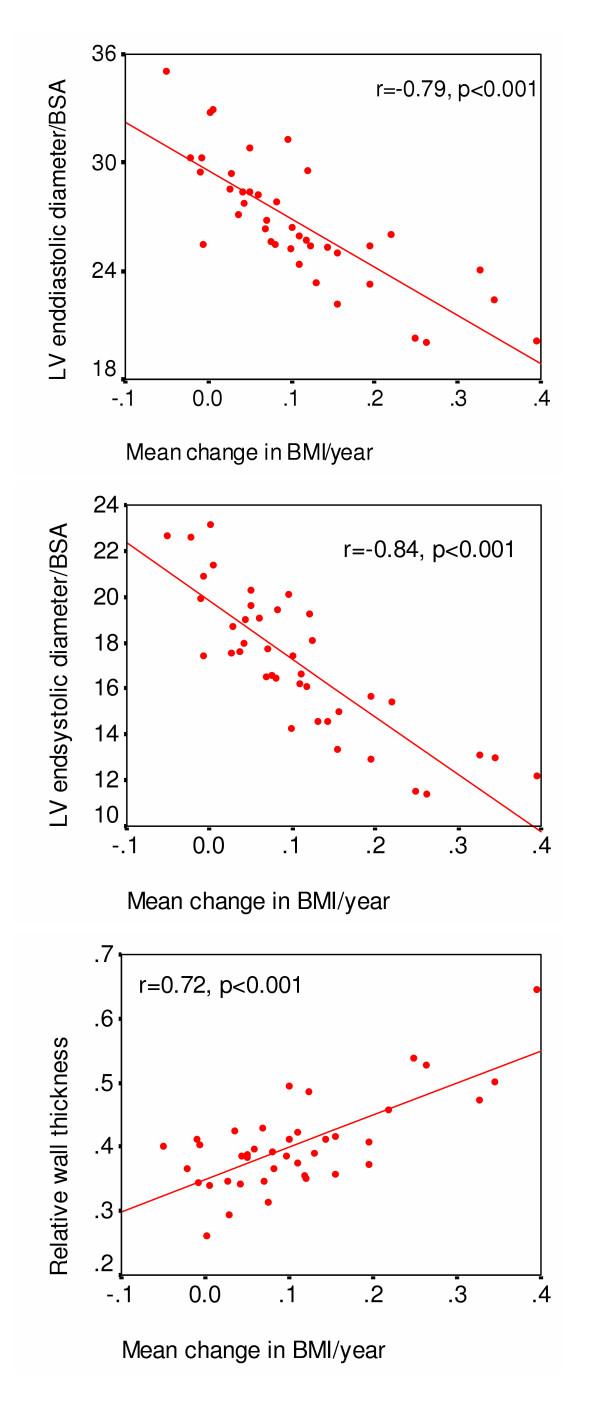
Results: In the 40 men not using cardiovascular drugs at follow-up, low type-I% predicted higher heart rate, blood pressure, and LV fractional shortening suggesting increased sympathetic tone. Low type-I% predicted smaller LV chamber diameters (P < or = 0.009) and greater relative wall thickness (P = 0.034) without increase in LV mass (concentric remodeling). This was explained by the association of type-I% with obesity related variables. Type-I% was an independent predictor of follow-up body fat percentage, waist/hip ratio, weight gain in adulthood, and physical activity (in all P < or = 0.001). After including these risk factors in the regression models, weight gain was the strongest predictor of LV geometry explaining 64% of the variation in LV end-diastolic diameter, 72% in end-systolic diameter, and 53% in relative wall thickness.
Conclusion: Low type-I% predicts obesity and weight gain especially in the mid-abdomen, and consequently unfavourable LV geometry indicating increased cardiovascular risk.
Figures


References
-
- Saltin B, Gollnick PD. Skeletal muscle adaptability, significance for metabolism and performance. In: Peachey LD, editor. Handbook of Physiology. Baltimore, United States: Williams and Wilkins; 1983. pp. 555–631.
-
- Simoneau JA, Bouchard C. Genetic determinism of fiber type proportion in human skeletal muscle. FASEB J. 1995;9:1091–1095. - PubMed
-
- Costill DL, Daniels J, Evans W, Finh W, Krahenbuhl G, Saltin B. Skeletal muscle enzymes and fibre composition in male and female track athletes. J Appl Physiol. 1976;90:149–154. - PubMed
Publication types
MeSH terms
LinkOut - more resources
Full Text Sources
Medical
