


Skin conductance responses are elicited by the airway sensory effects of puffs from cigarettes
- PMID: 16403585
- PMCID: PMC1486799
- DOI: 10.1016/j.ijpsycho.2005.10.018
Skin conductance responses are elicited by the airway sensory effects of puffs from cigarettes
Abstract
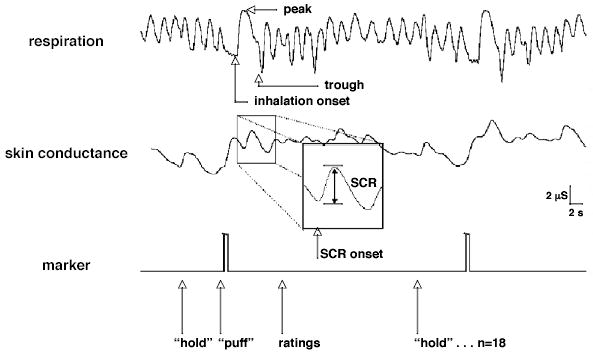
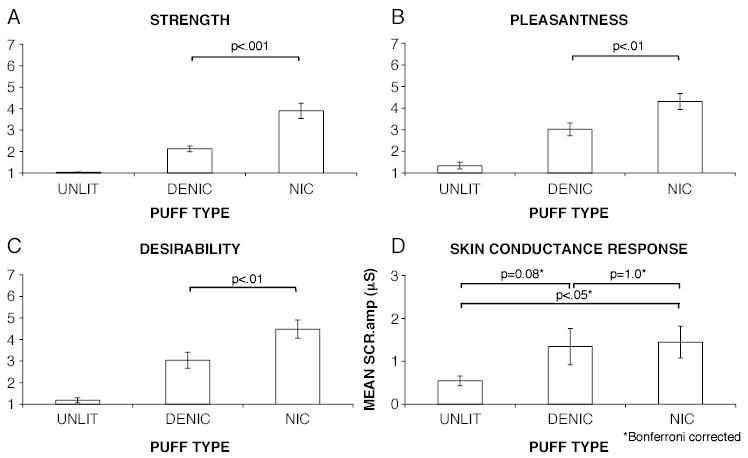
The airway sensations stimulated by smoking are an important source of hedonic impact (pleasure) for dependent smokers. The learning process by which these sensations become pleasurable is not well understood. The classical conditioning model predicts that airway sensory stimulation will elicit sympathetic arousal that is positively correlated with the hedonic impact that is elicited by airway sensory stimulation. To test this prediction, we measured skin conductance responses (SCRs) and subjective hedonic impact elicited by a series of individual puffs from nicotinized, denicotinized and unlit cigarettes. Nicotinized puffs elicited more subjective hedonic impact than denicotinized and unlit puffs partly as a result of the fact that they provided a greater level of airway sensory stimulation. We found that SCRs were not larger for nicotinized puffs than for denicotinized puffs, but that they were larger for both nicotinized and denicotinized puffs than for unlit puffs. We also found that the average SCR of a subject to denicotinized puffs was positively correlated with the average hedonic impact that a subject obtained from denicotinized puffs. Together, this suggests that SCR magnitude does not reflect within-subject variations in hedonic impact that are due to variations in the level of airway sensory stimulation, but that it does reflect individual differences in the amount of hedonic impact that is derived from a given level of airway sensory stimulation. The results of a post hoc correlation analysis suggest that these individual differences may have been due to variations in the prevailing urge to smoke. The implications of these findings for the classical conditioning model, as well as for other learning models, are discussed.
Figures
References
-
- American Psychiatric Association, A.P., 2001. Diagnostic and Statistical Manual of Mental Disorders. Edition IV.
-
- Bechara A, Tranel D, Damasio H, Damasio AR. Failure to respond autonomically to anticipated future outcomes following damage to prefrontal cortex. Cerebral Cortex. 1996;6:215– 225. - PubMed
-
- Bechara A, Dolan S, Hindes A. Decision-making and addiction (part II): myopia for the future or hypersensitivity to reward? Neuropsychologia. 2002;40 (10):1690–1705. - PubMed
-
- Behm FM, Levin ED, Lee YK, Rose JE. Low-nicotine regenerated smoke aerosol reduces desire for cigarettes. J Subst Abuse. 1990;2 (2):237–247. - PubMed
Publication types
MeSH terms
Substances
Grants and funding
LinkOut - more resources
Full Text Sources
Medical
