


Frequent high-level expression of the immunotherapeutic target Ep-CAM in colon, stomach, prostate and lung cancers
- PMID: 16404366
- PMCID: PMC2361083
- DOI: 10.1038/sj.bjc.6602924
Frequent high-level expression of the immunotherapeutic target Ep-CAM in colon, stomach, prostate and lung cancers
Abstract
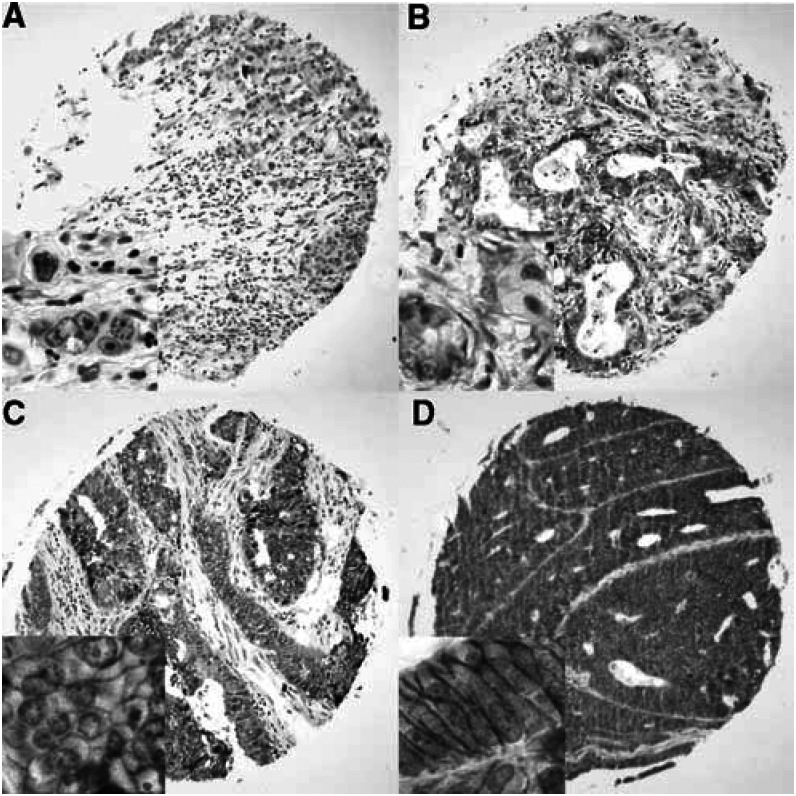
Epithelial cell adhesion molecule (Ep-CAM; CD326) is used as a target by many immunotherapeutic approaches, but little data are available about Ep-CAM expression in major human malignancies with respect to level, frequency, tumour stage, grade, histologic tumour type and impact on survival. We analysed by immunohistochemical staining tissue microarrays with 4046 primary human carcinoma samples from colon, stomach, prostate and lung cancers for both frequency and intensity of Ep-CAM expression under highly standardised conditions. A total of 3360 samples were analysable. High-level Ep-CAM expression was observed in 97.7% (n=1186) of colon, 90.7% of gastric (n=473), and 87.2% of prostate cancers (n=414), and in 63.9% of lung cancers (n=1287). No detectable Ep-CAM staining was found with only 0.4% of colon, 2.5% of gastric, 1.9% of prostate cancers, and 13.5% of lung cancers. The only significant correlation of Ep-CAM expression with tumour grading was observed in colon cancer where high-level Ep-CAM expression on grade 3 tumours was down to 92.1% (P<0.0001). Adenosquamous and squamous carcinomas of the lung had a lower percentage of high-level Ep-CAM expression compared to adenocarcinomas with 35.4 and 53.6%, respectively, and with 45.5 and 17.3% of tumours being Ep-CAM negative. With the exception of moderately differentiated colon carcinoma, where patients not expressing Ep-CAM on their tumours showed an inferior survival (P=0.0014), correlation of Ep-CAM expression with survival did not reach statistical significance for any of the other cancer indications and subgroups. In conclusion, the data strongly support the notion that Ep-CAM is a prime target for immunotherapies in major human malignancies. This is because the most common human cancers show (i) a low frequency of Ep-CAM-negative tumours, (ii) a high frequency of Ep-CAM expression on cells of a given tumour, and (iii) for most cancers, an insignificant influence of tumour staging, grading and histology on Ep-CAM expression.
Figures
References
-
- Al-Kuraya K, Schraml P, Torhorst J, Tapia C, Zaharieva B, Novotny H, Spichtin H, Maurer R, Mirlacher M, Kochli O, Zuber M, Dieterich H, Mross F, Wilber K, Simon R, Sauter G (2004) Prognostic relevance of gene amplifications and coamplifications in breast cancer. Cancer Res 64: 8534–8540 - PubMed
-
- Balzar M, Winter MJ, de Boer CJ, Litvinov SV (1999) The biology of the 17-1A antigen (Ep-CAM). J Mol Med 77: 699–712 - PubMed
-
- Brischwein K, Schlereth B, Guller B, Steiger C, Wolf A, Lutterbuese R, Offner S, Locher M, Urbig T, Raum T, Kleindienst P, Wimberger P, Kimmig R, Fichtner I, Kufer P, Hofmeister R, da Silva AJ, Baeuerle PA (2005) MT110: a novel bispecific single-chain antibody construct with high efficacy in eradicating established tumors. Mol Immunol; Epub ahead of print - PubMed
-
- Bubendorf L, Nocito A, Moch H, Sauter G (2001) Tissue microarray (TMA) technology: miniaturized pathology archives for high-throughput in situ studies. J Pathol 195: 72–79 - PubMed
MeSH terms
Substances
LinkOut - more resources
Full Text Sources
Other Literature Sources
Medical
Miscellaneous
