


Using relationship styles based on attachment theory to improve understanding of specialty choice in medicine
- PMID: 16405723
- PMCID: PMC1373627
- DOI: 10.1186/1472-6920-6-3
Using relationship styles based on attachment theory to improve understanding of specialty choice in medicine
Abstract
Background: Patient-provider relationships in primary care are characterized by greater continuity and depth than in non-primary care specialties. We hypothesized that relationship styles of medical students based on attachment theory are associated with specialty choice factors and that such factors will mediate the association between relationship style and ultimately matching in a primary care specialty.
Methods: We determined the relationship styles, demographic characteristics and resident specialty match of 106 fourth-year medical students. We assessed the associations between 1) relationship style and specialty choice factors; 2) specialty choice factors and specialty match, and 3) relationship style and specialty match. We also conducted mediation analyses to determine if factors examined in a specialty choice questionnaire mediate the association between relationship style and ultimately matching in a primary care specialty.
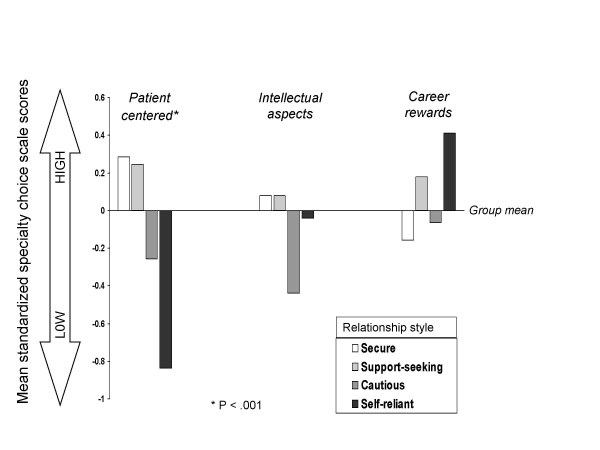
Results: Prevalence of attachment styles was similar to that found in the general population and other medical school settings with 59% of students rating themselves as having a secure relationship style. Patient centeredness was directly associated, and career rewards inversely associated with matching in a primary care specialty. Students with a self-reliant relationship style were significantly more likely to match in a non-primary care specialty as compared to students with secure relationship style (OR = 5.3, 95% CI 1.8, 15.6). There was full mediation of the association between relationship style and specialty match by the specialty choice factor characterized by patient centeredness.
Conclusion: Assessing relationship styles based on attachment theory may be a potentially useful way to improve understanding and counsel medical students about specialty choice.
Figures
References
-
- Kassenbaum DG, Szena PL. Factors influencing the specialty choice of 1993 medical school graduates. Acad Med. 1994;69:164–170. - PubMed
-
- Taylor AD. How to Choose a Medical Specialty. Third. Philadelphia, Pennsylvania: WB Saunders Company; 1999.
-
- Iserson K. Iserson's getting into a residency: a guide for medical students. 6. Tucson, AZ: Galen Press; 2003.
-
- Careers in Medicine. Association of American Medical Colleges, Washington, DC; 2005. http://www.aamc.org/students/cim/start.htm Accessed 08/18/05.
Publication types
MeSH terms
Grants and funding
LinkOut - more resources
Full Text Sources
Medical
