


Cryptic species within the cosmopolitan desiccation-tolerant moss Grimmia laevigata
- PMID: 16407098
- PMCID: PMC1334683
- DOI: 10.1073/pnas.0510267103
Cryptic species within the cosmopolitan desiccation-tolerant moss Grimmia laevigata
Abstract
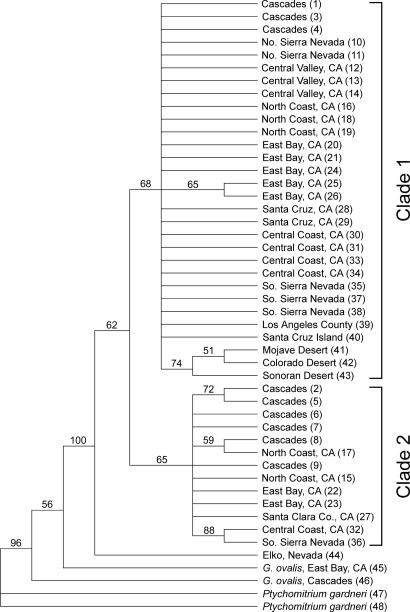
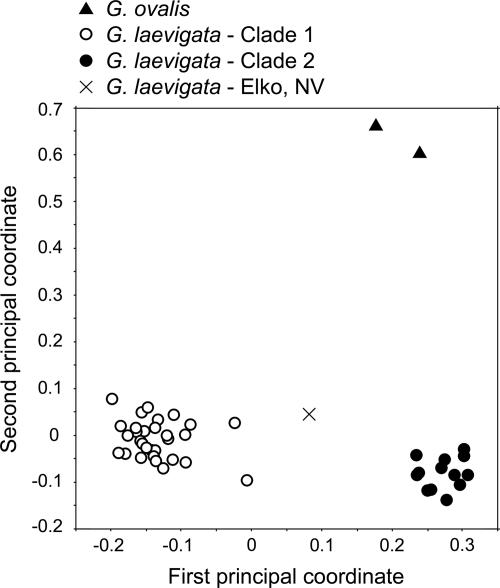
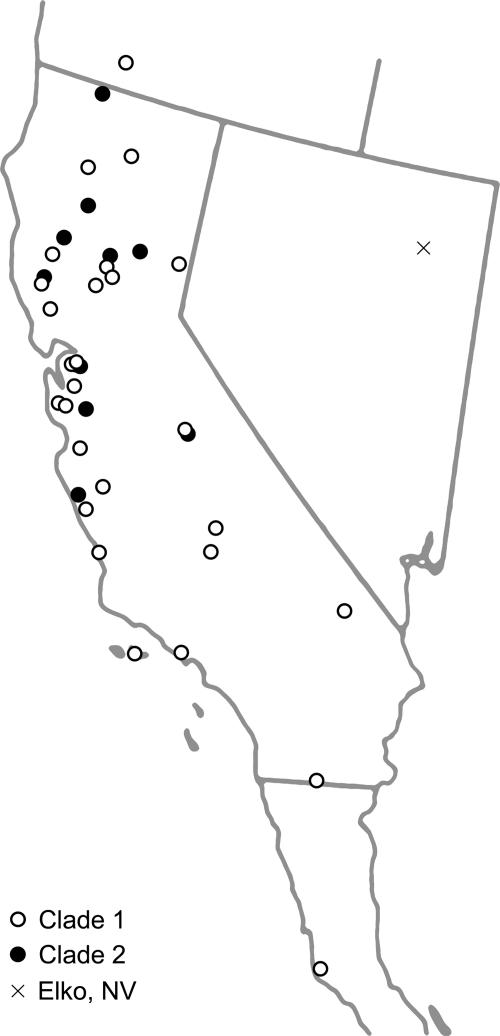
The common cushion moss Grimmia laevigata (Bridel) Bridel grows on bare rock in a broad range of environments on every continent except Antarctica. As such, it must harbor adaptations to a remarkably broad set of environmental stresses, the extremes of which can include very high temperatures, prolonged nearly complete desiccation, and high ultraviolet B (UVB) exposure. Yet, like many mosses, G. laevigata shows very little morphological variability across its cosmopolitan range. This presents an evolutionary puzzle, the solution to which lies in understanding the phylogeographic structure of this morphologically simple organism. Here we report the results of an analysis of amplified fragment length polymorphisms (AFLPs) in G. laevigata, focusing on individuals from the California Floristic Province. We found evidence that populations within California constitute two distinct geographically overlapping cryptic species. Each clade harbors multiple private alleles, indicating they have been genetically isolated for some time. We suggest that the existence of cryptic species within G. laevigata, in combination with its life history, growth habits, and extreme desiccation tolerance, makes this moss an ideal research tool and a candidate for a biological indicator of climate change and pollution.
Figures
References
-
- Pócs, T. (1982) in Bryophyte Ecology, ed. Smith, A. J. E. (Chapman & Hall, London), pp. 59–104.
-
- Shevock, J. R. (2003) Fremontia 31, 12–20.
-
- Longton, R. E. (1988) The Biology of Polar Bryophytes and Lichens (Cambridge Univ. Press, Cambridge, U.K.).
-
- Proctor, M. C. F. & Pence, V. C. (2002) in Desiccation and Survival in Plants: Drying without Dying, eds. Black, M. & Pritchard, H. W. (CABI, Wallingford, U.K.), pp. 207–237.
-
- Liu, Y., Cao, T. & Glime, J. M. (2003) Bryologist 106, 53–60.
Publication types
MeSH terms
Substances
LinkOut - more resources
Full Text Sources
Medical
Research Materials
