. 2006 Feb;140(2):671-80.
doi: 10.1104/pp.105.072132. Epub 2006 Jan 11.

Nitrogen fixation mutants of Medicago truncatula fail to support plant and bacterial symbiotic gene expression

Affiliations

Nitrogen fixation mutants of Medicago truncatula fail to support plant and bacterial symbiotic gene expression

Colby G Starker et al. Plant Physiol. 2006 Feb.

Abstract

The Rhizobium-legume symbiosis culminates in the exchange of nutrients in the root nodule. Bacteria within the nodule reduce molecular nitrogen for plant use and plants provide bacteria with carbon-containing compounds. Following the initial signaling events that lead to plant infection, little is known about the plant requirements for establishment and maintenance of the symbiosis. We screened 44,000 M2 plants from fast neutron-irradiated Medicago truncatula seeds and isolated eight independent mutant lines that are defective in nitrogen fixation. The eight mutants are monogenic and represent seven complementation groups. To monitor bacterial status in mutant nodules, we assayed Sinorhizobium meliloti symbiosis gene promoters (nodF, exoY, bacA, and nifH) in the defective in nitrogen fixation mutants. Additionally, we used an Affymetrix oligonucleotide microarray to monitor gene expression changes in wild-type and three mutant plants during the nodulation process. These analyses suggest the mutants can be separated into three classes: one class that supports little to no nitrogen fixation and minimal bacterial expression of nifH; another class that supports no nitrogen fixation and minimal bacterial expression of nodF, bacA, and nifH; and a final class that supports low levels of both nitrogen fixation and bacterial nifH expression.


Figures

Figure 1.
Figure 1.
Nodule phenotypes of wild-type and mutant plants. Nodules of wild-type (A) and mutant (B) 4A-17 plants 28 dai. Bars = 5 mm.
Figure 2.
Figure 2.
Quantification of the nitrogen fixation defect. Results are pooled from two or more independent experiments. n, Number of individual plants assayed 21 dai. Error bars indicate se.
Figure 3.
Figure 3.
Expression of bacterial symbiosis-associated genes inside mutant plant nodules. Expression of nodF (A), exoY (B), bacA (C), and nifH (D) promoter-uidA fusions inside the nodules of wild-type and mutant plants 21 dai. Values are expressed as a percent of wild-type positive-staining nodules ± sd; data are pooled from at least two independent experiments, from five to 10 plants assayed per plant genotype-promoter fusion combination. All nodules from each plant assayed were scored. a, Significant (P < 0.05) difference between mutant and wild type as determined by the Mann-Whitney U test with Bonferroni correction.
Figure 4.
Figure 4.
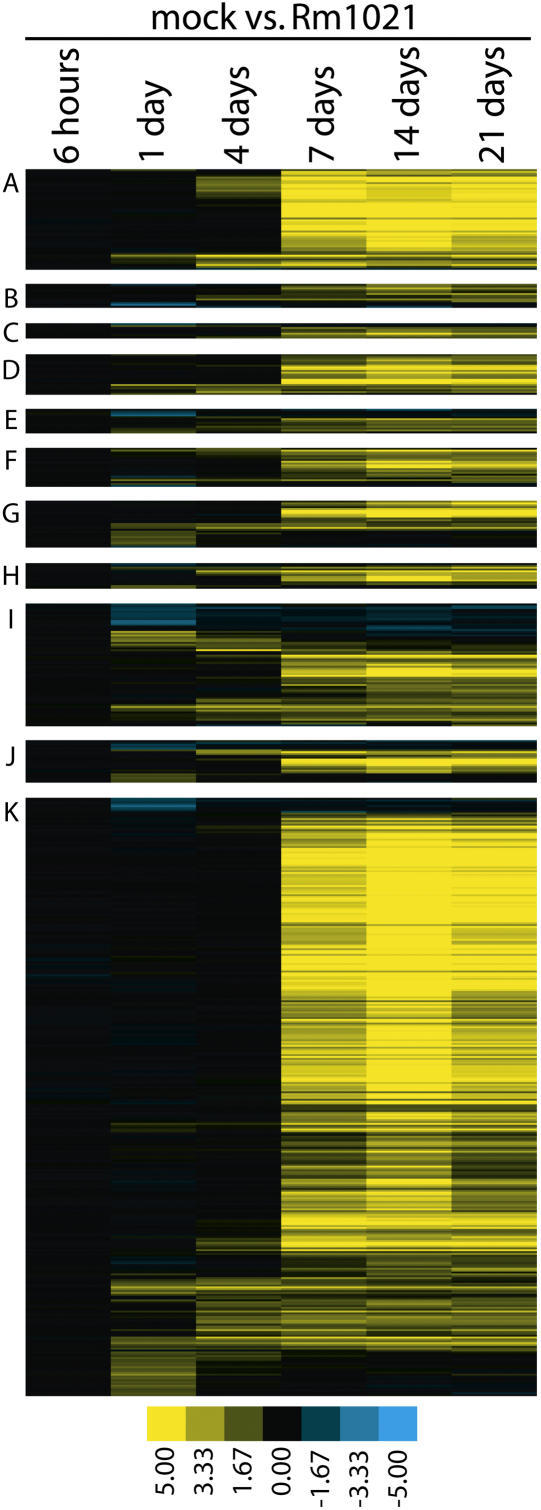
Gene expression changes during nodulation. Color representation of the log2-fold change in expression level of 584 TCs that change during nodulation. TCs are clustered according to classification and expression pattern. TCs are classified into groups based on the The Institute for Genomic Research M. truncatula gene index as nodulins (A), defense related (B), hormone related (C), signaling (D), cell structure (E), transport (F), transcription and translation (G), primary metabolism (H), secondary metabolism (I), function unknown (J), and unknown hypothetical (K). Fold changes represent pooled data from three biological replicates for each condition. Data from the 1-dai time point has previously been published (Mitra et al., 2004).
Figure 5.
Figure 5.
Gene expression in three Fix mutants is altered. Color representation of the log2-fold change in expression level. TCs are clustered according to expression pattern. All TCs shown change at least 2-fold when compared to wild-type plants with the same treatment. M, Change in the mutant versus wild-type mock-inoculated treatment; S, change in the mutant versus wild-type S. meliloti comparison. Identity of closest protein and e-value as determined by tBLASTX are shown.

References

    1. Amor BB, Shaw SL, Oldroyd GE, Maillet F, Penmetsa RV, Cook D, Long JD Sr, Gough C (2003) The NFP locus of Medicago truncatula controls an early step of Nod factor signal transduction upstream of a rapid calcium flux and root hair deformation. Plant J 34: 495–506 - PubMed
    1. Ane JM, Kiss GB, Riely BK, Penmetsa RV, Oldroyd GE, Ayax C, Levy J, Debelle F, Baek JM, Kalo P, et al (2004) Medicago truncatula DMI1 required for bacterial and fungal symbioses in legumes. Science 303: 1364–1367 - PubMed
    1. Barnett MJ, Toman CJ, Fisher RF, Long SR (2004) A dual-genome Symbiosis Chip for coordinate study of signal exchange and development in a prokaryote-host interaction. Proc Natl Acad Sci USA 101: 16636–16641 - PMC - PubMed
    1. Bénaben V, Duc G, Lefebvre V, Huguet T (1995) TE7, an inefficient symbiotic mutant of Medicago truncatula Gaertn. cv Jemalong. Plant Physiol 107: 53–62 - PMC - PubMed
    1. Boivin C, Camut S, Malpica CA, Truchet G, Rosenberg C (1990) Rhizobium meliloti genes encoding catabolism of trigonelline are induced under symbiotic conditions. Plant Cell 2: 1157–1170 - PMC - PubMed

Publication types

MeSH terms